
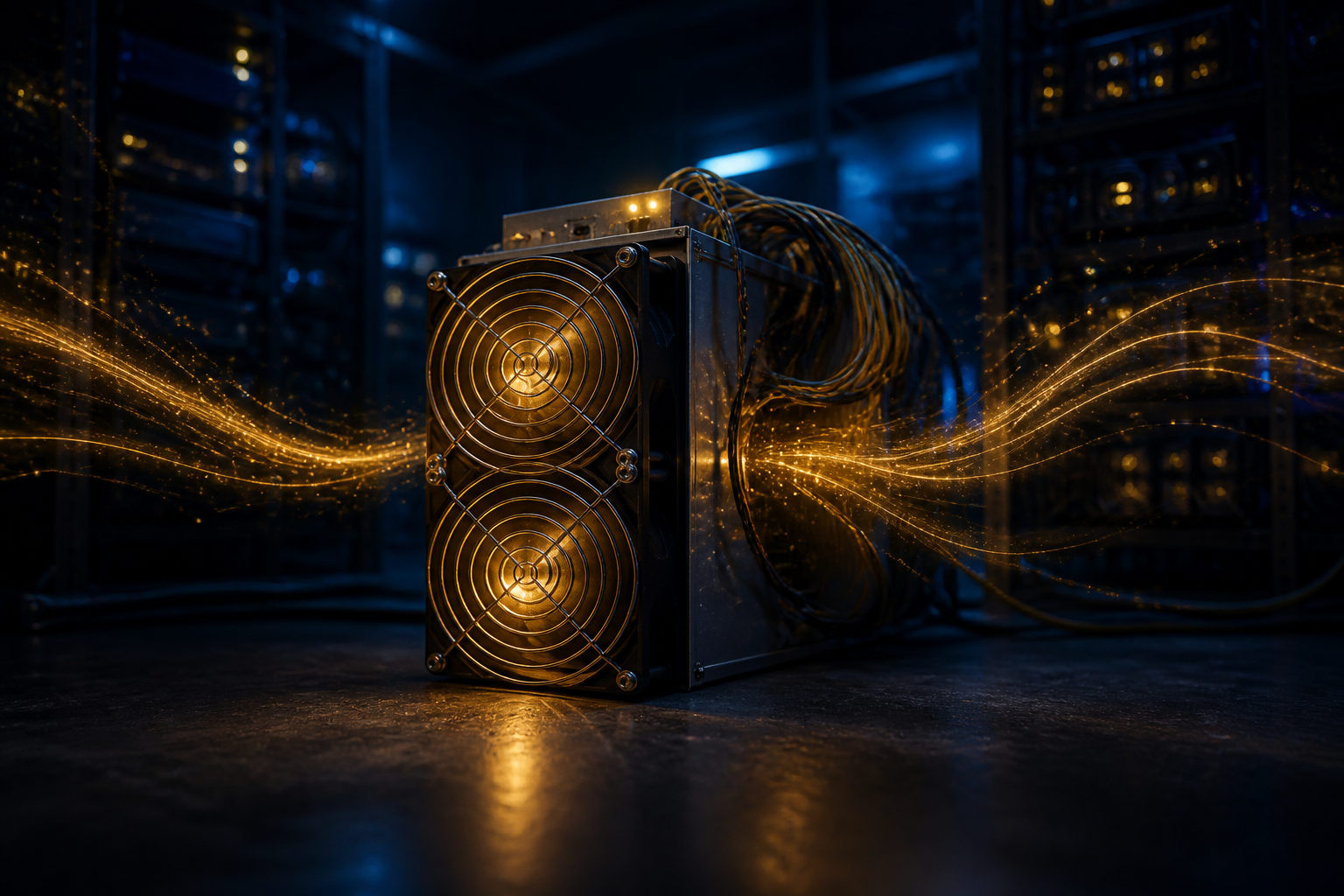
When mining bitcoins, your computer is not digging up coins. It is entering a block-writing race: checking transactions, building a candidate block, and running repeated hash calculations until it finds a result the network accepts.
What your computer actually does during bitcoin mining
A useful way to picture bitcoin mining is to think of the network as a shared ledger that nobody controls alone. New transactions keep arriving, and miners compete for the right to add the next page. Your machine joins that contest by following a strict set of rules, not by making judgments or predictions.
The process starts with transaction data. Nodes across the network receive transfers and examine whether they are valid. That includes checking digital signatures, making sure coins are not being spent twice, and confirming that the transaction format fits the protocol. A miner then selects a group of valid pending transactions and places them into a candidate block.
From there, the heavy work begins. The computer takes the block header data and runs it through a hash function. If the output does not meet the current difficulty target, the machine changes a variable field and tries again. Then again. Then thousands, millions, or far more times after that. The task is repetitive by design.
So what is your computer doing in plain terms? It is performing the same narrow type of calculation over and over, at very high speed, with tiny input changes each round. The goal is simple: produce a valid hash before competing miners do.
| Stage | What the computer does | Why it matters |
|---|---|---|
| Receive network data | Listens for new transactions and blocks | Collects the information needed for a candidate block |
| Validate transactions | Checks signatures, format, and double-spend rules | Keeps invalid transfers out of the block |
| Assemble a candidate block | Packs selected transactions with block metadata | Creates a block that can be tested |
| Run hash calculations | Changes a variable field and hashes again | Searches for an output that meets difficulty rules |
| Broadcast a valid block | Sends the result to the network if successful | Tries to have the block accepted by other nodes |
| Start over | Moves on to the next block race | Keeps participating in the chain |
Why hashing is the center of mining
Bitcoin uses proof of work to decide who gets to add the next block. The system needs something that is hard to produce but easy for everyone else to verify. Hashing fits that job well. A node can quickly check whether a miner found a valid result, but the miner cannot shortcut the search in any reliable way.
That is why mining is often described as a probability game. Your computer is not slowly getting closer to a hidden answer. Each attempt is a fresh shot. Better hardware increases how many attempts you can make, yet it does not turn the work into a puzzle with a neat path to the finish.
Bitcoin also adjusts mining difficulty so blocks continue to arrive on a steady rhythm, about every 10 minutes. As more computing power joins the network, the difficulty can rise. That keeps the system from speeding up too much just because more machines are competing.
This design serves two purposes at once. It helps order transactions into blocks, and it makes rewriting the ledger costly because any attacker would need to reproduce a huge amount of computation.
What parts of your machine are under pressure
For someone using a personal computer, mining stress shows up as sustained hardware load. The processor or specialized chip stays busy almost all the time. Cooling fans run harder. Power draw stays elevated. Heat becomes a constant concern rather than an occasional spike.
If you are thinking about a normal desktop or laptop, it helps to separate what is technically possible from what is practical. A regular computer can run software related to mining, but that does not mean it is well suited for competitive bitcoin mining. Modern mining is dominated by specialized hardware built for this one repeated task.
Graphics cards once had a much bigger role in proof-of-work mining discussions, but for bitcoin itself, dedicated mining machines became the standard because they are designed specifically for this kind of hashing workload. A household computer today is more useful for learning, testing software, or running a full node than for competing seriously in bitcoin block production.
| Hardware type | Main strength | Role in bitcoin mining today | Common trade-off |
|---|---|---|---|
| General-purpose CPU | Flexible computing for many tasks | Can demonstrate the process but has weak mining competitiveness | Low efficiency and steady heat |
| GPU | Parallel computation | No longer the standard path for bitcoin mining | High power use and fan noise |
| ASIC miner | Purpose-built hashing | The realistic choice for serious bitcoin mining | Upfront cost, cooling, noise, and maintenance |
| Full node computer | Verification and ledger storage | Supports the network without doing heavy mining work | Needs storage, bandwidth, and uptime |
How people actually participate: solo mining, pools, and nodes
Many newcomers assume mining means installing software and clicking start. In practice, you need to know what kind of participant you want to be. Solo mining means your setup competes directly for block discovery. Pool mining means many participants combine their computing power and share results according to the pool's rules.
The underlying work stays the same in both cases: your machine performs repeated hash attempts. What changes is how that work is organized. In a mining pool, a server coordinates tasks, tracks contributed work, and handles distribution according to its method. For individuals, that can make participation feel more regular, though it also introduces pool fees, operational rules, and dependence on an outside operator.
Running a full node is different again. A full node downloads blocks, verifies transactions and consensus rules, and stores the ledger independently. It helps you check the chain for yourself, but it is not the same as mining because it is not competing to create the next block.
| Participation mode | What your computer does | Main feature | Best fit |
|---|---|---|---|
| Solo mining | Builds and tests candidate blocks directly against network rules | Independent, but outcomes can be highly uneven | Operators with strong hardware and tolerance for variance |
| Pool mining | Performs assigned hashing work and submits results to a pool | More common for individuals, with smoother distribution patterns | Most hands-on participants |
| Full node | Validates and relays transactions and blocks | Strengthens verification and self-reliance, not mining output | Users focused on network integrity and privacy |
The practical reality: your computer is also spending power and aging
When people ask what a computer is doing while mining bitcoins, they are often also asking whether that activity makes sense in the real world. The answer depends on more than the software window. Mining is tied to electricity use, cooling capacity, noise, uptime, and hardware wear.
A machine that runs at sustained load for long periods needs stable power and enough airflow to avoid thermal trouble. Fans collect dust. Components age. Living spaces can become harder to tolerate if the equipment is loud. These are not side issues; they are part of the operating environment.
Another common misunderstanding is to equate active computation with guaranteed returns. Bitcoin has a fixed supply cap of 21 million coins, new issuance follows block rewards, and halvings reduce that issuance on a set schedule. Competition remains a constant. Whether mining is sensible for a given person depends on hardware efficiency, electricity costs, cooling conditions, and the scale of competition they face.
If your goal is education, you do not need to jump straight into buying mining equipment. Learning how blocks are built, why transaction validation matters, and how proof of work secures ordering in the chain will give you a much clearer picture before any hardware decision.
FAQ
Is my computer cracking passwords when it mines bitcoin?
No. Mining hardware is not trying to break someone else's account or decrypt private keys. It is performing repeated hash calculations to find a valid block result under the network's proof-of-work rules.
Bitcoin does rely on cryptography, but transaction ownership and block mining are different functions. People often mix them together because both involve math.
Can a normal home computer still mine bitcoin?
It can participate at a basic technical level, but that is very different from being competitive. A home computer is usually better suited to learning the process or running a full node.
If you keep it under heavy load for long stretches, heat, noise, and hardware wear become part of the picture. Those costs are easy to overlook at the start.
Does joining a mining pool change what my computer is doing?
The core task stays the same: your machine still performs hashing work. The difference is that a pool coordinates the work and handles how results are measured and shared.
For individuals, that changes the experience a lot. You are no longer relying only on rare solo block wins, but you are accepting the pool's structure and rules.
Is running a full node the same as mining?
No. A full node validates blocks and transactions and keeps its own copy of the ledger. That helps you verify network activity independently.
Mining is about competing to add the next block. Both matter to bitcoin, but they serve different roles.
If I do not want to buy mining hardware, how can I still learn this well?
Start with the basics: how blocks connect, why transactions need confirmation, and what a hash function contributes to proof of work. That gives you the core model without forcing an equipment purchase.
If what you really want is to understand bitcoin price moves, focus on supply, demand, market liquidity, and live market data tools instead of treating mining as the only starting point.
Before you experiment, keep your everyday machine separate from any long-running test setup, and make sure power and cooling are adequate for continuous load. That one decision can prevent a lot of avoidable trouble.
Disclaimer: This article is for informational and educational purposes only and is not investment, financial, or legal advice. Crypto assets are highly volatile and you could lose your entire investment. Do your own research and decide carefully.