
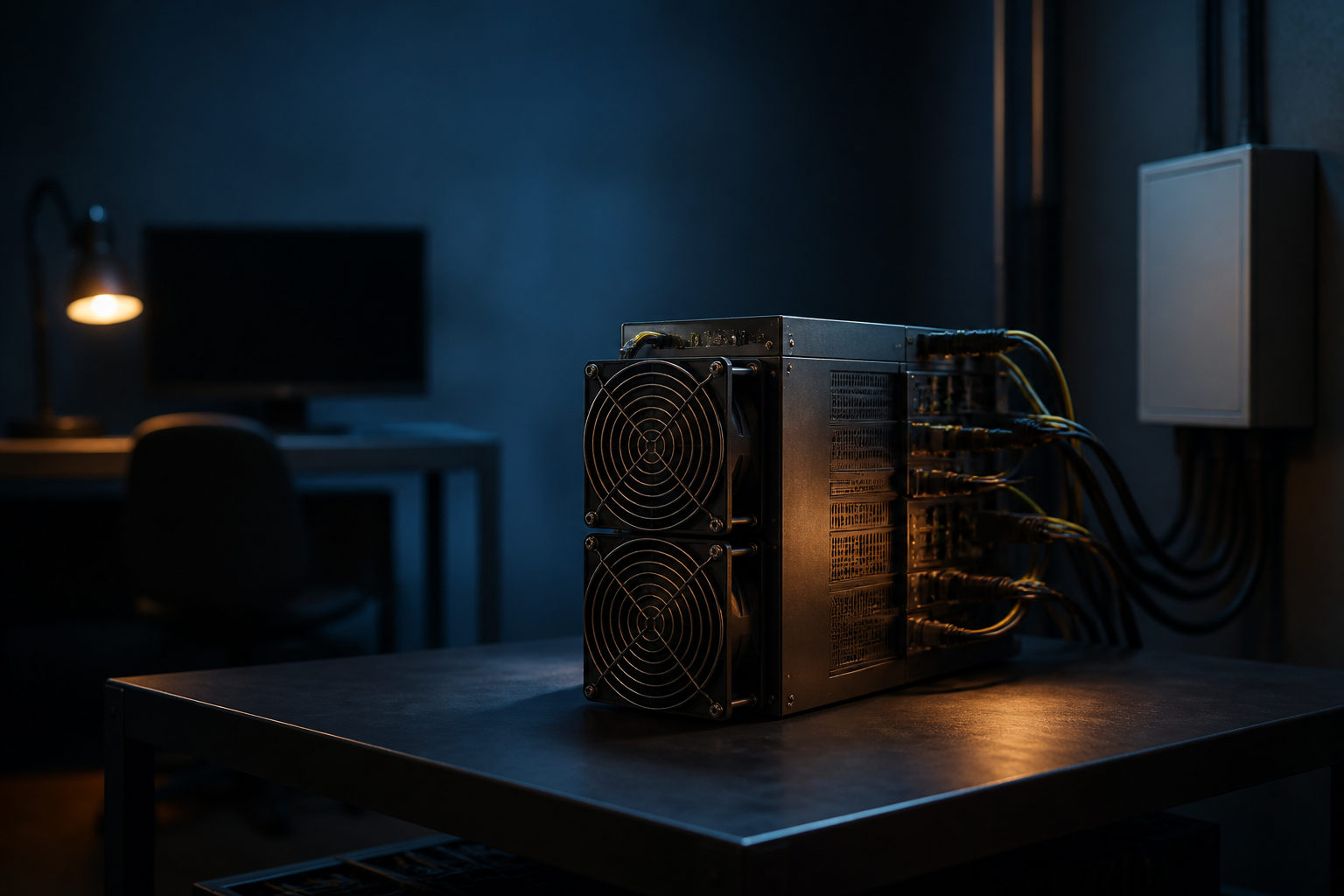
If you are asking what computer you need to mine bitcoins, the short answer is simple: a normal home PC is usually not the right tool. In practice, Bitcoin mining depends far more on dedicated ASIC hardware, stable power, cooling, and where you plan to run the machine.
Think of Bitcoin mining as a nonstop race to write the next page of a public ledger
Bitcoin runs on a public transaction record that anyone can inspect. New transactions are grouped into blocks, and miners compete to add the next block to the blockchain. That competition is based on computation: miners keep trying hashes until one finds a valid result, then that block can be added and the miner can claim the block reward plus transaction fees.
This is why hardware matters so much. Bitcoin produces a new block about every 10 minutes, and the network adjusts mining difficulty so that block production stays close to that rhythm even as more machines join. As stronger hardware enters the race, weaker hardware loses relevance fast.
So the real question is rarely, “Which desktop or laptop should I buy?” A better version is: what kind of hardware setup is needed to take part in Bitcoin mining under current conditions? That shift in wording helps avoid the biggest beginner mistake, which is treating mining like a background task for a spare computer.
Today, Bitcoin mining is built around ASICs, not regular computers
Early in Bitcoin’s history, general-purpose hardware had a role. That is not how the field works now. Modern Bitcoin mining is dominated by ASIC miners, machines built for one narrow job: performing the specific hashing work required by the Bitcoin network as efficiently as possible.
A home computer, gaming rig, or workstation may still be powerful in a general sense. It can run wallets, manage files, monitor the network, or even host a Bitcoin node. None of that means it is competitive for mining Bitcoin itself. A machine that is excellent at gaming or video work is not automatically useful in a mining race built around specialized hardware.
| Hardware option | Suitable for Bitcoin mining | Main use | Main limitation |
|---|---|---|---|
| Home or office PC | No | Web use, documents, wallet management | Too little mining efficiency |
| Gaming computer | Usually no | Games, graphics, general performance tasks | Not competitive against ASIC miners |
| High-end GPU rig | Usually no | Parallel computing, rendering | Poor fit for Bitcoin mining today |
| ASIC miner | Yes | Dedicated Bitcoin hashing | Heat, noise, and power demands |
| Hosted or cloud-based setup | Depends on the arrangement | Indirect participation | Transparency and counterparty risk |
That is why many articles that focus on CPU speed, memory size, or gaming-grade graphics miss the point for this topic. For Bitcoin mining, the deciding factor is not whether your computer feels fast to you. It is whether your hardware can compete in a network where specialization matters.
If you want to mine at home, the environment matters almost as much as the machine
People often focus on buying hardware and ignore the room around it. ASIC miners are built to run under heavy load for long periods. That means heat. It also means noise, often far beyond what most people would tolerate in a bedroom, study, or shared living area.
Power is another hard limit. Running a mining device is not the same as occasionally using a desktop PC for work or entertainment. You need reliable electrical capacity, safe cabling, and a place where continuous operation is realistic. If your wiring is weak, your space is cramped, or your power supply is unstable, the problem starts before mining does.
Then there is maintenance. A mining machine is not a “buy it, switch it on, forget it” device. Dust buildup, fan issues, high ambient temperature, network drops, or bad control settings can all push the machine offline or reduce its performance. You do not need to be a hardware engineer, but you do need enough familiarity to monitor status pages and catch problems early.
| What to check | What you are looking for | Why it matters |
|---|---|---|
| Power | Stable supply and suitable electrical setup | Mining hardware is sensitive to long-term heavy use conditions |
| Cooling | Airflow, heat exhaust, room temperature | Too much heat can reduce stability |
| Noise | Whether your household or neighbors can tolerate it | ASIC miners are often loud |
| Network | Stable internet connection | Frequent disconnects interrupt participation |
| Maintenance | Ability to monitor basic machine health | Helps reduce avoidable downtime |
| Location | A place designed for sustained operation | Affects safety, airflow, and daily usability |
If those conditions are missing, the issue is no longer what computer you need. The issue is whether home mining makes sense for you at all.
There is more than one way to participate, and each path changes what you need
Some people try to mine on their own. Others connect their machines to a mining pool, which combines the work of many miners and distributes rewards according to the pool’s rules. A pool can reduce the uncertainty of waiting for a solo result, but it does not remove the hardware requirement. You still need equipment that can contribute meaningful hashing power.
Another route is hosting. In that model, you own the hardware but place it in a facility that already has the power and cooling setup needed for mining. This can solve the home-noise and heat problem, yet it adds dependence on a third party. You need to understand service terms, uptime handling, maintenance responsibility, and how clearly the operator reports machine status.
Cloud mining sits even further away from the hardware. That may sound convenient, but it also means less visibility. If you cannot inspect the machine, the environment, or the actual operating conditions, you rely heavily on what the provider tells you. For newcomers, that makes due diligence more important, not less.
| Participation method | What you need | Who it may suit | Main concern |
|---|---|---|---|
| Run your own ASIC | Hardware, power, cooling, internet, basic maintenance | People with space and hands-on tolerance | Noise, heat, downtime, operating conditions |
| Join a mining pool | Mining hardware plus pool configuration | People who want less payout variability | Pool rules, fees, reliability |
| Use hosting | Owned hardware placed off-site | People who cannot run machines at home | Provider transparency and service terms |
| Use cloud mining | Account setup and contract review | People avoiding physical hardware | Counterparty risk and low visibility |
For many readers, this is the point where the original keyword needs a reality check. You may not need a “computer” at all in the usual sense. You may need to decide whether you want direct mining, hosted mining, or simply to learn how the system works without mining yourself.
The biggest beginner errors come from confusing technical possibility with practical viability
A regular computer can often run software related to Bitcoin. It can store a wallet, sync a node, watch transactions, and interact with mining services at a software level. That does not make it a sensible Bitcoin mining machine. Being able to launch a program is not the same as having a setup that works well in real conditions.
Another common mix-up is treating a Bitcoin node and a Bitcoin miner as the same thing. They are different. A node validates and relays transactions and blocks. Mining competes to produce the next block. A standard computer can be useful for the first role even when it is unsuited for the second.
| Common assumption | Better way to see it |
|---|---|
| A powerful PC can mine Bitcoin well | Bitcoin mining is shaped by ASIC efficiency, not general PC performance |
| If the software runs, the setup is fine | Software is only one layer; the physical environment matters just as much |
| A machine at home should be easy enough | Noise, heat, and power constraints often become the real barrier |
| Running a node means you are mining | Nodes validate; miners compete for block production |
FAQ
Can I mine Bitcoin with my home desktop?
You can use a home desktop for Bitcoin-related tasks, but that is different from competitive mining. For actual Bitcoin mining, a normal desktop is usually not an effective choice.
What about a gaming PC with a strong graphics card?
A gaming machine may be powerful for many workloads, but Bitcoin mining is not mainly a GPU contest today. Dedicated ASIC miners are the hardware that matters in this field.
Do I need a laptop or a desktop to start?
For Bitcoin mining itself, neither is usually the real answer. If you want to learn the basics, either can help you run wallets or a node; if you want to mine, you are usually looking at ASIC hardware instead.
Does joining a mining pool mean I do not need my own machine?
No. A mining pool changes how work and rewards are shared, but it does not replace the need for mining hardware unless you move into hosting or another indirect model.
Is there still a reason to use a regular computer if I am interested in mining?
Yes. A regular computer is useful for learning how Bitcoin works, managing your wallet, reviewing block data, and running a node. Those activities can teach you a lot before you decide whether mining hardware makes sense.
If you are serious about taking the next step, write down four things before shopping for equipment: where the machine would run, how power and cooling would be handled, whether the noise is acceptable, and whether you want to manage hardware yourself. Those answers will tell you far more than any consumer computer spec sheet.
Disclaimer: This article is for informational and educational purposes only and is not investment, financial, or legal advice. Crypto assets are highly volatile and you could lose your entire investment. Do your own research and decide carefully.