
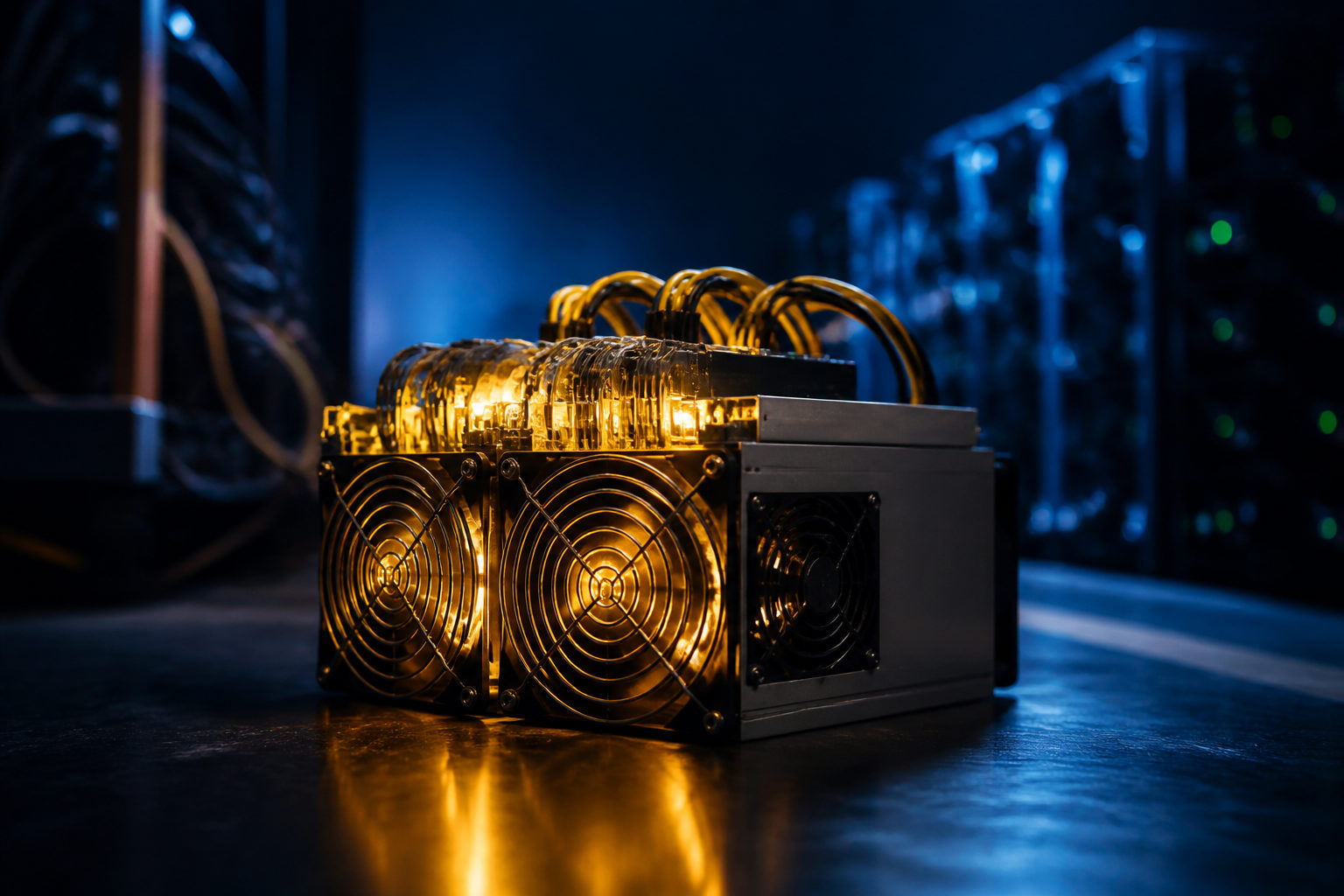
Bitcoin data mining usually refers to Bitcoin mining: miners use computing power to compete for the right to add a new block to the blockchain.
What “data mining” means in a Bitcoin context
The phrase can be confusing because in other fields, data mining means finding patterns in large sets of information. In Bitcoin, people often use it loosely to mean mining. The activity is about block production and network security, not about collecting user information or analyzing customer records.
A simple way to picture it is a nonstop bookkeeping contest. Pending transactions wait to be confirmed, miners group them into candidate blocks, and then machines keep trying different combinations until one result fits the network rules. The first valid block can be broadcast to the network for verification.
Why mining exists in Bitcoin
Bitcoin does not rely on one company or one server to keep the ledger. Instead, it lets participants compete for block creation through proof of work. That competition gives the network a way to decide transaction order without handing control to a central operator.
A new block is produced about every 10 minutes. Once a block is accepted and more blocks are built on top of it, changing older records becomes harder. That is why mining matters even for people who never plan to run a machine: it helps secure the chain by making ledger rewrites expensive.
Mining also plays a role in how new bitcoin enters circulation. Bitcoin has a hard cap of 21 million coins, and issuance is tied to block creation rather than released all at once. The subsidy is reduced in halvings that happen about every 4 years, or every 210,000 blocks. The halving years so far are 2012, 2016, 2020, and 2024.
How the mining process works
Miners start by selecting valid pending transactions and assembling them into a candidate block. They then vary certain block data and keep hashing until one result satisfies the protocol target. The miner that finds a valid result first shares the block with the network.
Other nodes do not trust that block automatically. They check whether the transactions follow the rules, whether the block structure is valid, and whether the proof of work meets the required standard. If those checks pass, the block is added to the chain.
This distinction matters. Mining is not a free-form search through internet data. It is a rule-based computational process tied to transaction ordering, block validation, and chain security.
| Term | Meaning in Bitcoin | Main role |
|---|---|---|
| Data mining | A loose phrase often used for mining | Describes the computing activity |
| Mining | Competing with hash power to create blocks | Block creation, network security, coin issuance |
| Node validation | Independent rule checking by network nodes | Stops invalid blocks from being accepted |
Ways people can participate
For most readers, the practical question is not just “What is Bitcoin data mining?” but also whether participation makes sense. There are a few different paths, and they serve different goals.
| Approach | Best for | What you need | Main challenge |
|---|---|---|---|
| Run your own mining hardware | People comfortable with equipment and operations | Mining machine, power, cooling, network, location | Noise, heat, maintenance, and operating pressure |
| Join a mining pool | People who want less variance in results | Hardware plus pool connection setup | Power and hardware costs still remain |
| Run a node only | People focused on learning and verification | Computer, storage, stable internet | No block race participation; the value is independent validation |
Running your own hardware is the most direct way to mine, but it is also the most demanding. A machine is only part of the job. You also need suitable power conditions, ventilation, cooling, uptime management, and the ability to handle hardware issues when they appear.
Mining pools let many miners combine their hash power. When the pool finds a block, rewards are shared according to the pool’s rules. That can smooth out the waiting time compared with solo mining, but it does not erase electricity costs, hardware wear, or the need for efficient operation.
The cost reality people often miss
Beginners often focus on the machine itself and overlook the ongoing operating burden. Bitcoin mining is closer to infrastructure management than casual software use. A setup that looks simple on paper can become difficult once heat, noise, dust, power limits, and downtime enter the picture.
Electricity is one of the main cost factors, but it is not the only one. Equipment delivery, installation, wiring, airflow, replacement parts, monitoring, and recovery after interruptions all matter. In a home environment, the practical issues can become obvious very quickly.
Another point is competition. Mining conditions do not stand still. The broader network keeps moving, so understanding the mechanism does not mean every entry point is sensible. Hardware efficiency, operating skill, and access to suitable power conditions shape the experience.
| Common belief | Closer to reality |
|---|---|
| A normal PC can mine Bitcoin effectively | Bitcoin mining has long moved to specialized hardware, so ordinary computers are usually useful for learning, not for serious competition |
| Joining a pool makes mining easy | A pool reduces variance, but it does not remove operating costs or hardware limits |
| Buying a machine is the hard part | Long-term cooling, power management, upkeep, and downtime handling can be harder |
| Mining is the same as buying bitcoin | Mining is an operations activity; buying bitcoin is market exposure |
Mining vs buying bitcoin vs running a node
Many people who search this topic are actually trying to choose a path. If your goal is simply to own bitcoin, buying it is a different decision from mining it. If your goal is to verify the rules of the network for yourself, running a node may be more relevant than chasing block rewards.
| Goal | Closer fit | What it means |
|---|---|---|
| Get bitcoin exposure | Buy bitcoin directly | Simple path, but you take market price risk |
| Compete to add blocks | Mine | Higher barrier, centered on hardware and operations |
| Verify chain rules independently | Run a node | No hash competition; the focus is validation |
If you are still at the learning stage, it often makes more sense to understand blocks, transactions, private keys, public keys, and node verification before thinking about machines. That foundation makes the rest of the topic much easier to judge.
FAQ
Does Bitcoin data mining just mean Bitcoin mining?
In most search contexts, yes. The more precise phrase is Bitcoin mining because it describes a computing competition for block creation rather than data analysis in the usual business sense.
Can a home computer still mine Bitcoin?
A home computer can help you learn the process, but it usually is not a realistic tool for competitive Bitcoin mining. It is better suited to studying node software and validation flow.
Is joining a mining pool enough to make mining practical?
A pool can make outcomes less uneven because you do not have to wait for a solo block on your own. You still have to deal with hardware efficiency, electricity, cooling, and maintenance.
Do I need mining hardware to understand how Bitcoin mining works?
No. You can learn a lot by first understanding why proof of work exists, how blocks are checked by nodes, and how transactions get confirmed.
Where should I check the live Bitcoin price?
Price is separate from the mining mechanism, but it often shapes interest in the topic. If you want real-time quotes, use major market data platforms and compare spot listings, quote timing, and order book depth.
If you want to go beyond the definition of Bitcoin data mining, start by deciding what you actually want: technical understanding, independent verification, or hands-on mining operations. That choice tells you whether your next step should be reading about protocol rules, running a node, or researching hardware and power conditions.
Disclaimer: This article is for informational and educational purposes only and is not investment, financial, or legal advice. Crypto assets are highly volatile and you could lose your entire investment. Do your own research and decide carefully.