
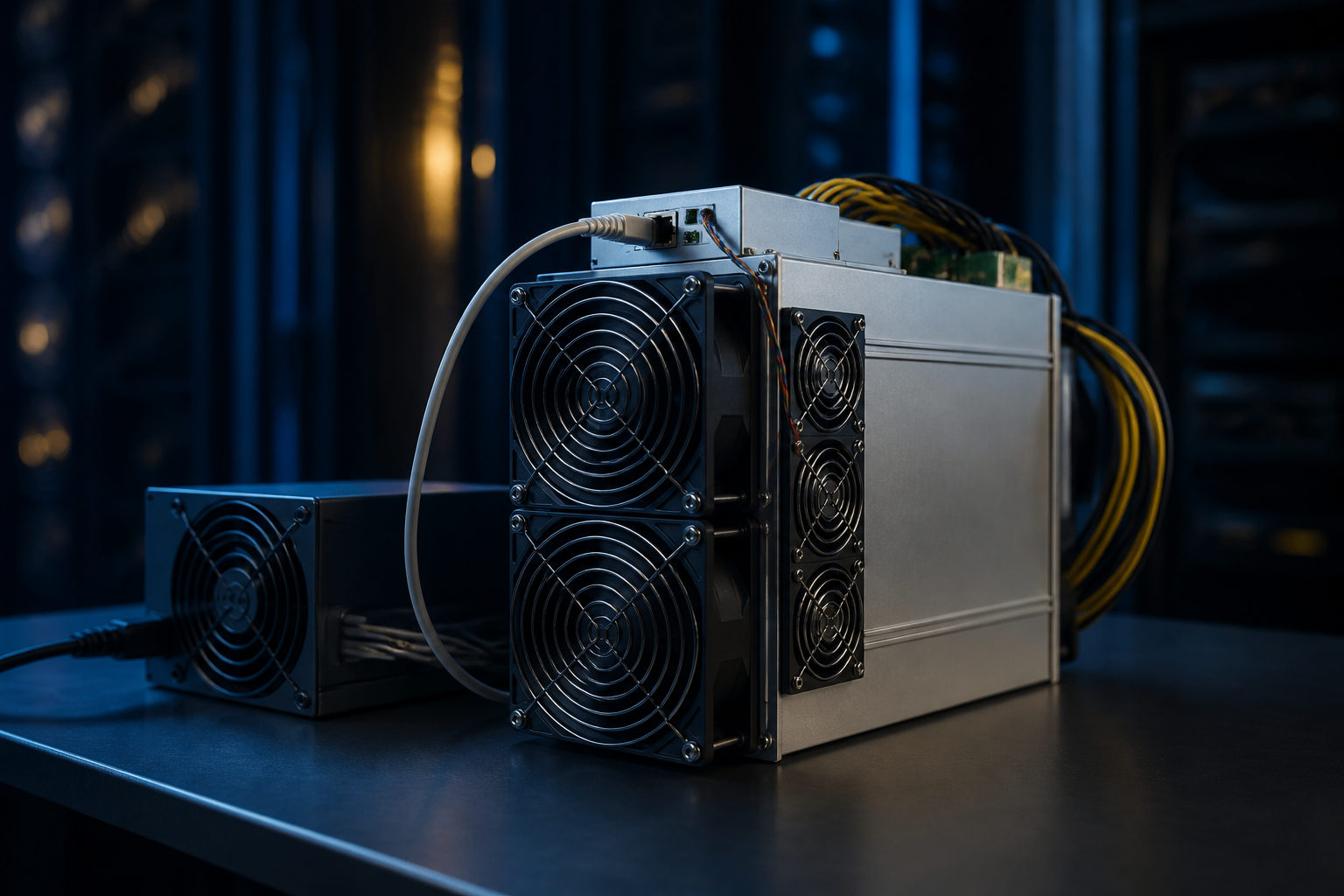
What hardware do you need to mine Bitcoin? In practice, the answer is usually an ASIC miner, plus power, cooling, internet access, and a location that can handle heat and noise.
Start with the idea of a bookkeeping race
A simple way to picture Bitcoin mining is to think of it as an ongoing race to earn the right to add the next page to a shared ledger. Miners package transactions into blocks and keep running calculations until one participant finds a result that fits the network rules. That winning block is then added to the blockchain.
This matters because the task is repetitive and specialized. Bitcoin mining is built around proof of work, so participants compete by committing real computing power. Once you understand that, the hardware question becomes much clearer: the useful device is the one designed to perform that specific work as efficiently and as steadily as possible.
The main hardware used to mine Bitcoin today
If you are asking what hardware is needed to mine Bitcoin in a real-world setup, it helps to separate the core machine from the support gear around it. The miner gets most of the attention, but the surrounding equipment often decides whether the setup can run for long periods without trouble.
| Hardware or requirement | What it does | Why it matters |
|---|---|---|
| ASIC miner | Performs the specialized calculations used in Bitcoin mining | This is the standard hardware for the job today |
| Power supply | Delivers stable electricity to the machine | Poor power delivery can lead to instability and downtime |
| Cooling system | Removes the heat produced during continuous operation | Heat affects reliability, noise, and hardware lifespan |
| Internet connection | Keeps the miner connected to a pool or node | Frequent disconnects reduce effective operating time |
| Physical location | Provides space, airflow, cabling, and access for maintenance | A bad site can make even a good machine impractical |
The central piece is the ASIC miner. ASIC stands for application-specific integrated circuit, which tells you almost everything you need to know: the machine is built for a narrow purpose rather than general computing. A laptop, desktop, or server can do many kinds of work. An ASIC miner is built to do one kind of work very well.
Power equipment is less exciting, but it is not optional. Mining hardware is expected to run continuously, not in short bursts like many household devices. If the electrical side is mismatched or unstable, the miner may shut down, restart, or perform poorly even when the machine itself is perfectly fine.
Cooling deserves the same level of attention. Bitcoin mining hardware generates sustained heat, and that heat has to go somewhere. A setup with weak airflow can run into thermal issues, louder operation, and extra maintenance. For many people, cooling and noise are the first practical barriers, long before software setup becomes a problem.
Internet needs are modest in one sense, since mining does not require extreme bandwidth. Stability is the real priority. The miner has to stay in contact with the service it is working with, usually a mining pool, so an unreliable connection can leave the machine powered on while contributing less useful work than expected.
Why a normal PC, GPU rig, or server is usually the wrong answer
People often begin with the hardware they already understand: a gaming PC, a spare workstation, or an old server. That sounds reasonable, especially if the question is framed as “Can I mine Bitcoin with what I already own?” The problem is that Bitcoin mining has long been a specialized competition, and general-purpose hardware no longer matches the demands of that competition very well.
| Option | Can it run mining software? | Real-world fit for Bitcoin mining |
|---|---|---|
| CPU in a standard computer | Yes | Usually not practical for meaningful participation |
| GPU graphics card setup | Yes, for some crypto workloads | Not the main route for Bitcoin mining |
| General-purpose server | Yes | Stable operation does not mean good mining efficiency |
| ASIC miner | Yes | Built for the actual task miners compete on |
The key issue is specialization. General-purpose devices are designed to handle a broad range of tasks. Bitcoin mining rewards hardware that is optimized for one task only. That is why older advice about mining on a normal computer can be misleading if it is taken as current guidance.
There is also a common misunderstanding around servers. A server may sound more serious than a desktop because it is built for uptime, management, and business use. None of that automatically makes it a good Bitcoin miner. In this case, matching the machine to the algorithm matters more than buying something that sounds professional.
What to check before buying mining hardware
The shopping list is only part of the decision. Many first-time buyers focus on the machine itself and only later discover that the site, wiring, ventilation, or maintenance burden makes the plan hard to live with. A mining setup should be evaluated as a system, not as a single product purchase.
| Factor | What to examine | Why it affects the decision |
|---|---|---|
| Electrical capacity | Whether the location can support continuous load safely | Without suitable power, the miner may be unusable |
| Airflow and cooling | Whether heat can be removed consistently | Poor ventilation can lead to instability and more downtime |
| Noise tolerance | Whether the environment can handle constant machine noise | Home and office spaces are often a poor fit |
| Maintenance ability | Whether someone can handle reboots, cleaning, and basic troubleshooting | Minor issues can turn into long outages if no one can respond |
| Connection method | Whether you will mine solo, join a pool, or use hosting | The operating model changes the hardware burden on you |
Power comes first. Mining gear is built for long, steady operation, so the site has to support that pattern. If the wiring or electrical environment is not suited to sustained load, the machine may become a source of hassle rather than a functioning tool.
Noise is another issue people tend to notice too late. Mining machines are not like a quiet office computer under a desk. Even if the unit fits physically in a room, that does not mean the room is a sensible place to operate it day after day.
Maintenance should also be part of the plan from the start. Dust buildup, temperature management, connection drops, and occasional restarts are normal parts of running hardware. You do not need to become a repair specialist, but you do need a realistic idea of who will handle basic problems when they show up.
Owning the machine yourself vs using hosting and pools
Sometimes the hardware question hides a different one: do you actually need to keep the machine at home or on your own premises? Not always. The answer depends on how you want to participate in mining.
| Participation method | What you need to provide | What changes for you |
|---|---|---|
| Buy and run the miner yourself | The machine, power setup, cooling, internet, space, and upkeep | You control the setup but handle the operational burden |
| Buy a miner and use hosting | The machine plus the hosting arrangement | The site and day-to-day operation are handled elsewhere |
| Join a mining pool | Usually still the miner itself, then a pool connection | Rewards are shared based on contribution rather than waiting alone |
A mining pool is not a substitute for hardware. It is a coordination method that lets many miners combine their work and share results according to their contribution. For an individual operator, that is often the more practical way to participate, since it smooths out the experience of earning from mining without changing the hardware requirement.
Hosting solves a different problem. It addresses the site: electricity, cooling, noise, and routine maintenance. That can make sense if your home or workplace is not suitable for mining hardware, but it also means you need to understand service terms, hardware custody, downtime handling, and how access to your machine is managed.
FAQ
Can I mine Bitcoin with a powerful home computer?
You can run software on a strong computer, but that is different from having a setup that makes sense in current Bitcoin mining conditions. In most practical discussions today, the relevant machine is still an ASIC miner.
Do I need a GPU rig to mine Bitcoin?
GPU rigs are associated with other crypto mining use cases, but they are not the standard route for Bitcoin. When comparing hardware, make sure the advice you are reading is specifically about Bitcoin rather than mining in general.
Is buying one miner enough to get started?
It can be enough to begin, but only if the rest of the environment is ready as well. Power, cooling, internet stability, noise tolerance, and maintenance access all matter before that first machine becomes usable in practice.
Do I have to join a mining pool?
No, but many individual miners treat pools as the practical default. A pool changes how mining rewards are shared; it does not turn unsuitable hardware into competitive hardware.
What do beginners miss most often?
Power planning, cooling, and placement are common blind spots. People often compare machines first and only later realize that the harder question was whether they had a place where the hardware could run properly.
If you are weighing whether to mine Bitcoin, make a checklist before you buy anything: machine type, power, cooling, noise, location, maintenance, and whether hosting fits better than home deployment. That order usually saves more trouble than picking a miner first and solving the rest afterward.
Disclaimer: This article is for informational and educational purposes only and is not investment, financial, or legal advice. Crypto assets are highly volatile and you could lose your entire investment. Do your own research and decide carefully.