
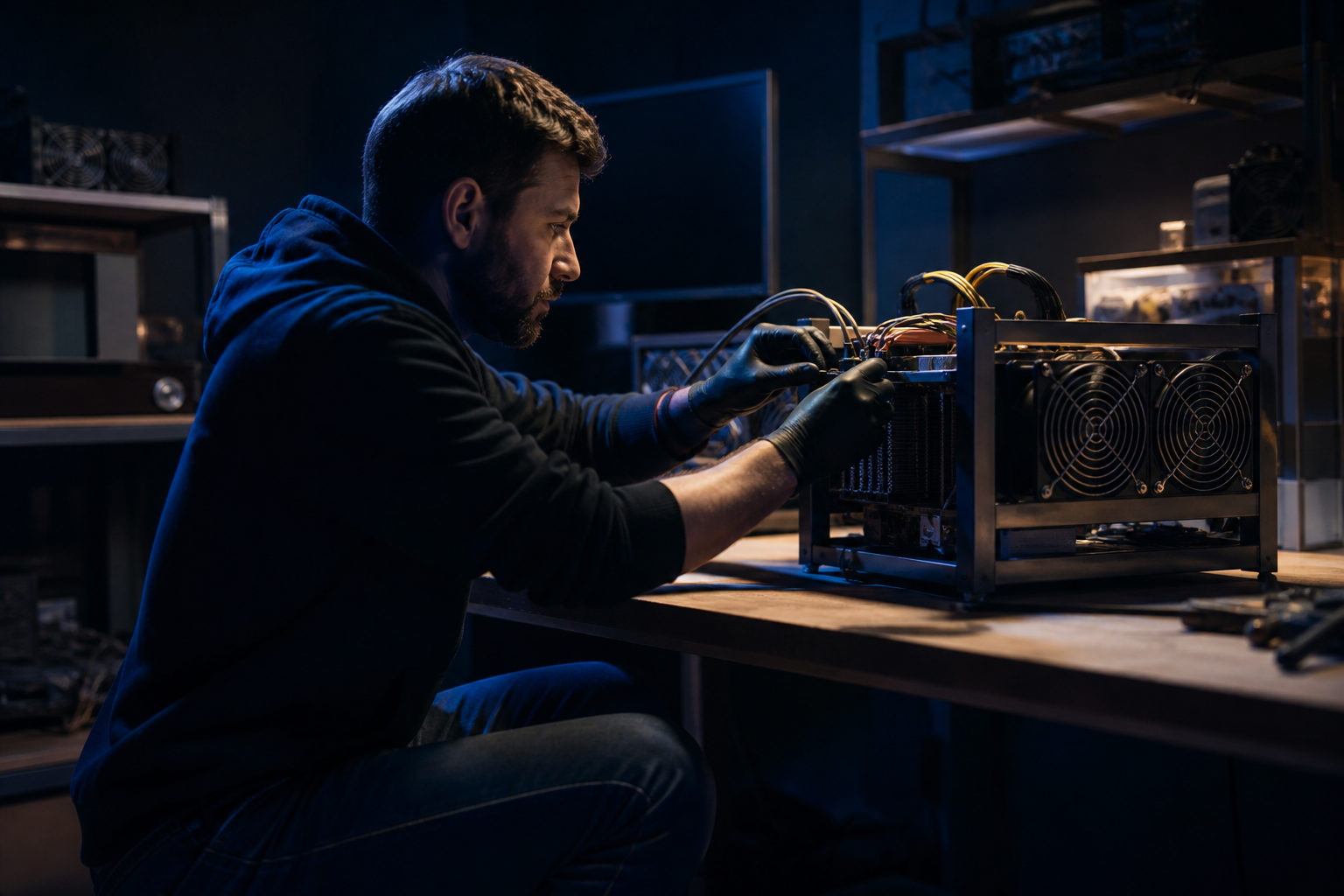
A solo bitcoin miner is someone who mines without joining a pool and competes alone to find a valid block. If that miner finds one, the block reward and fees go to that setup; if not, there is no payout for that round.
Think of solo mining as a bookkeeping race
Bitcoin does not hand out coins by scanning a hard drive or clicking a button in an app. The network keeps processing transactions, and miners compete to add the next block to the chain. The target pace is about one block every 10 minutes.
A simple way to picture it is a nonstop public contest. Each participant keeps trying answers until one answer satisfies the network rules. In solo mining, one operator enters that contest alone instead of combining computing power with a pool.
This system started with the genesis block on 2009-01-03. Its design was laid out earlier in Satoshi Nakamoto’s white paper, published on 2008-10-31 under the title Bitcoin: A Peer-to-Peer Electronic Cash System. For a solo miner, the real task is keeping hardware, software, and node infrastructure working well enough to compete directly on the network.
What a solo bitcoin miner actually does
People often use the word “miner” as if it means a person pressing start on one machine. In practice, solo mining is a stack of moving parts. There is mining hardware that produces hash power, a Bitcoin node that verifies the chain and tracks new blocks, software that hands work to the machine, and a wallet address ready to receive BTC if a block is found.
| Part of the setup | What the solo miner handles | Why it matters |
|---|---|---|
| Mining hardware | Uses specialized Bitcoin mining equipment | General-purpose computers are not competitive for real Bitcoin mining today |
| Bitcoin node | Syncs the blockchain and validates consensus rules | A found block must follow the rules to be accepted |
| Mining software | Connects the machine to the mining workflow | Hash power only counts once it is directed into valid work |
| Network and power | Keeps the system online, cooled, and connected | Downtime cuts effective participation |
| Wallet destination | Sets a valid address for block rewards | A successful block needs a clear reward destination |
The node is easy to overlook. Buying a machine and plugging it in does not, by itself, explain how solo mining works. A miner still needs the chain data, current rules, and a way to broadcast a valid block. That is why solo mining is better understood as independent block production rather than simple machine ownership.
The current block subsidy is 3.125 BTC after the 2024-04-19 halving, and that figure remains in place until the next halving, expected around 2028. Bitcoin cuts the subsidy every 210,000 blocks, roughly every 4 years. The hard cap is 21,000,000 BTC, with issuance continuing until about 2140. A solo miner takes part in that fixed issuance schedule by competing for newly created blocks.
How solo mining differs from pool mining
The biggest difference is the payout pattern. In a pool, many miners combine their hash power and share proceeds according to the pool’s rules. In solo mining, one operator keeps the full upside of a found block but also takes the full weight of long stretches with no block at all.
| Comparison | Solo mining | Pool mining |
|---|---|---|
| Reward ownership | If a block is found, the setup receives the full block reward and fees | Rewards are divided among participants by pool rules |
| Payout pattern | Highly uneven and luck-sensitive | Smoother and easier to plan around |
| Operational burden | The miner handles node, monitoring, and troubleshooting | Some workflow is handled by the pool |
| Independence | Direct participation in block finding | Relies on pool coordination |
| Typical fit | People who want control and accept long dry spells | People who prefer steadier distributions |
The whole Bitcoin network currently creates about 450 BTC per day, based on 3.125 BTC across about 144 blocks. That number describes the network total, not what one miner earns. A solo miner’s result depends on a much narrower question: how much of the total network hash power that setup controls, plus the randomness of when a valid block is found.
That point matters because many beginners ask for a fixed daily output. There is no honest fixed answer for solo mining. Even if the machine runs correctly day and night, the result arrives in bursts, not in a neat line.
Why solo mining is hard for ordinary users
The first pressure point is hardware. Real Bitcoin mining usually means specialized ASIC equipment, not a laptop, desktop, or phone. The second is the environment around the machine: stable electricity, cooling, noise management, and enough attention to keep the system online.
Then comes upkeep. A solo miner may need to deal with firmware issues, network interruptions, wallet configuration, node synchronization, and local network settings. Any break in that chain can reduce valid work time, even if the machine itself still looks powered on.
There is also a financial reality without using any guesswork about returns: solo mining has lumpy outcomes. Pool mining spreads that uncertainty across many participants, while solo mining leaves one operator exposed to it directly. That makes the experience mentally harder than many people expect.
| Reality check | Question to ask first | What can go wrong |
|---|---|---|
| Power quality | Can the setup run continuously without frequent interruptions? | Downtime reduces effective participation |
| Heat and noise | Is there a suitable place for long-running hardware? | Overheating, throttling, and poor day-to-day usability |
| Network stability | Is the connection reliable enough for constant operation? | Late submissions or disconnects |
| Technical upkeep | Can you diagnose basic hardware and software issues? | Long outages and wasted runtime |
| Patience for variance | Can you accept long periods with no block found? | Quitting early after committing time and equipment |
If your goal is education rather than block hunting, running a full node and learning how transactions and blocks are validated may be the better starting point. Solo mining is one way to participate in Bitcoin. It is not the only way to learn how Bitcoin works.
When solo mining is a learning project and when it is serious operation
Some people want to solo mine because they like the idea of direct participation in Bitcoin’s rules. Others want a technical hobby and care more about understanding block templates, node behavior, and reward flow than about ongoing operation. Those are valid reasons, but they call for a different mindset from someone planning a long-running setup.
Bitcoin aims for a new block about every 10 minutes, yet no single miner gets a personal schedule. Finding a block is probabilistic. That is why solo mining can feel quiet for long periods and then suddenly produce a major event for the operator who gets lucky at the right moment.
A practical path is to separate the learning steps. First understand wallets, addresses, nodes, and the mining workflow. Then decide whether you actually want to maintain hardware under real conditions instead of treating “solo miner” as a label for any machine that happens to be powered on.
FAQ
Does a solo bitcoin miner just use one computer at home
Solo means mining without a pool, not simply using any single computer. In real Bitcoin mining, specialized hardware is the normal tool, and a proper setup also needs node access, software, stable power, and a wallet destination.
If a solo miner finds a block, do they keep the whole reward
Yes, if the block is valid and accepted by the network, that setup receives the block reward and transaction fees tied to that block. The current block subsidy is 3.125 BTC, and fees depend on the transactions included in the block.
Why would anyone choose solo mining over a pool
Control is a major reason. Some miners want direct participation without pool rules, while others treat it as a technical challenge or educational project. The trade-off is much less predictable payout timing.
Is running a node the same thing as solo mining
No. A node validates and relays Bitcoin data, while mining uses hash power to compete for blocks. In solo mining, though, a reliable node is part of the foundation because block production still depends on current chain data and consensus rules.
Can a beginner estimate a fixed daily result from solo mining
Not honestly. The network as a whole adds about 450 BTC per day at the current subsidy level, but a solo miner’s own result depends on share of total hash power and luck. That is why fixed daily promises are a poor way to think about solo mining.
If you want to try the process, start by learning the node, wallet, and machine management pieces separately before leaving hardware on for long stretches. That approach exposes the operational work early and keeps the idea of solo mining grounded in how Bitcoin actually functions.
Disclaimer: This article is for informational and educational purposes only and is not investment, financial, or legal advice. Crypto assets are highly volatile and you could lose your entire investment. Do your own research and decide carefully.