
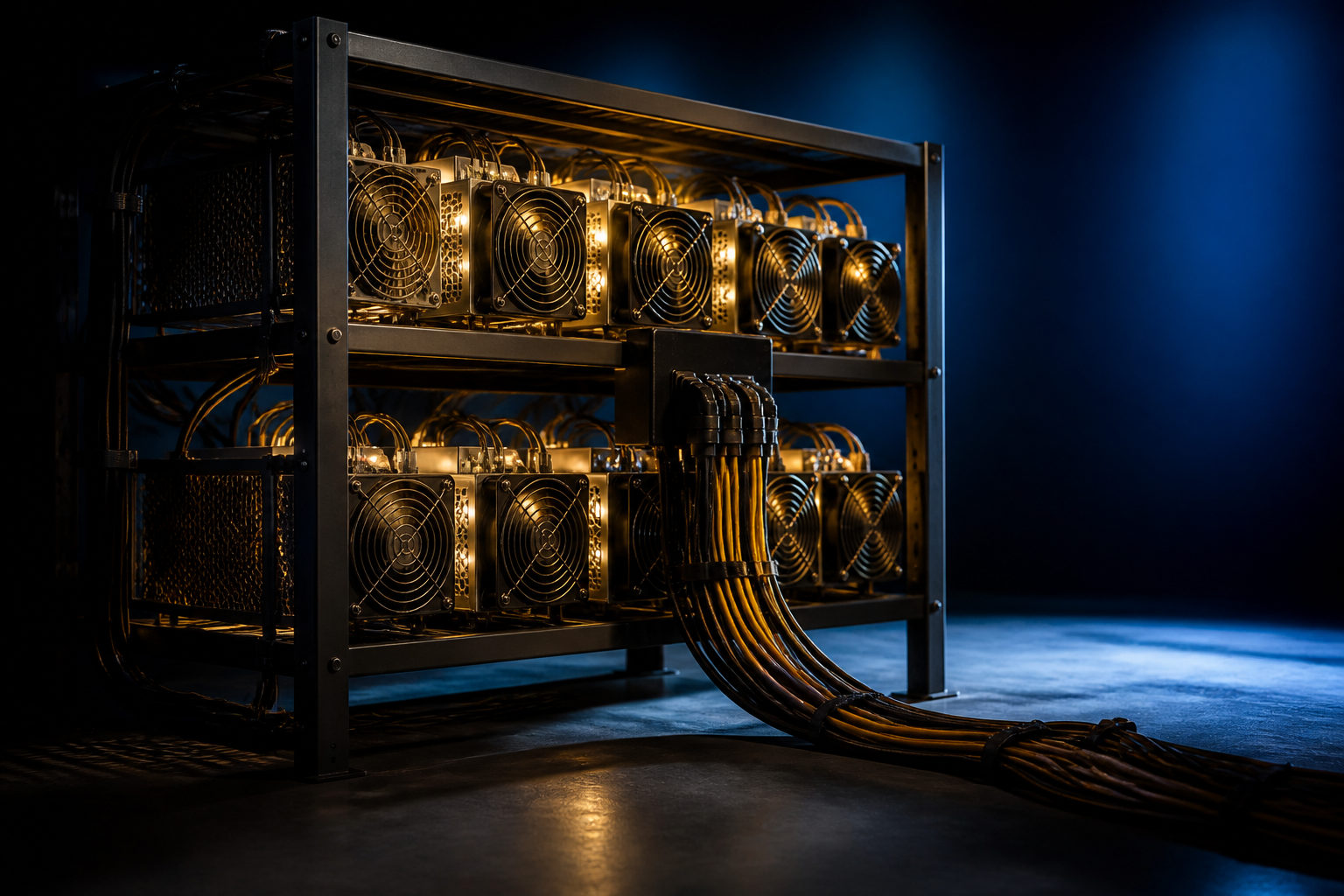
Traditional Bitcoin mining pools are centralized services that group many miners’ hash power, assign work from one operator, and split block rewards by a set payout rule. If you are asking what traditional Bitcoin mining pools are, the useful answer starts with the model itself, not with a random list of brand names.
What makes a mining pool “traditional”
Bitcoin mining is a nonstop contest to add the next block. The network aims for roughly one block every 10 minutes. After the 2024-04-19 halving, the current block subsidy is 3.125 BTC. With about 144 blocks per day, the network adds about 450 BTC daily. That figure is for the whole network, not for one miner, one facility, or one pool.
A solo miner competes alone and may wait a very long time before finding a valid block. A traditional pool changes that experience by combining many miners into one coordinated group. The pool server sends jobs to connected machines, records each miner’s contribution through submitted shares, and pays participants according to its internal rules when the pool finds a block.
The word “traditional” matters because this setup usually has a clear operator at the center. You connect to the operator’s servers, create an account or worker name, follow the pool’s payout terms, and depend on its uptime, accounting, and withdrawal process. The Bitcoin protocol stays the same; the coordination layer is what changes.
How to think about “which pools”
Many readers want a simple list when they ask which traditional Bitcoin mining pools exist. That sounds practical, but the better approach is to understand what features define this category. Pool names change over time. Operating quality can change too. What stays relevant is the framework you use to judge them.
In broad terms, traditional pools often fall into a few familiar buckets: long-running specialist pools, large multi-coin mining platforms that also support Bitcoin, and pools operated by mining hardware makers or industrial mining firms. Those labels tell you something about the operator, yet they do not tell you whether the service is a good fit for your setup.
| Area | Typical trait of a traditional pool | What to check |
|---|---|---|
| Operator model | One company or team runs the pool | Whether rules and notices are clear |
| Work delivery | Jobs come from the pool server | Node stability and connection quality |
| Payout method | Rewards are split by a defined formula | Whether the logic is easy to understand |
| Account system | Users usually create accounts or workers | How much monitoring detail the dashboard shows |
| Withdrawals | The pool releases funds by its own process | Minimum threshold and payment timing |
| Main risk | Service outage, custody risk, rule changes | How the operator handles exceptions and updates |
So when people ask which traditional Bitcoin mining pools are out there, the real answer is not just a list of names. It is a category of pools with centralized coordination, pooled hash power, share-based accounting, and operator-managed payouts.
How traditional pools work under the hood
Mining pools do not change Bitcoin’s supply schedule. The hard cap remains 21,000,000 BTC, with issuance continuing until around 2140. The block subsidy halves every 210,000 blocks, roughly every four years. The halvings already took place on 2012-11-28, 2016-07-09, 2020-05-11, and 2024-04-19, with the next one expected around 2028. A pool only changes how miners coordinate and how rewards are shared.
Here is the basic flow. The pool prepares a work template. Connected mining machines run calculations and submit shares back to the pool. A share is proof that a miner has performed useful work for the pool’s accounting system. It is not the same thing as a valid Bitcoin block accepted by the network.
When someone inside the pool eventually finds a valid block, the pool receives the block reward and then allocates it according to its stated rules. That is the practical reason pools exist: they turn a highly uneven probability game into a smoother stream of pooled results.
| Stage | What the pool does | What the miner sees |
|---|---|---|
| Connection | Provides server address and access settings | The machine is pointed to the pool with worker details |
| Job assignment | Sends mining work to connected devices | The device starts hashing and sending shares |
| Share tracking | Counts valid, invalid, and rejected shares | The dashboard shows hashrate and connection quality |
| Block found | A miner in the pool finds a valid block | The pool moves to reward calculation |
| Payout | Distributes rewards by pool policy | Balance updates and later becomes withdrawable |
New miners often confuse shares with mined bitcoin. That misunderstanding causes a lot of frustration. Shares are internal accounting units used by the pool. A mined block is a network event. The two are related, but they are not interchangeable.
How people join a traditional pool
The join process is usually simple on paper. You choose a pool, create an account or worker ID, enter the server information into your mining machine, and watch for accepted shares. The hard part is not the menu setup. The hard part is everything required to keep mining hardware running well.
Bitcoin mining today relies on specialized machines rather than general-purpose computers. That means a participant needs suitable hardware, stable internet access, reliable power, and the ability to deal with heat, noise, dust, and equipment faults. A pool does not remove those requirements. It only gives your machines a place to send work and a method for getting credited.
This is where the cost reality becomes important. Mining is an operating activity with several moving parts: hardware purchase, electricity, cooling, maintenance, machine aging, network quality, pool fees, and the level of competition across the network. Even if a traditional pool makes reward timing less erratic, it does not guarantee a positive result for a given participant.
That is why mining pools should not be mistaken for a passive software product. Joining one may take only a few steps, but staying connected with healthy machines is a continuing technical and operational task.
What to evaluate before picking a pool
If you compare traditional Bitcoin mining pools, start with transparency. Can you understand the payout model? Can you tell when and how withdrawals happen? Does the pool explain rejected shares, maintenance events, and account records in plain language? A familiar name means little if the operating rules are hard to verify.
| Selection point | Why it matters | What to look for |
|---|---|---|
| Payout structure | Shapes reward timing and variance | Clear written rules and understandable accounting |
| Fee policy | Affects long-term net outcome | Visible fee terms without hidden deductions |
| Server coverage | Influences latency and rejected shares | Stable nodes that suit your location |
| Monitoring tools | Helps detect downtime or machine trouble | Useful dashboards, alerts, and history |
| Operating record | Shows service discipline over time | Regular notices and sensible incident handling |
| Withdrawal process | Matters for access to funds | Clear threshold, schedule, and exception handling |
Pool size also needs context. Larger pools often produce a steadier block-finding rhythm and may offer more polished tools. At the same time, higher concentration raises centralization concerns at the network level. For an individual miner, that means convenience comes with dependence on a single operator.
So the best answer to the keyword is this: traditional Bitcoin mining pools are operator-run pooled mining services, and the right way to compare them is by structure, reliability, accounting clarity, and fit for your hardware conditions rather than by brand recognition alone.
FAQ
How is a traditional pool different from solo mining?
Solo mining leaves one miner to face the full probability curve alone, so rewards can be very uneven. A traditional pool groups many miners together and splits results by rule, which usually makes outcomes feel more regular.
Do pools change Bitcoin’s issuance schedule?
No. Bitcoin still has a hard cap of 21,000,000 BTC, and the subsidy still halves every 210,000 blocks. Pools only change coordination and payout distribution among participants.
Will a pool send bitcoin straight to my wallet?
Sometimes, but not always. Many pools first credit an internal account balance and then release funds once the withdrawal conditions are met. Reading the payment rules before connecting equipment avoids a lot of confusion.
Is joining a large pool always the safest choice?
Not automatically. A larger pool may offer steadier operations and better dashboards, yet the better fit still depends on fee terms, node quality, transparency, and how well the service matches your setup.
Can a beginner treat pool mining as an easy first step into Bitcoin?
Only if that beginner is ready for the hardware side as well. Pool mining involves machines, power, heat management, maintenance, and ongoing monitoring. For many people, understanding the model first is wiser than rushing to buy equipment.
Before you connect any machine, read the pool’s payout and withdrawal rules line by line, then compare that with your power, cooling, and maintenance reality. That check matters more than picking a famous pool name.
Disclaimer: This article is for informational and educational purposes only and is not investment, financial, or legal advice. Crypto assets are highly volatile and you could lose your entire investment. Do your own research and decide carefully.