
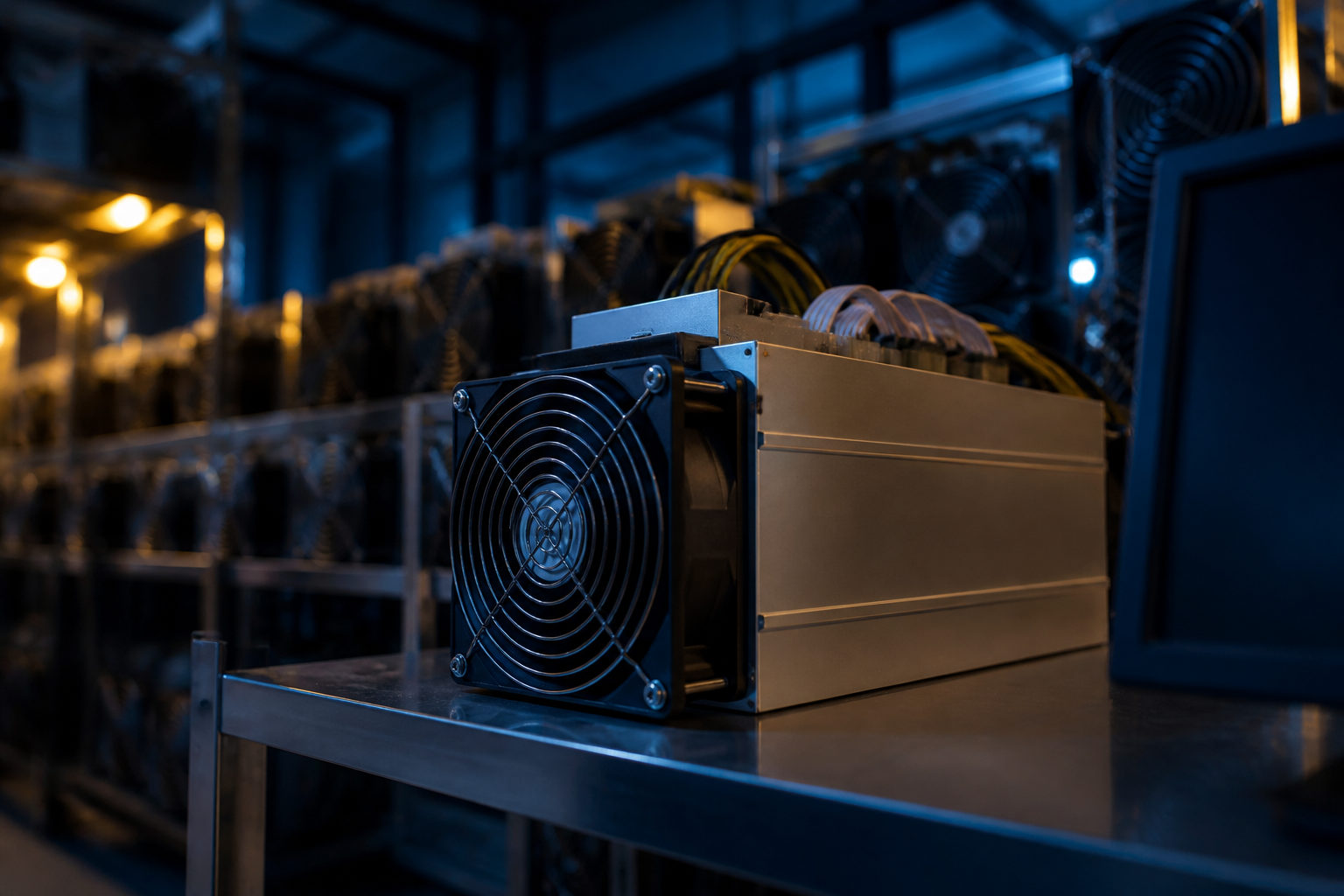
To mine Bitcoin today, you mainly use an ASIC miner. A regular PC can still illustrate the process, but it is generally not a practical tool for real Bitcoin mining under current network conditions.
Bitcoin mining is a race to win the next block
New transactions wait to be confirmed, and miners compete to package them into a block by performing repeated hash calculations until one participant finds a valid result.
The network aims for a block roughly every 10 minutes. The miner that wins can add the block and receive the block reward plus transaction fees. After the 2024-04-19 halving, the current block reward is 3.125 BTC. With about 144 blocks per day, the network issues about 450 BTC daily in total, which says nothing about what any single person or company will mine.
So “what do you use to mine bitcoin” is really a question about computing power, energy use, and network connection.
What hardware is used to mine Bitcoin now
Early participants could mine with CPUs, then competition moved toward GPUs, and later to specialized machines built for one narrow job. Today, the standard hardware is the ASIC miner, short for application-specific integrated circuit.
An ASIC is designed for the specific hashing work used in Bitcoin mining. Mining is not just about whether a machine can compute. It is about how much useful work it can do over time and how much electricity it burns while doing it.
A laptop, desktop CPU, or gaming GPU may still run software related to Bitcoin, but that does not make it a realistic mining setup. In the current environment, general-purpose hardware usually cannot compete with dedicated ASIC units on either output or efficiency.
| Option | Can it be used for Bitcoin mining? | Practical today? | Main point |
|---|---|---|---|
| CPU | Yes, in a basic sense | No, for real competition | Useful for learning, weak for actual mining |
| GPU | Yes | Generally no | Versatile hardware, but not the main tool for Bitcoin |
| ASIC miner | Yes | Yes | Built specifically for Bitcoin mining work |
| Cloud mining contract | Indirectly | Depends on the provider | No physical machine to manage, but contract risk matters |
The plain answer is simple: people mine Bitcoin with ASIC miners. The machine only works as part of a larger setup.
What else you need besides the miner
A working setup also needs stable power, reliable internet access, a wallet to receive BTC, and usually a mining pool account so the machine knows where to send its work and where payouts should go.
Mining pools are common because solo mining can be extremely uneven for smaller participants. A pool combines the computing power of many miners, competes as a group, and then distributes proceeds according to its own payout method.
| Component | Role | Why it matters |
|---|---|---|
| ASIC miner | Provides hashing power | It is the core machine doing the mining work |
| Power supply | Keeps the unit running | Mining depends on continuous operation |
| Cooling and airflow | Controls heat | Heat affects stability, noise, and hardware life |
| Internet connection | Connects to pool or network | Unstable connections can disrupt submitted work |
| Bitcoin wallet | Receives payouts | You need a destination for mined BTC |
| Mining pool account | Lets you join pooled mining | Common for individual miners |
An ASIC miner is not like a quiet household appliance. It creates heat, can be loud, and needs a place where airflow, wiring, and uptime are taken seriously.
Ways to participate: run it yourself, use hosting, or buy cloud mining
Most people looking at mining consider three routes: run their own ASIC machine, place owned hardware with a hosting provider, or buy access through cloud mining contracts.
Running your own machine gives the most direct control. You choose the hardware, handle the network setup, deal with noise and cooling, and take responsibility for repairs or downtime.
With hosting, you still own or select the hardware, but the machines sit in a facility built for power delivery, ventilation, and maintenance. This reduces the burden on the user, though it adds dependence on the host’s service quality, reporting, and contract terms.
Cloud mining is the most hands-off version. You buy access to someone else’s mining operation through a service agreement. The appeal is convenience, but you must read the contract carefully and judge the provider’s transparency, fees, shutdown terms, and counterparty risk.
| Path | What you handle | Benefit | Main concern |
|---|---|---|---|
| Self-run ASIC | Setup, power, cooling, repairs | Direct control and visibility | Operational burden is high |
| Hosted mining | Hardware choice and account management | Less on-site work | Dependence on host performance and terms |
| Cloud mining | Provider selection and contract review | Fast entry, no machine management | Counterparty and transparency risk |
If your goal is simply to own Bitcoin, mining is not the only route. Holding BTC and running mining hardware are very different activities.
The hard part is often cost, not setup
Mining means power bills, heat management, maintenance, downtime, possible hardware replacement, and the need to stay competitive as the network adjusts over time.
Bitcoin’s issuance schedule also shapes the business side. The block reward halves every 210,000 blocks, roughly every 4 years. The halving dates so far are 2012-11-28, 2016-07-09, 2020-05-11, and 2024-04-19, with the next one expected around 2028. When the reward drops, less efficient hardware can become much harder to justify.
There is also a fixed supply cap of 21,000,000 BTC, with issuance expected to continue until about 2140. Mining follows protocol rules, and those rules keep competition tight.
There is no universal answer to whether mining will “work” for you. The right question is whether your power access, operating environment, and chosen participation model fit the reality of ASIC-based mining.
- Check your power and space before comparing machines.
- Decide whether you want direct control or a hosted arrangement before spending time on vendors.
- Review pool payout rules and wallet setup before turning equipment on.
- Treat noise and heat as core planning items, not afterthoughts.
FAQ
Can I mine Bitcoin with a normal computer?
You can use a normal computer to understand the process or test software behavior. For actual mining in current conditions, regular consumer hardware is generally not competitive, so ASIC miners are the usual choice.
Do I need to join a mining pool?
No, not in a strict technical sense. Many individuals still choose a pool because solo mining can be highly uneven, while a pool spreads results across participants under a payout formula.
Is buying an ASIC enough to get started?
Not by itself. You also need stable power, networking, cooling, a Bitcoin wallet for payouts, and a clear plan for where the machine will run and who will maintain it.
Is cloud mining the same as owning mining hardware?
No. With cloud mining, you are buying access to someone else’s operation rather than running a machine you control. That makes contract review and provider trust far more important.
What is the smallest amount of Bitcoin a miner can receive?
The smallest Bitcoin unit is 1 satoshi, equal to 0.00000001 BTC. In practice, pool payouts follow the pool’s own accounting and withdrawal rules, so timing and minimum payout conditions vary by service.
If you plan to take the next step, learn the process first if your goal is education, compare hosting if you want less operational work, and only shop for an ASIC after you have checked power, cooling, and the terms of the pool or service you intend to use.
Disclaimer: This article is for informational and educational purposes only and is not investment, financial, or legal advice. Crypto assets are highly volatile and you could lose your entire investment. Do your own research and decide carefully.