
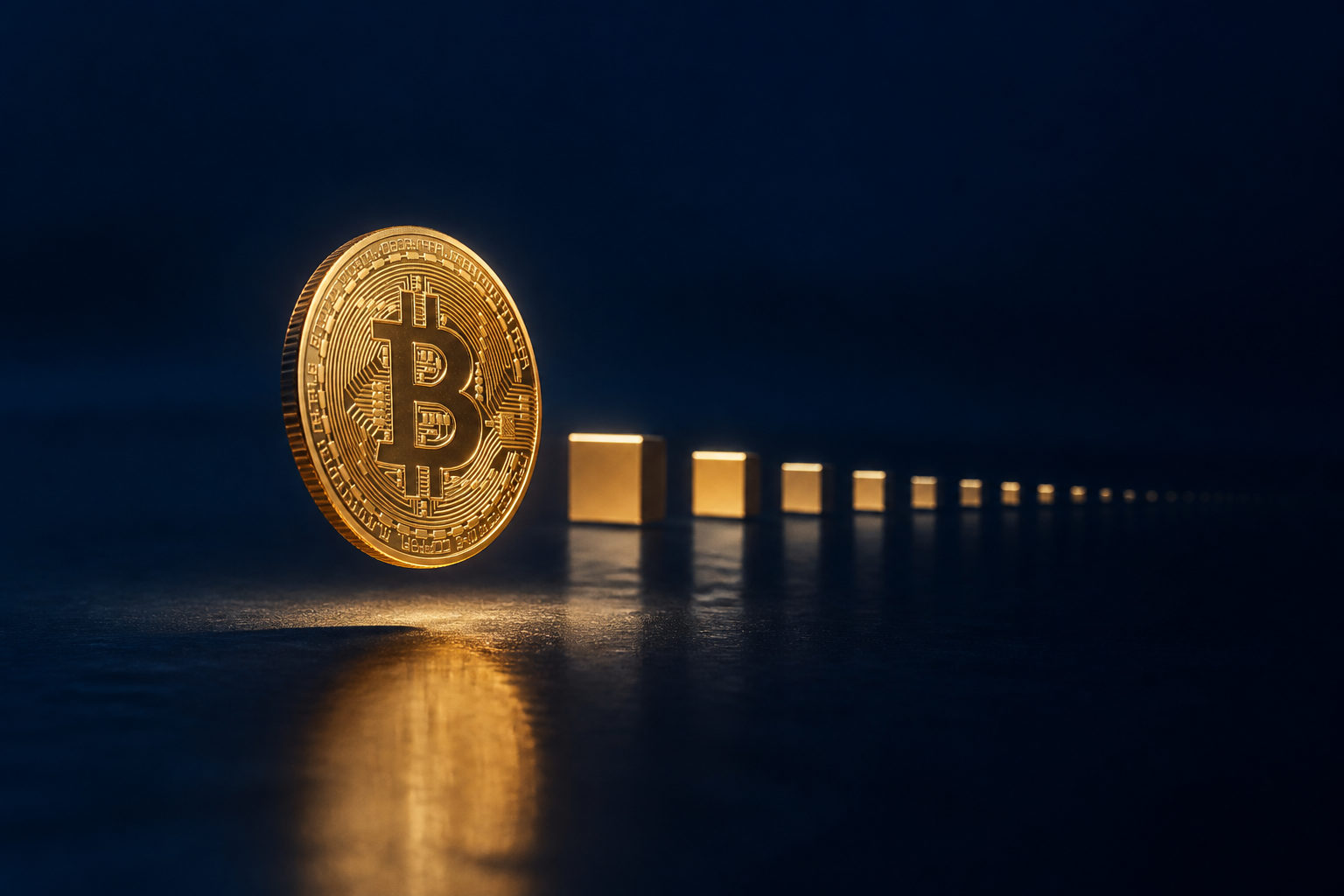
The last bitcoin will not be mined any time soon. Bitcoin keeps producing new blocks, but the block subsidy falls on a fixed schedule, so new supply slows down again and again and the final stretch takes a very long time.
Think of mining as a race to write the next page of the ledger
Bitcoin mining is closer to a public bookkeeping contest than digging metal out of the ground. Many participants compete to package valid transactions into the next block, and the winner gets to add that block to the chain and receive the block reward.
This system has been running since the genesis block in January 2009. Its main job is to keep a shared ledger updated without a central operator. New bitcoin issuance is part of the incentive design. It gives miners a reason to spend on machines, electricity, cooling, and operations so the network keeps moving.
Bitcoin is designed to produce a block about every 10 minutes. Each new block comes with newly issued bitcoin, but that issuance is spread over time instead of released all at once. That is why the question of when the last bitcoin is going to be mined is really a question about how slowly the remaining supply is released as rewards keep shrinking.
| Concept | What it does | Why it matters here |
|---|---|---|
| Block production | Adds new transaction data to the chain | New bitcoin enters circulation block by block |
| Block reward | Motivates miners to compete for valid blocks | The reward size sets the pace of new issuance |
| Supply cap | Limits bitcoin to 21 million coins | Shows that issuance has an upper boundary |
| Halving | Reduces new issuance on a fixed schedule | Explains why the ending takes so long |
Why the final bitcoin takes so long to arrive
The key is Bitcoin’s halving schedule. The protocol cuts the block subsidy in half every 210,000 blocks, which is roughly every 4 years. Halvings have already taken place in 2012, 2016, 2020, and 2024. After each halving, the same amount of network activity produces less new bitcoin than before.
Total supply keeps moving closer to 21 million, but the closer Bitcoin gets to that cap, the slower the remaining issuance becomes.
Another detail matters here: bitcoin can be divided into very small units. The smallest unit is a satoshi, and 1 satoshi equals one hundred millionth of 1 BTC. Because the system can express very small amounts, the subsidy can keep shrinking over many cycles while still being distributed in tiny increments.
People often expect a neat calendar date with a clean finish line. Blocks keep being produced, rewards keep dropping, and issuance approaches its endpoint gradually rather than stopping with a sudden switch.
| Factor | What happens | Effect on the end of mining |
|---|---|---|
| About 10 minutes per block | Issuance follows block production | Coins are released step by step, not in one event |
| Halving about every 4 years | Each block creates less new bitcoin | The final phase slows down sharply |
| 21 million supply cap | Total issuance cannot expand forever | There is a clear ceiling to approach |
| Satoshi-level divisibility | Very small rewards can still be represented | The tail of issuance can stretch out |
What participation looks like today
Participation is still possible, but the practical reality is very different from the early idea of running a home computer and waiting for coins to appear.
Modern bitcoin mining is shaped by hardware efficiency, electricity cost, cooling, noise, uptime, and operational discipline. If your goal is education, building a small test setup or following block production with public tools can teach you more than chasing output. If your goal is actual mining, you are stepping into a competitive environment where specialized hardware and careful cost control matter.
Many participants use mining pools. A pool combines the computing power of many miners so rewards can be shared more regularly instead of waiting alone for a winning block. Solo mining remains possible in principle, but it pushes more uncertainty onto one participant. For most people, the better starting point is to decide whether they want to learn the mechanics, invest in the asset, or operate mining equipment as a business activity.
| Approach | Best fit | Main reality check |
|---|---|---|
| Learning setup | People who want to understand the process | Useful for education, not for meaningful production |
| Pool mining | People seeking active participation | Requires hardware, power planning, and ongoing oversight |
| Solo mining | People comfortable with high variance | Possible, but success may take a long wait |
| No mining, only research or holding | People focused on the asset or the protocol | Avoids machine operations, but not market risk |
Bitcoin has not all been mined yet, but that does not answer whether your equipment, power bill, location, heat management, and maintenance habits can survive real competition over time. Mining participation exists; easy mining is a different story.
FAQ
What happens after all bitcoin has been mined?
Blocks still need to be produced and transactions still need to be confirmed. In that later stage, miners are expected to rely more on transaction fees than on newly issued bitcoin.
Does halving make mining unattractive right away?
Halving lowers the block subsidy immediately, but that does not mean every miner sees the same outcome. Hardware efficiency, power cost, downtime, and pool terms can change the picture a lot.
Will one miner get the very last bitcoin?
The protocol does not behave like a dramatic final treasure hunt. The more useful way to see it is as a long reward tail that gets smaller over time.
Can a regular home computer still mine bitcoin?
A home machine can still help you study the process and understand how mining works. Competing for actual block rewards is another matter, because specialized machines are built for that job.
Why is bitcoin often described as scarce?
Scarcity comes from both the 21 million cap and the public issuance schedule. Market participants can see in advance that new supply gets reduced through repeated halvings.
What to pay attention to instead of obsessing over the final coin
Focus on three things. First, learn how halvings change the pace of new supply. Second, separate learning about mining from running mining as an operation. Third, pay attention to transaction fees, pool rules, machine efficiency, and operating costs, because those are the real variables that shape participation.
For most readers, the practical move is to watch block explorers and market tools, follow how new blocks and fees behave, and then decide whether your interest is technical, financial, or operational. That gives you a framework for judging how Bitcoin mining actually works.
Disclaimer: This article is for informational and educational purposes only and is not investment, financial, or legal advice. Crypto assets are highly volatile and you could lose your entire investment. Do your own research and decide carefully.