
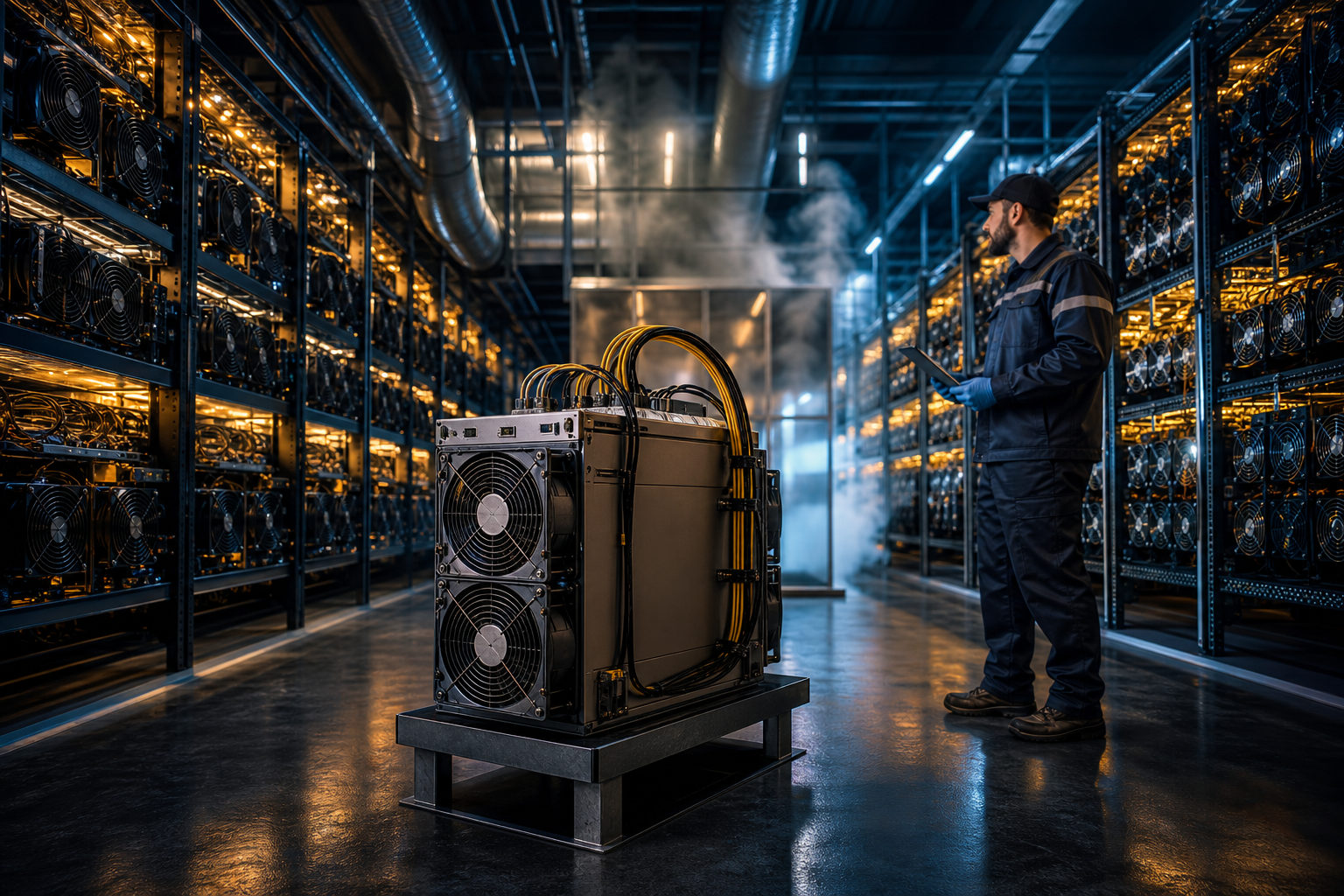
Where to mine bitcoin is really a question about where your hardware can run well enough to join Bitcoin’s block-finding race, not about finding a special website that hands out coins.
What bitcoin mining actually means
A simple way to think about mining is to picture a constant competition to write the next page of a public ledger. Miners collect transactions into a candidate block and use computing power to satisfy the network’s rules. The winner earns the chance to add that block to the chain.
So you are not digging bitcoin out of the ground. You are using specialized machines, electricity, cooling, and network access to compete in a proof-of-work system. Bitcoin began with the genesis block in January 2009, and the network produces a block roughly every 10 minutes. That design ties security to real-world cost.
Where to mine bitcoin: the practical choices
When people ask where to mine bitcoin, they usually mean one of two things: where should the machines physically sit, and how should they connect to the network. In practice, most individuals end up choosing among home mining, hosted mining, and pool participation.
Mining at home
Home mining sounds straightforward because the hardware stays under your control. The hard part is not switching a machine on. The hard part is running it day after day with stable power, enough ventilation, tolerable noise, and a safe electrical setup.
That is where many first-time miners hit reality. A bitcoin miner is not like an ordinary desktop computer. It can generate constant heat and noise, and it needs an environment that can handle both. Dust, room temperature, internet interruptions, and basic maintenance all matter more than beginners expect.
Using a hosting site or mining facility
Another option is to place your machines in a dedicated facility. The appeal is clear: better power management, better airflow, and staff who deal with mining hardware on a daily basis. For someone who does not want industrial equipment running in a home or office, hosting can be the more realistic path.
Still, a hosting provider does not remove risk. It changes the kind of risk you carry. You need to know how machine ownership is documented, how downtime is handled, who authorizes repairs, what information you can see remotely, and how fees are structured. A machine that sits far away is only useful if you can verify what is happening to it.
Joining a mining pool
A mining pool is not a place in the physical sense. It is a coordination system. Your miner connects to the pool, combines its hashpower with other miners, and shares in the outcome according to the pool’s rules.
For most small participants, this is the standard way to mine bitcoin. Solo mining leaves you exposed to a highly uneven result, because the competition to find blocks is intense. A pool smooths the distribution process, but it also means you should review payout rules, account security, server reliability, and the clarity of the pool dashboard before you commit.
Cloud mining needs extra caution
Some services frame the answer to where to mine bitcoin as “buy hashpower online” or “start mining from your phone.” That can be misleading. In many cases, you do not control a machine at all. You may only hold a contract or a revenue-sharing promise, and the underlying equipment may be hard to verify.
That does not mean every remote service is invalid. It does mean you should ask direct questions. Is there actual hardware behind the offer? Can you verify the operating status? Are downtime, maintenance, and termination terms clearly written? If the sales pitch focuses on convenience and avoids the physical and operational details, caution is justified.
The real answer is cost structure, not geography
At first glance, the phrase where to mine bitcoin sounds geographic. In practice, the better question is where your machines can run with acceptable operating conditions over time. The location matters because of what it provides, not because of the map pin itself.
- Power quality: Can the site support sustained electrical load without frequent interruption?
- Cooling: If heat cannot be removed well, uptime and hardware health suffer.
- Noise tolerance: A setup that is possible in a warehouse may be impossible in an apartment.
- Internet stability: Mining hardware must stay connected consistently.
- Maintenance access: Cleaning, restarts, diagnostics, and repairs all take time and planning.
- Site rules: Lease terms, building policies, and utility restrictions can decide whether the setup is workable at all.
This is why “the best place” has no universal answer. A site with poor ventilation or unstable power can ruin a mining plan even if the machine itself is fine. The practical decision is always about whether the full operating environment supports the hardware.
What beginners often misunderstand
The first mistake is assuming a normal PC is enough. Bitcoin mining is highly specialized, and serious participation uses purpose-built ASIC hardware rather than laptops or standard desktops. The second mistake is assuming a phone app is mining bitcoin locally. In many cases, an app is only tracking an account, showing data, or connecting you to a remote service.
The third mistake is treating mining as the default way to get bitcoin. That is not always true. If your real goal is simply to own bitcoin, buying and securing it may fit better than running mining hardware. Mining is closer to operating infrastructure than pressing a button.
It also helps to understand the supply schedule. Bitcoin has a maximum supply of 21 million coins. New issuance enters through block rewards, and the reward is reduced roughly every 4 years, or every 210,000 blocks. Halving years include 2012, 2016, 2020, and 2024. That structure means miners are always dealing with efficiency pressure, not a static environment.
Another useful detail is the unit structure. One bitcoin can be divided into smaller units, and 1 satoshi equals one hundred millionth of 1 BTC. That matters less for mining operations than for general understanding, but it helps explain why owning or earning bitcoin does not require a whole coin.
How to choose a path that fits your goal
If you are still asking where to mine bitcoin, step back and define what you actually want. People often mix three different goals together: learning how Bitcoin works, operating hardware themselves, and gaining bitcoin exposure. Those goals lead to different decisions.
- If you want to learn the mechanism: Start with blocks, hashing, proof of work, mining pools, and wallet basics. You do not need to buy hardware on day one.
- If you want to run equipment: Review power, cooling, noise, physical space, and your ability to maintain machines. Then compare home setup versus hosting.
- If you mainly want to own bitcoin: Mining may not be the direct path you need. Acquisition and secure storage may be the more relevant topics.
That distinction matters because mining is not just a financial choice. It is also an operational one. Once you frame it that way, the phrase where to mine bitcoin becomes easier to answer: choose the environment that matches your technical limits, your living situation, and your willingness to manage ongoing problems.
FAQ
Where are bitcoins usually mined?
They are not mined from a single website or a fixed country-based source. Bitcoin is mined by hardware connected to the network, and that hardware may sit in a home, a warehouse, a hosting facility, or a professional mining site.
Where do I go to start mining bitcoin?
You usually begin by choosing hardware, a wallet, and a mining pool, then deciding whether the machine will run at home or in a hosted environment. The real starting point is setup planning, not a secret destination.
Can I mine bitcoin at home?
Yes, in principle, but the limits are practical. Noise, heat, electrical load, internet reliability, and maintenance make home mining harder than many beginners expect.
Is a mining pool the place where bitcoin is mined?
Not in a physical sense. A pool is a coordination layer that lets miners combine hashpower and share results, while the actual machines still run somewhere in the real world.
Is cloud mining the easiest way to mine bitcoin?
It may look easy, but it can also be the hardest model to verify. Before using any cloud mining service, check whether there is real hardware behind it and whether the contract terms clearly explain downtime, maintenance, and control.
If you want to move from research to action, make a checklist for power, cooling, noise tolerance, site rules, and maintenance time before comparing machines, pools, or hosting offers. That checklist will answer more than any generic “best place to mine” list.
Disclaimer: This article is for informational and educational purposes only and is not investment, financial, or legal advice. Crypto assets are highly volatile and you could lose your entire investment. Do your own research and decide carefully.