
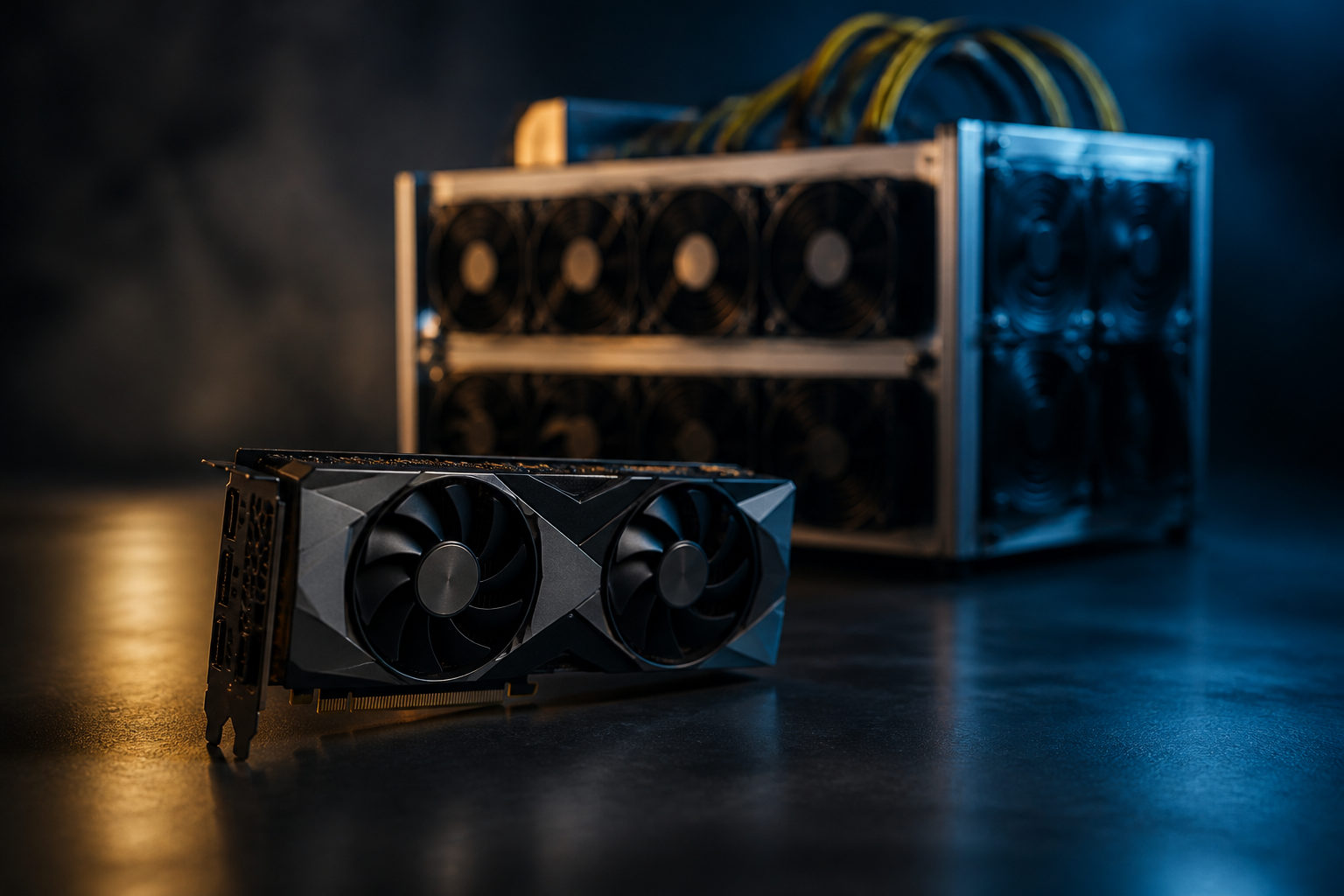
If you are asking which VGA is good for bitcoin mining, the direct answer is simple: for Bitcoin mining today, a graphics card usually is not the main tool people study first. In most real setups, the discussion shifts to dedicated mining hardware, while GPUs are more useful as a starting point for understanding how mining hardware is evaluated.
Why people still ask about VGA for Bitcoin mining
The question makes sense on the surface. Graphics cards are built for heavy parallel workloads, so they became closely associated with crypto mining in general. A lot of beginners hear “mining” and immediately think of racks of GPUs.
Bitcoin mining, though, is best understood as a nonstop bookkeeping race. Everyone follows the same public rules and keeps trying calculations until someone finds a valid result first. The network produces a new block about every 10 minutes, and that constant competition pushes hardware toward whatever can do the task most efficiently over long periods.
Why GPUs are no longer the center of Bitcoin mining
Imagine a huge group of participants trying to solve the same puzzle again and again, with the winner earning the right to add the next page to a public ledger. That is the rough intuition behind proof-of-work. Bitcoin launched with its genesis block in January 2009, and mining has been part of the system from the start.
In the early phase of a new network, general-purpose hardware can have a larger role because the environment is less specialized. Over time, competition changes the equipment mix. Once dedicated hardware built for a narrow mining task becomes the practical standard, asking “which VGA is good for bitcoin mining” stops being a question about the best graphics card model and becomes a question about whether a GPU is even the right category anymore.
| Approach | Main trait | Fit for Bitcoin mining today | Best for |
|---|---|---|---|
| GPU setup | Flexible hardware with broader uses | Usually not the strongest fit | Learning hardware basics and comparisons |
| Dedicated miner | Built for a narrow mining workload | Usually closer to real-world conditions | People seriously studying participation |
| Hosted or managed route | You do not keep the machine on-site | Requires extra trust and contract review | People avoiding noise and maintenance at home |
If you still want to compare graphics cards, look at the right things
The useful version of the question is this: what should you evaluate when you compare any mining device? Once framed that way, the discussion becomes much more practical. It is less about a famous model name and more about how the machine behaves when it runs for long stretches.
Start with efficiency per unit of power. Mining hardware is meant to stay active, so power draw matters alongside raw compute ability. Then look at stability. A machine that can boot and run a test is not automatically suitable for continuous operation, especially when heat, airflow, and power delivery begin to matter.
Maintenance is another major factor. A GPU-based rig is never just the card itself; the motherboard, power supply, cooling path, operating system, and tuning choices all affect results. Exit flexibility matters too. A graphics card can often be reused or resold for other workloads, while dedicated mining hardware tends to have a narrower second life.
| Evaluation area | What to check | Why it matters |
|---|---|---|
| Efficiency | Useful compute output relative to power use | Shapes long-run operating pressure |
| Cooling | Airflow, temperature control, dust handling | Affects stability and hardware life |
| Power delivery | PSU headroom, cable quality, sustained load behavior | Reduces failures and instability |
| Noise and space | Placement, ventilation, effect on your living area | Determines whether you can keep it running |
| Maintenance load | Driver issues, restarts, troubleshooting, part swaps | Consumes time beyond the initial setup |
| Resale flexibility | How easily the hardware can be repurposed | Changes your exit risk |
For most people, the better first step is not picking a GPU
If your goal is education, spend time on the mechanism before shopping for hardware. Learn how proof-of-work secures the ledger, what a block is, how mining pools fit into participation, and how wallet reception works. Bitcoin has a maximum supply of 21 million coins, and its smallest unit is 1 satoshi, which equals one hundred millionth of a BTC. Those basics will help you ask better hardware questions later.
If your goal is real participation, check your environment before you compare machines. Is your power stable enough for continuous operation? Do you have enough ventilation? Can you tolerate the noise? If the hardware stops, are you prepared to troubleshoot it yourself? These questions decide far more than many beginners expect.
You also need to be clear about the path you are choosing. Some people run equipment themselves. Some connect their machines through a mining pool so their contribution is part of a larger combined effort. Others look at hosting or managed options, which can reduce hands-on work but create new risks around fees, terms, and trust. You can even begin without buying anything by learning block explorers, wallet flow, and pool payout logic first.
| Participation route | What you handle | Main difficulty |
|---|---|---|
| Self-run hardware | Buying, setup, cooling, power, repairs | High friction and many moving parts |
| Mining pool participation | Configuration, account setup, payout rules | Need to understand the pool structure |
| Hosted or managed service | Reviewing terms, costs, and counterparties | Trust risk can be significant |
| Learning first | Studying tools, flow, and core concepts | No immediate hands-on machine experience |
The cost reality matters more than the model name
A lot of discussions about which VGA is good for bitcoin mining skip the long-run burden. The device itself is only the opening step. After that come power use, cooling needs, dust, noise, downtime, part wear, replacement logistics, and the time you spend monitoring and fixing problems.
There is also a common mistake in the way people frame viability. A machine being technically able to mine does not mean it makes practical sense in a competitive network. For Bitcoin in particular, hardware choice has to be judged together with your location, power conditions, maintenance ability, and tolerance for operating friction.
Security belongs on the checklist early. If you manage your own setup, account permissions, wallet handling, system updates, and fake support scams all matter. If you use a third party, you add counterparty risk on top of the hardware question. The expensive lesson for many newcomers is that the weak point often sits outside the machine itself.
FAQ
Can you still mine Bitcoin with a graphics card?
If you mean whether a GPU can be used in a technical sense, that is one question. If you mean whether it is the right choice for actual Bitcoin mining conditions, that is a different one. In practice, a graphics card usually is not the main route people consider for Bitcoin today.
What should I learn before buying any mining hardware?
Start with proof-of-work, block creation, the role of mining pools, and the way wallet payouts are received and checked. Once those pieces make sense, hardware comparisons become much easier to judge in context.
Why did Bitcoin mining move away from GPUs?
Competition rewards the equipment that can perform the required calculations more efficiently over time. As hardware became more specialized, general-purpose graphics cards lost their place in the center of Bitcoin mining.
What do beginners overlook when comparing mining devices?
They often focus on headline performance and miss the full operating picture. Power delivery, cooling, noise, maintenance time, and failure handling have a huge effect on whether a setup remains workable.
Can I explore mining without running hardware at home?
Yes. You can begin by learning how pools work, how wallet addresses receive funds, how block explorers display activity, and how service terms should be read. That gives you a grounded view of the process before you take on machine ownership.
If this topic started with “which VGA is good for bitcoin mining,” the more useful next question is whether Bitcoin mining is something you should approach with a GPU at all. Clarify your goal first, then review your power, space, maintenance capacity, and security plan before you spend money on any device.
Disclaimer: This article is for informational and educational purposes only and is not investment, financial, or legal advice. Crypto assets are highly volatile and you could lose your entire investment. Do your own research and decide carefully.