
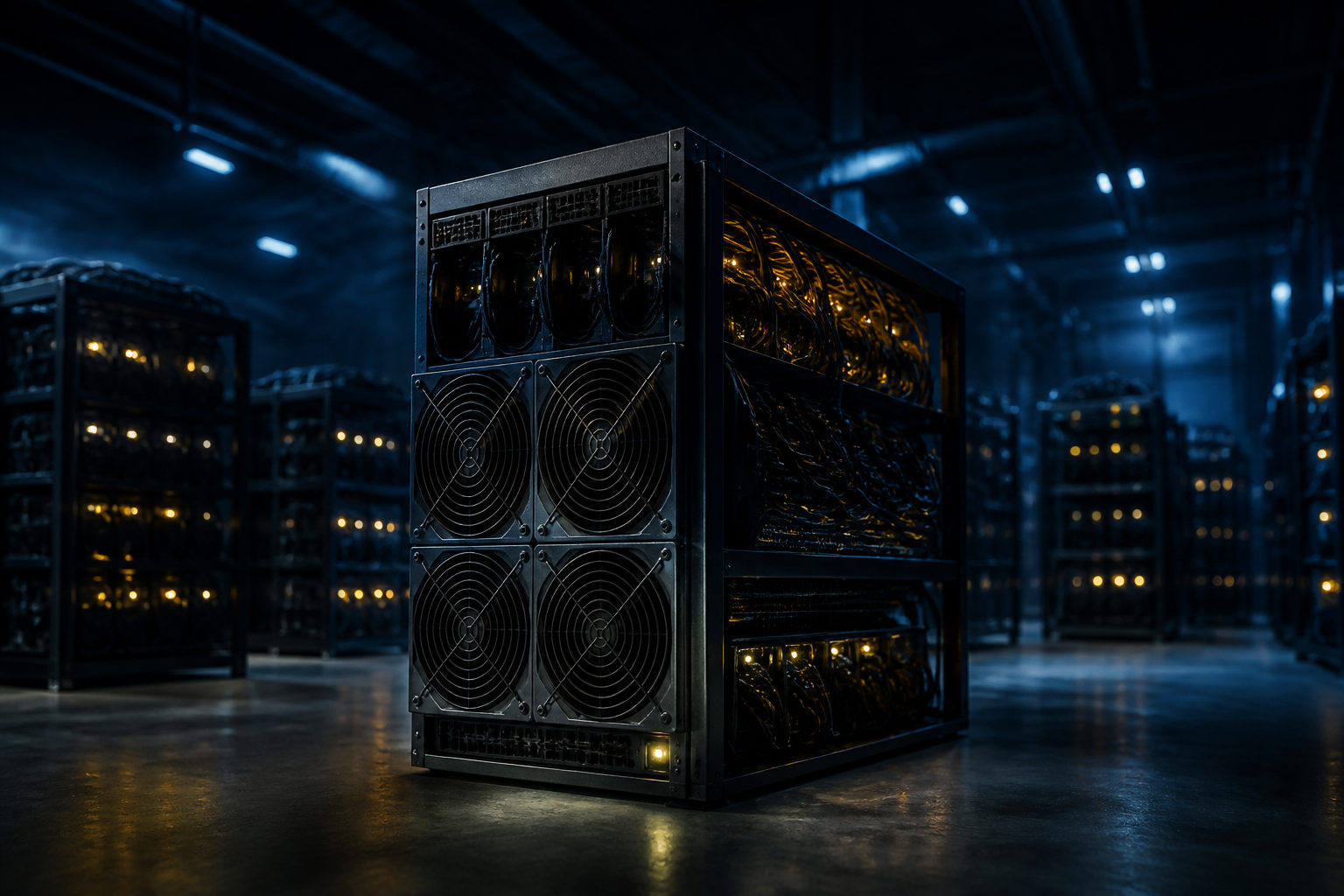
Bitcoin mining is hard because it is a global competition for bookkeeping rights. Raw computing power decides your odds of winning, while electricity and hardware costs keep adding up no matter what.
What Miners Actually Do: A Race to Write the Ledger
Bitcoin has no central bank and no central server. Every transaction ends up in one public ledger, and miners are the ones who write it.
Here's the job in plain terms. Miners gather pending transactions into a new block, then search for a hash value that meets the protocol's requirements. That hash cannot be worked out with a clever formula; it can only be found by trying guess after guess. The first miner to find a valid answer broadcasts the block and receives newly issued bitcoin as a reward. That, in short, is mining, and the network produces a new block about every 10 minutes.
This design is called proof of work. Checking someone's answer is nearly instant, but producing one requires serious effort. No shortcut means no free entry into the race.
Three Reasons Mining Keeps Getting Harder
First, you are racing against industrial-scale hardware. In the early years, a home CPU could mine. Graphics cards took over, then ASIC miners designed for one single job. Today the network runs on vast arrays of specialized machines, and a single home computer barely shows up in the comparison.
Second, the protocol raises the bar on its own. It watches the total computing power of the network and adjusts the difficulty so blocks keep arriving roughly every 10 minutes. The more hashing power joins, the harder the math becomes. Latecomers always face a tougher problem than the people who started earlier.
Third, costs never pause. Electricity runs around the clock. Hardware loses value from the day you buy it. Heat and noise need to be managed. Whether you win a block or not, those bills keep coming.
| Challenge | What it looks like | Effect on a regular miner |
|---|---|---|
| Computing race | The network is dominated by ASIC machines | A home device has almost no chance |
| Difficulty adjustment | More hashing power means harder math | The bar rises as more people join |
| Fixed costs | Electricity, depreciation, heat, noise | Costs can easily outweigh returns |
How Ordinary People Still Participate
If you understand the odds and still want to try, three routes are common. Each has a different trade-off.
| Route | Entry barrier | Main costs | Best for |
|---|---|---|---|
| Mining from home | Low: install software and go | Electricity and hardware wear | People who just want to see how it works |
| Buying a miner and joining a pool | Medium: you need the machine first | Hardware plus power | People with space and a long horizon |
| Cloud mining | Low: rent hashrate, done | Rental fees are usually non-refundable | People who don't want to manage machines |
A pool combines the computing power of many miners. When it finds a block, the reward is split by each member's contribution. A pool does not make the puzzle easier; it turns long stretches of silence into a steady trickle of small payments. Cloud mining is renting someone else's hardware instead. It removes the maintenance headache but adds two new questions: is the provider trustworthy, and is the contract fair.
Three Misconceptions Worth Dropping
“I'll just run my PC and call it a hobby.” Trying it for a few days teaches you the process. Leaving it running for months is a different story, because power bills and wear add up quietly.
“Mobile mining is a real thing.” A phone's hashing power is negligible next to the global network. Apps that advertise phone mining are usually marketing gimmicks, and some make money from ads or in-app purchases rather than from mining at all.
“A mining pool means steady income.” A pool only handles the payouts. It cannot fix your electricity price, your hardware efficiency, or the network difficulty, and those are the variables that decide whether anything is left.
FAQ
Can I still mine bitcoin with a regular PC?
The protocol does not ban any device. But your computer is competing with professional miners around the world for the same puzzle. Solo mining on a PC is closer to holding a lottery ticket than to earning a paycheck.
Can the mining difficulty ever go down?
Yes. When many miners leave and the network's total computing power drops, the protocol automatically lowers the difficulty to keep the roughly 10-minute block rhythm. Difficulty drops tend to come after a wave of exits, so they are not necessarily a friendlier moment to enter.
Does joining a mining pool really help?
A pool makes payouts more frequent by pooling the work of many miners, but it also charges a fee and requires trust in the operator's accounting. Bigger pools are not automatically better; very large pools raise concerns about concentration of power.
Is mobile mining legit?
Mostly no. A phone's processor is far too weak to produce meaningful output. Apps that advertise mobile mining generally use the idea as a hook for downloads and make money through ads or in-app purchases.
If you are serious about mining, start with the boring steps: check your local electricity price, open a public mining calculator, enter your device's hashrate and power draw, and see what is left after the bill. Watch the difficulty trend too. Any deal that promises a guaranteed profit deserves a long, skeptical look.
Disclaimer: This article is for informational and educational purposes only and is not investment, financial, or legal advice. Crypto assets are highly volatile and you could lose your entire investment. Do your own research and decide carefully.