
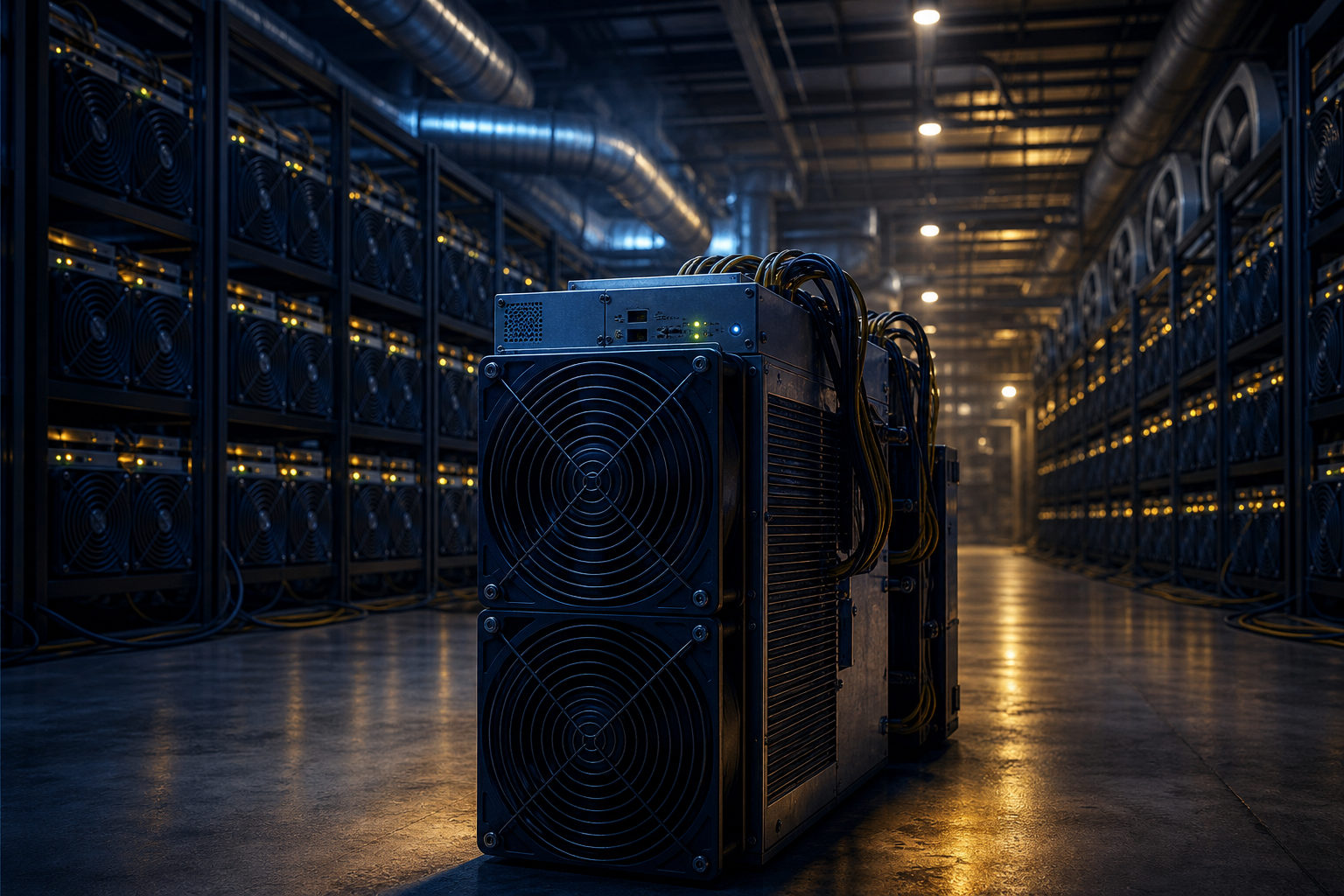
Bitcoin mining is unlikely to suddenly end. A better question is who can still compete in it, because the network can keep running while smaller miners get pushed out by power costs, hardware demands, and operational pressure.
Think of mining as a nonstop race to write the next page of the ledger
If you are asking whether bitcoin mining will end, it helps to drop the image of digging something out of the ground. Mining is closer to a public accounting race. Transactions wait to be grouped into a block, and miners compete to be the one that satisfies the network rules first and earns the right to add that block to the chain.
That is why the process exists in the first place. It is part of how the network keeps a shared ledger without handing control to one operator. Miners spend computing power for a chance to win block production in a given round. The winner can receive the block reward and transaction fees tied to that block. Everyone else spent resources and does not get paid for that round.
Seen this way, mining does not behave like a limited-time program that simply expires on a calendar date. As long as the Bitcoin network continues to process transactions and produce blocks under the same general security model, some set of miners will continue to compete. The structure can become more demanding, but the contest itself does not just switch off under normal conditions.
Why mining may not end, yet can still feel out of reach
People often mix up two different questions. One is whether the network will stop needing miners. The other is whether an ordinary person can still take part in a practical way. Those are not the same issue.
At the network level, mining remains part of Bitcoin's security process. Blocks need to be produced, transactions need to be ordered, and the system still depends on competition among miners under the current model. So when people ask whether bitcoin mining will end, the strict answer is usually no, not in the sense of the network suddenly abandoning block production.
At the business level, though, participation can become much harder. A miner is not only competing on raw hardware. They are also competing on electricity access, cooling design, uptime, repair speed, facility quality, replacement planning, and cash flow discipline. That is where many smaller operators run into reality.
So the better framing is this: mining may continue while becoming less forgiving. The network can stay alive even as older machines lose relevance, home setups become less practical, and operators without cost advantages leave the field. To someone on the outside, that can look like mining is ending. In practice, it is often a shift in who remains competitive.
Can ordinary users still participate in bitcoin mining?
They can, but that does not mean they should assume it is simple. For many people, buying a machine is the easiest part. Running it well is the hard part.
Power costs come first
Mining equipment is designed to run continuously. That makes electricity one of the most direct pressures on the operation. A machine can be active all day and still leave the operator in a weak position if the power bill is too high relative to the machine's efficiency and the broader competitive environment.
Hardware does not keep its edge forever
Mining devices are not timeless productive assets. Newer generations can change the competitive balance, and older units may become far less attractive in the same setting. A setup that looks workable today can age badly once hardware standards move forward.
The operating environment matters more than beginners expect
Heat, noise, dust, airflow, wiring load, monitoring, and restart procedures all matter. A home setup may technically run, yet still be unsuitable for continuous use. Many first-time users underestimate how quickly these practical issues pile up.
Downtime is not a minor inconvenience
Mining depends on staying online. If a machine overheats, loses connectivity, suffers fan trouble, or develops a power issue, the lost time matters. Larger operations tend to build routines around these risks. Individuals often discover them only after problems appear.
That is why the answer to whether bitcoin mining will end should not be reduced to a yes-or-no slogan. For most people, the sharper question is whether they are entering a capital-intensive, operations-heavy activity with realistic expectations.
What would count as mining "ending" in practice?
To answer the original question carefully, it helps to define what "end" even means. There are several very different situations that people may describe with that word.
The first is that small-scale participation becomes unappealing. The network is still running, blocks are still being produced, and professional miners are still active. Yet home users or small operators decide the economics and operational demands no longer make sense for them. From their point of view, mining can feel finished even though the system is still functioning.
The second is that a class of hardware stops making sense to operate. That does not mean all mining has stopped. It means certain machines, under certain power and facility conditions, no longer hold up. This is why reports about shutdown waves should be read carefully. They often describe stress among specific operators rather than a network-wide end state.
The third is a fundamental rule change at the protocol level. That would be a different category of event because it would alter the security process itself. In ordinary discussion, though, people are usually not talking about a full replacement of Bitcoin's mining model. They are reacting to shrinking margins, rising competition, and tougher operating standards.
So mining is better understood as an ongoing contest that regularly removes weaker participants. What tends to end is not the race itself, but the viability of certain players inside it.
Why market expectations still matter to the mining debate
The question "will bitcoin mining end" is mostly about network mechanics and operating costs, but market expectations still shape miner behavior. Price outlooks can influence expansion plans, hardware upgrades, financing conditions, and the willingness to keep machines online during tougher periods. As of August 2, 2026, public forecasts from major institutions were far from uniform, which itself shows how uncertain the operating backdrop can be.
In a report published on 2026-06-15, Bernstein set a target of 150,000 美元 for Bitcoin by the end of 2026. Its stance was bullish, with the published rationale saying the firm had cut its view from 200,000 美元 and was now looking first for a recovery into the 100,000 to 150,000 range. In a forecast published on 2026-02-12, Standard Chartered gave a target of 100,000 美元 for Bitcoin by the end of 2026, while keeping a cautiously bullish stance and pointing to ETF flows as a key variable.
In a view published on 2026-02-01, JPMorgan gave a 150,000-170,000 美元 target range for Bitcoin in 2026, based on a volatility model comparing Bitcoin with gold. Galaxy Digital CEO Mike Novogratz, in comments published on 2026-07-10, took a more cautious line and said Bitcoin could trade in a 60,000-80,000 美元 range through 2026, arguing that a return to 100,000 would be difficult without a strong catalyst.
In a view published on 2026-06-01, Fidelity's Jurrien Timmer placed Bitcoin in a 65,000-75,000 美元 consolidation zone for 2026, saying the four-year cycle had not been broken and that the market appeared to be in a post-peak consolidation phase. None of these projections decides the fate of mining on its own. Still, they can shape sentiment, funding, equipment purchases, and the pace at which operators expand or pull back.
That is the link between price talk and the mining question. The network can keep producing blocks, but miner confidence and miner behavior can change a lot depending on how future conditions are perceived.
If you are considering mining, check these realities first
Before focusing on equipment, it is smarter to test whether the basic operating conditions make sense for you.
- Electricity access: not just whether power is available, but whether the ongoing cost is acceptable over time.
- Site suitability: cooling, airflow, noise tolerance, wiring safety, and physical maintenance all matter.
- Operational skill: you need at least a basic ability to monitor machines, handle faults, manage connectivity, and react to downtime.
- Hardware obsolescence awareness: a machine's competitive position can weaken as more efficient models arrive.
- Cash flow resilience: pressure does not disappear when conditions worsen; it often becomes more visible.
If those foundations are weak, the key issue is not whether bitcoin mining will end in the abstract. The real issue is whether your setup can survive the practical demands of mining at all. Start with power, site conditions, noise, cooling, maintenance planning, and downtime response before you think about buying hardware.
FAQ
Is it still realistic to mine Bitcoin at home?
It can be done, but realism depends on power costs, heat management, noise tolerance, and maintenance ability. For many people, the gap between "running a machine" and "running it well" is much larger than expected.
Does mining stop once all Bitcoin has been issued?
People often ask this as a shortcut for a broader concern about the long-term model. A better way to think about it is that miners still matter as long as the network needs block production and transaction ordering under the existing competitive process.
Why do shutdown waves happen if mining is still alive?
Shutdown waves usually reflect stress among certain operators or certain classes of hardware. They do not automatically mean the Bitcoin network has stopped needing miners.
What should a beginner evaluate first?
Start with electricity cost and operating conditions, then look at equipment quality and your ability to manage downtime. If the first two do not work, the rest of the plan is usually weak from the start.
Do price forecasts guarantee whether mining stays attractive?
No. Forecasts are only public views, and they can differ widely. They may affect confidence and spending decisions, but they do not remove the operational realities that miners face every day.
If you want a practical next step, write down your power situation, cooling plan, noise limits, maintenance ability, and downtime response process first. That checklist will tell you more about whether mining fits you than any headline prediction.
Disclaimer: This article is for informational purposes only and does not constitute investment advice. Cryptocurrency prices are highly volatile. Always do your own research.