
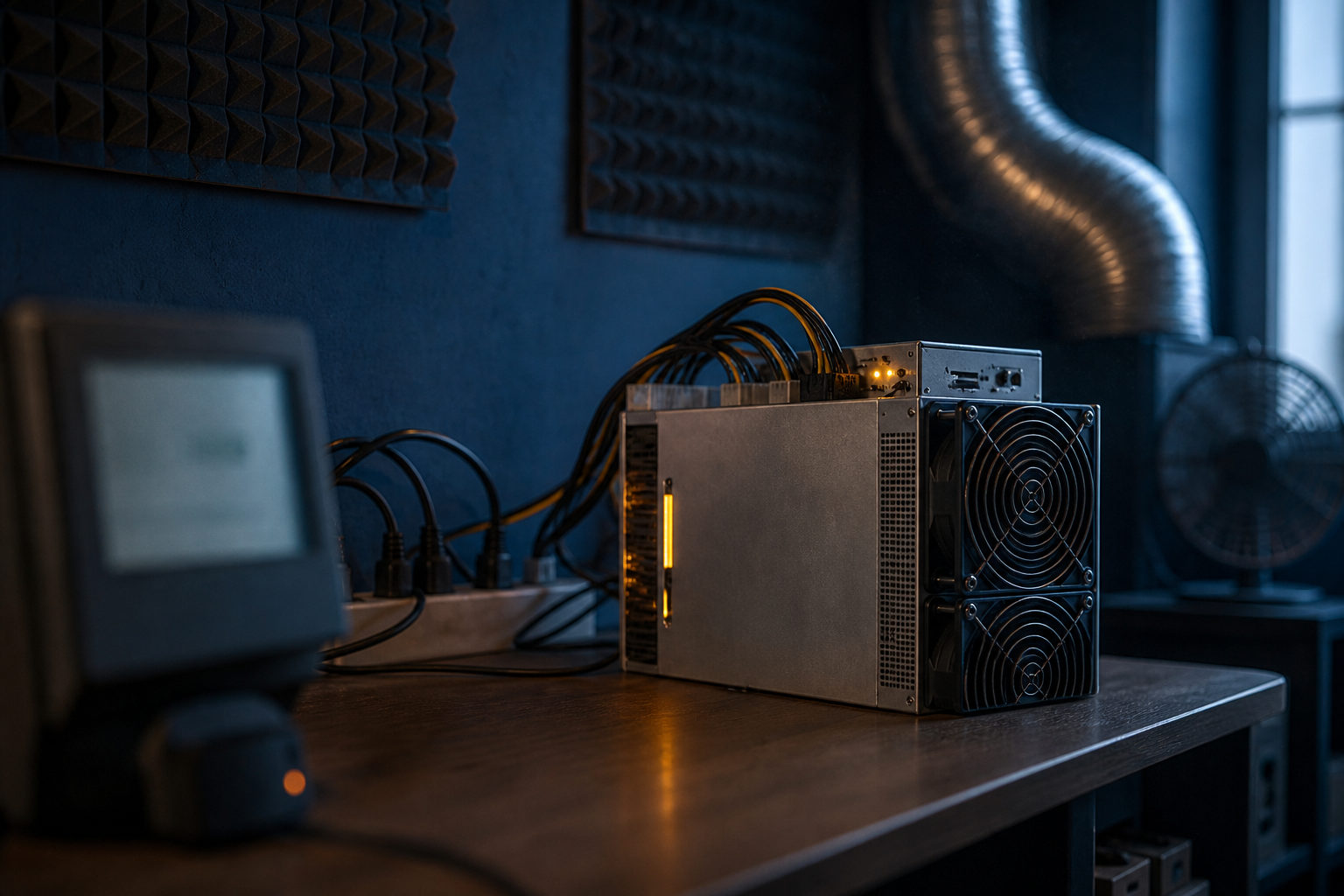
Yes, you can mine bitcoin. The harder question is whether mining makes practical sense for you once you factor in equipment, electricity, heat, noise, and the time needed to keep everything running.
What bitcoin mining actually does
A simple way to picture bitcoin mining is to think of the network as a public ledger and miners as competitors in a nonstop bookkeeping race. They try to package recent transactions into a new block, and the participant that satisfies the network rules gets to add that block to the chain.
This is not a matter of clicking a button or installing an app and waiting. Mining hardware performs repeated calculations that help secure the network and validate the order of transactions; bitcoin produces a new block about every 10 minutes, so miners are always competing around that rhythm.
When people ask, “can I mine bitcoin,” they are often mixing two different questions together. One is whether it is technically possible to take part. The other is whether taking part is realistic for a small operator today.
Can you still mine bitcoin on your own?
Yes, but “on your own” means something different now than many beginners expect. Bitcoin mining has become highly specialized, and serious participants usually rely on dedicated mining machines instead of a standard home computer.
The reason is straightforward. Bitcoin uses proof of work, and competition for block production is intense; a normal laptop or desktop may run certain tools, but it usually cannot compete efficiently with purpose-built hardware. So if you are asking whether you can mine your own bitcoins, the practical answer depends less on access and more on operating conditions.
Common ways individuals participate
- Run your own machine: You buy the hardware and handle power, internet, cooling, and maintenance yourself.
- Join a mining pool: You combine effort with other miners and receive payouts based on the pool's rules.
- Use hosted equipment: Your machine runs in a specialized facility while someone else manages the physical environment.
All three routes are real forms of participation. Still, being able to join does not mean mining will be a good fit for your budget or living situation.
The real limits are cost, hardware, and environment
Electricity is usually the first issue to check. Mining machines need steady power for long periods, and that ongoing cost can shape the entire decision. Two people with similar hardware can end up with very different results if their power conditions are different.
Hardware matters just as much. Bitcoin mining today commonly uses specialized machines built for one job: high-volume computation. Those machines can produce significant heat and noise, which makes home use less simple than many guides suggest.
You also need a place where airflow, dust, and electrical load are under control. A mining setup that looks manageable on paper can become difficult once you deal with room temperature, sound, cable safety, and unexpected shutdowns.
Then there is the time factor. Mining is not always a set-it-and-forget-it activity; machines age, settings may need attention, internet connections can drop, and any issue with your wallet or mining pool account can create a separate problem from the hardware itself.
Mistakes beginners often make
Mistake one: assuming any computer can mine bitcoin effectively. A regular computer can help you learn the basics, but learning the process is different from competing in actual mining. That gap is where many first-time miners get surprised.
Mistake two: treating mining like easy passive income. Bitcoin mining depends on ongoing operating conditions, not just the initial purchase. If power, cooling, or maintenance become annoying fast, the plan may stop making sense just as quickly.
Mistake three: focusing only on the machine price. The machine is only one part of the setup. Heat control, noise, safe power delivery, cleaning, and account security can matter just as much once the system is live.
Mistake four: thinking mined bitcoin is automatically safer. Mining changes how you acquire bitcoin, not how you store it. Wallet security, backups, and access control still need careful attention.
FAQ
Can anyone mine bitcoin today?
In principle, yes. In practice, the better question is whether a person has the right hardware, power costs, space, and patience to keep a mining setup running well.
Can I mine bitcoin at home?
You can, but home mining is not always comfortable. Noise, heat, ventilation, and electrical limits often become the first obstacles rather than the software side of the process.
Can you mine bitcoin without a mining machine?
You can study the system without specialized hardware, and that is a good starting point for many people. If the goal is to compete in real bitcoin mining, suitable equipment is usually necessary.
Is joining a mining pool better for beginners?
For many beginners, a pool is easier to understand than running alone because the participation model is simpler to manage. It still does not remove power costs, hardware issues, or the need to protect your wallet and account access.
Can I mine my own bitcoins and keep them in my own wallet?
Yes, if your setup is configured correctly, mining rewards distributed to you can be sent to a wallet you control. That means you also take full responsibility for backups, private key safety, and access management.
If you are seriously asking whether you can mine bitcoin, start by checking your power costs, available space, cooling options, noise tolerance, internet stability, and maintenance time. That list will tell you more than any sales pitch or short tutorial.
Disclaimer: This article is for informational and educational purposes only and is not investment, financial, or legal advice. Crypto assets are highly volatile and you could lose your entire investment. Do your own research and decide carefully.