
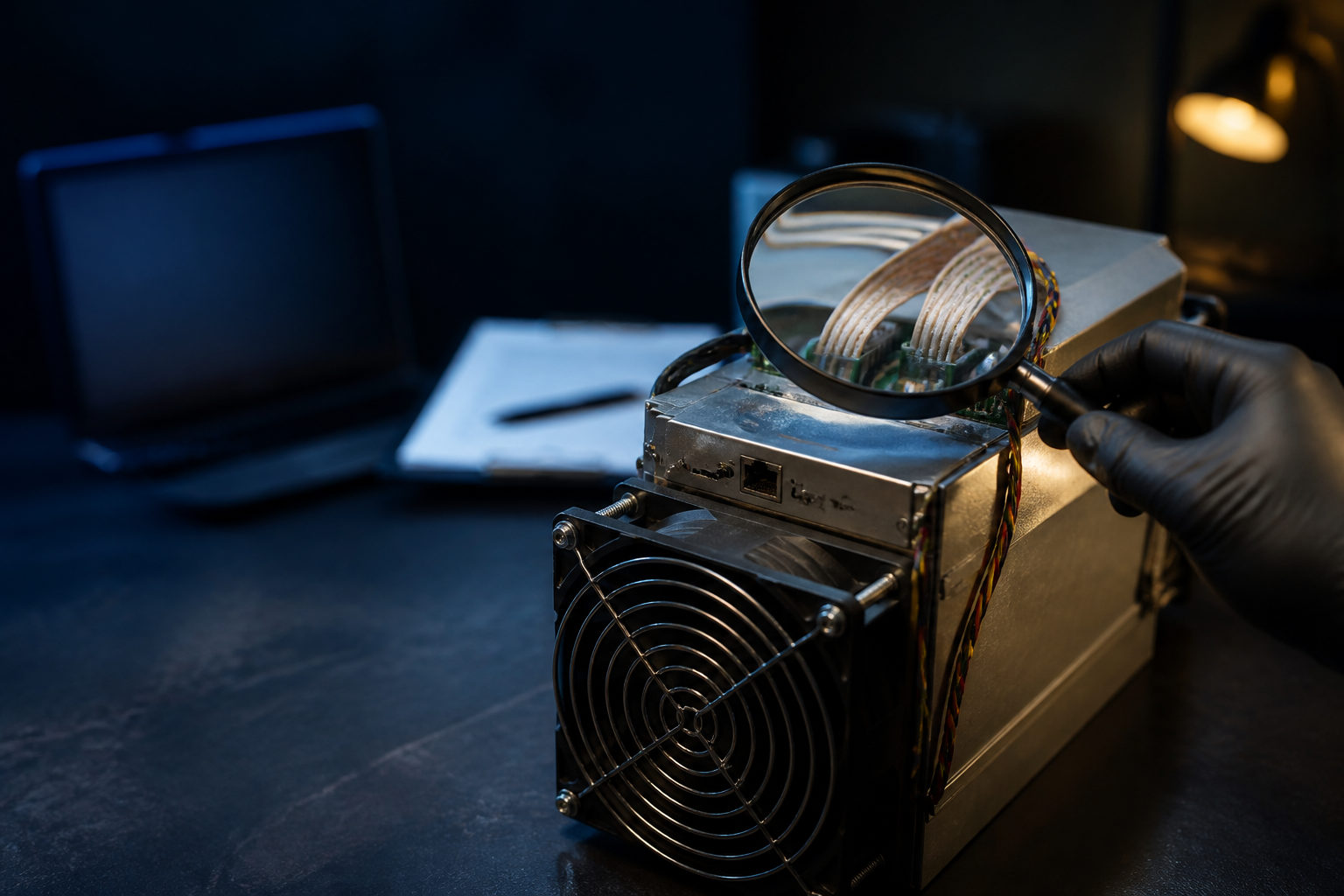
Is Yessera Bitcoin Miner legit? No one can answer that from the name alone. The real question is whether it offers actual mining hardware or services, or whether it uses Bitcoin mining as a sales story for a risky scheme.
Start with the basics: what Bitcoin mining actually does
A simple way to picture Bitcoin mining is to treat it as an open bookkeeping race. Miners gather transactions into a block and compete to produce a valid block under the network rules. The winner gets to add that block to the chain and receives the block reward plus transaction fees.
This is not a manual approval system. Since the genesis block on 2009-01-03, Bitcoin has targeted roughly one block every 10 minutes. After the halving on 2024-04-19, the current block reward is 3.125 BTC, which means the network issues about 450 BTC per day across roughly 144 blocks. That figure belongs to the whole network, not to any one machine, home miner, or company.
That distinction matters because weak or deceptive mining offers often blur it on purpose. They present a network-level number as if it were a personal payout promise. Real mining never works that way. Your result depends on hash rate, machine efficiency, mining pool rules, electricity cost, downtime, cooling, and maintenance.
“Legit” means different things depending on what Yessera is selling
When people ask whether Yessera Bitcoin Miner is legit, they are often mixing several questions together. Is it selling a physical ASIC miner? Is it offering hosted mining? Is it selling cloud hash rate? Or is it collecting deposits and calling the product mining? Those are very different models.
| Model | What you appear to buy | Main checks | Common risk |
|---|---|---|---|
| Physical miner sale | A mining machine | Model, delivery, warranty, written terms | You pay and never receive the machine, or receive old hardware |
| Hosted mining | Machine plus facility service | Equipment ownership, hosting terms, maintenance responsibility | You cannot verify where the machine is or how costs are billed |
| Cloud mining | A contract for hash rate | Hash rate source, payout method, auditability | The platform controls the data and can change terms |
| Managed “mining” program | You send funds and they do the rest | Source of returns, withdrawal rules, referral structure | It may operate like a deposit scheme rather than mining |
If Yessera is presenting itself as a hardware seller, it should be able to describe the machine clearly: what model it is, how delivery works, who handles failures, and what support exists after the sale. If the sales page talks more about passive income than hardware details, that is already a warning sign.
If the product is hosted or cloud-based, the bar should be even higher. You cannot see the machine yourself, so the contract and operating rules carry more weight. Vague ownership language, weak billing details, and unclear withdrawal terms are all reasons to slow down.
Why the mining business is harder than the marketing makes it sound
Bitcoin mining is shaped by a fixed issuance schedule and a competitive network. The total supply cap is 21,000,000 BTC, with issuance continuing until around 2140. The block reward is cut in half every 210,000 blocks, about every four years. The halving dates so far were 2012-11-28, 2016-07-09, 2020-05-11, and 2024-04-19, and the next one is expected around 2028.
Those facts matter because they explain why personal mining is not a simple plug-in-and-profit activity. As the reward declines over time, efficient operations tend to matter more. A machine can be real and still be a poor purchase if electricity is expensive, cooling is weak, noise is a problem, or the hardware is too far behind current competition.
That is why any offer framed as easy, fixed, or automatic deserves extra scrutiny. Bitcoin mining is participation in a global probability contest. You spend money on hardware, power, networking, and upkeep to compete for a share of block production. There is no stable personal output number that applies to everyone.
| Way to participate | Best suited for | What you control | Main issue to watch |
|---|---|---|---|
| Buy and run your own miner | People comfortable with hardware and networking | Wallet, pool, machine settings | Power, heat, noise, and maintenance |
| Buy a miner and host it | People without a suitable location | Some equipment ownership rights | Whether the host is transparent about billing and uptime |
| Buy cloud mining | People seeking low-friction access | Very little | Hard to verify output and operating costs |
| Buy BTC directly | People whose goal is simply to hold Bitcoin | Direct asset custody choices | Price volatility and wallet security |
How to assess whether Yessera is credible
If you are trying to judge whether Yessera Bitcoin Miner is legit, follow the money and the control rights. A real mining business should be able to answer four plain questions: what exactly you are buying, how you can verify it exists, how payouts are calculated, and how you can exit.
- Check whether the product description is specific. Real hardware offers usually identify the machine, delivery path, and support obligations. Real service offers explain what is being hosted or rented and on what terms.
- Read the contract for ownership and responsibility. You want clear language on who owns the machine, who pays for repairs, how downtime is handled, what fees apply, and under what conditions the agreement can end.
- Look closely at withdrawals. If access to your funds depends on upgrading plans, adding more deposits, or inviting other users, the risk level rises sharply.
- Watch the emphasis of the sales pitch. Genuine mining businesses talk about machines, pools, maintenance, uptime, and costs. Weak operations often center the message on easy earnings and urgency.
- Inspect the referral structure. If the product mainly rewards recruitment instead of mining activity, that points away from a normal mining service.
One practical test is to ask the company to explain the mining logic in plain language. It should be able to state that the current block reward is 3.125 BTC, that blocks target about 10 minutes, and that network issuance of about 450 BTC per day does not translate into a guaranteed personal payout. If the answer stays fuzzy, the “mining” branding may be doing more work than the business itself.
At the same time, technical fluency alone does not prove trustworthiness. A seller can explain Bitcoin correctly and still use weak contracts, poor support, or restrictive withdrawal terms. You need the paperwork, the operating process, and the user-side ability to verify what was promised.
FAQ
Does the phrase “Bitcoin miner” mean the company is legitimate?
No. It only tells you how the product is marketed. It does not prove the company has real machines, fair terms, or a reliable withdrawal process.
The first step is to identify the exact business model, then review the contract and verification methods attached to it.
Can a beginner still mine Bitcoin personally?
Yes, but the reality is harder than many ads suggest. Personal mining involves hardware selection, electricity, cooling, noise, pool setup, and ongoing maintenance.
If your main goal is simply to hold BTC, buying Bitcoin directly and managing your own wallet may be easier to understand than entering a vague mining program.
Which is riskier, hosted mining or cloud mining?
Both can be risky, but the risk usually rises as independent verification falls. Cloud mining often leaves the customer with the least visibility into the hardware, the cost base, and the payout calculation.
Hosted mining can still go wrong, yet it may offer more traceable details if machine ownership, facility terms, and maintenance records are documented.
Why do so many mining offers promise stable returns?
Because stable returns are easier to market than variable outcomes. Actual Bitcoin mining is tied to competition and operating costs, so fixed personal returns should never be treated as a built-in feature of mining itself.
Whenever a pitch sounds easier than the business behind it, read the terms again before sending funds.
What is the safest first step if I want to test a mining service?
Ask for the full contract, fee schedule, and the method used to verify the machine or hash rate. If those documents are incomplete or hard to obtain, that is already useful information.
If you still proceed, keep control of your own BTC receiving address and test the withdrawal process before making any larger commitment.
The most useful action is simple: verify the product, verify the contract, verify withdrawals, and keep custody of your own receiving address. If any one of those stays unclear, pause there rather than relying on promotional language.
Disclaimer: This article is for informational and educational purposes only and is not investment, financial, or legal advice. Crypto assets are highly volatile and you could lose your entire investment. Do your own research and decide carefully.