
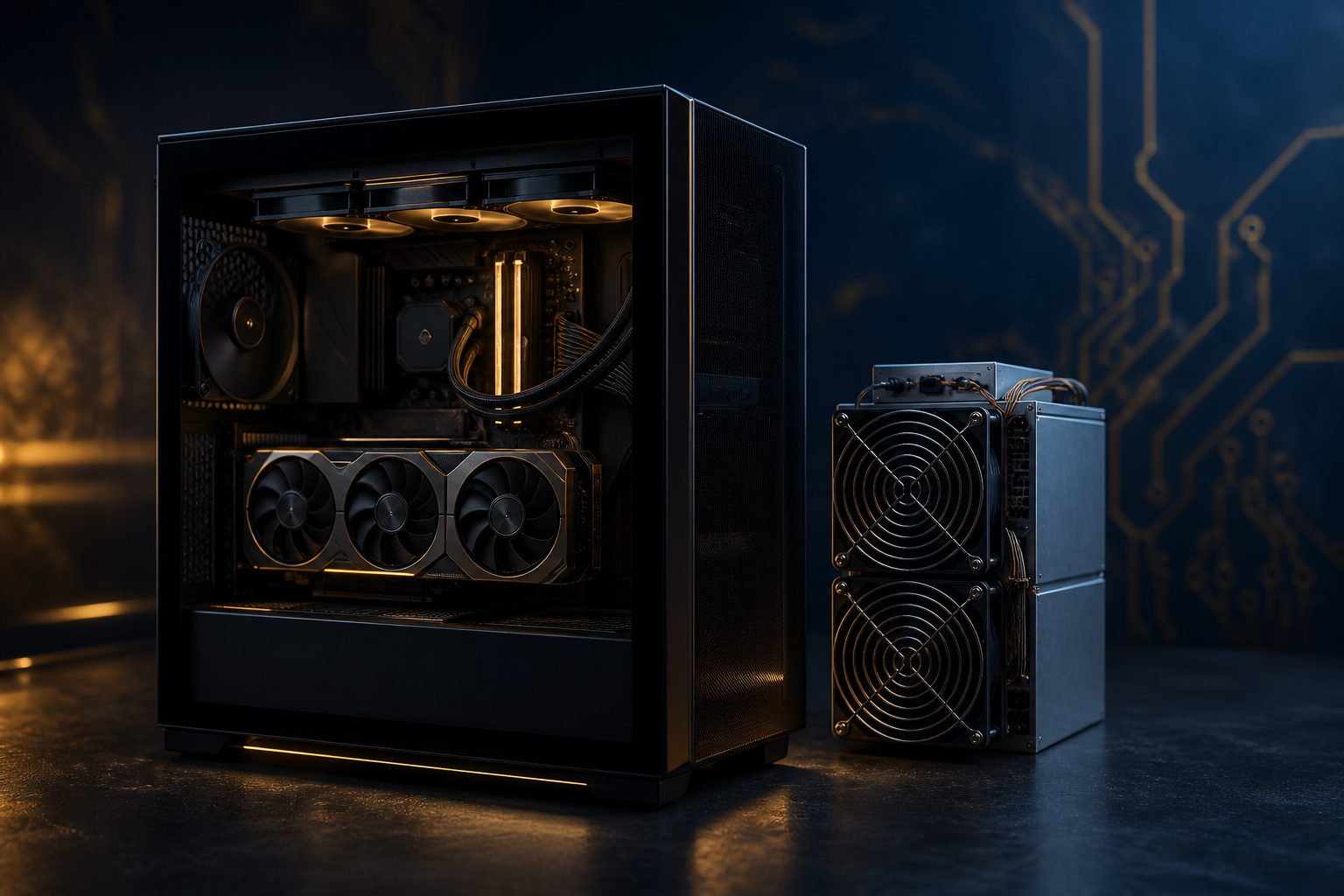
Can a gaming PC mine bitcoins? Yes, it can participate in Bitcoin mining, but in most cases it is not an effective setup for direct Bitcoin mining. The real issue is not whether the machine can run mining software, but whether it can compete in a network built around specialized hardware.
Think of mining as a nonstop bookkeeping race
Bitcoin mining makes more sense when you picture it as an open race to update a shared ledger. Miners gather pending transactions into a candidate block, then keep running hash calculations in search of a result that meets the network’s current rules. If one miner finds a valid result first, that block can be broadcast to the network for verification.
By that standard, a gaming PC can mine bitcoins in the most basic sense. It can run software, perform computations, and connect to a pool. That part is true. What changes the answer is scale and efficiency. Bitcoin mining is not a casual computing task. It is a competition based on sustained hash power, power consumption, cooling, uptime, and hardware design.
A gaming PC is built for flexible performance. It has to handle games, media work, general apps, and everyday use. A Bitcoin miner is built for one narrow purpose: carrying out Bitcoin hashing as efficiently as possible. That difference shapes everything else.
What Bitcoin mining is actually doing
Mining is often described as “solving math problems,” but that shorthand leaves out the part that matters. Miners are not answering open-ended questions. They are repeatedly hashing block data while adjusting certain inputs until they find a hash that satisfies the network difficulty target. The process depends on repeated attempts, not insight or clever shortcuts.
Bitcoin is designed so that new blocks are produced at a fairly steady pace, about every 10 minutes. The network adjusts difficulty in response to changes in total mining power, which keeps block production from speeding up too much when more miners join. That means a faster or more efficient machine has a better chance of contributing, but the system itself keeps raising or lowering the bar to maintain the schedule.
The broader supply rules are fixed in the protocol. Bitcoin’s maximum supply is 2100 million? No, that would be incorrect.
Bitcoin’s maximum supply is 2100万枚? That would break the language rule for English. So the correct statement is this: Bitcoin has a maximum supply of 21 million coins. The block subsidy is reduced roughly every 210,000 blocks, which works out to about every 4 years. The halving years so far include 2012, 2016, 2020, and 2024.
Those details matter because they show why direct Bitcoin mining is not a simple matter of installing software on whatever PC you already own. The network is structured around long-term competition.
Why a gaming PC usually falls short for direct Bitcoin mining
People often assume that a powerful graphics card should make a gaming PC a strong Bitcoin miner. That sounds reasonable at first, but Bitcoin mining has long moved toward specialized machines designed around this exact workload. A gaming rig may be fast in general computing terms, yet still be poorly matched for the specific job Bitcoin mining requires.
There are several practical reasons.
- Purpose-built hardware wins: A gaming PC is a general-purpose system. Bitcoin mining hardware is designed around one task only.
- Power efficiency matters: Mining is continuous. A machine that draws more electricity for less useful work is at a clear disadvantage.
- Cooling becomes a daily problem: Playing games pushes a PC hard for stretches of time. Mining can keep it under heavy load for much longer, which changes the thermal picture.
- Wear and maintenance add up: Fans, dust buildup, power delivery, and overall system stability become more important when the machine is running hard on a regular basis.
A useful comparison is motorsport. A strong road car can drive on a race track, and it may even feel fast. That does not mean it can keep up with a vehicle designed only for racing. A gaming PC sits in a similar position when it enters direct Bitcoin mining.
What people often mean when they ask this question
Many searchers who type can a gaming pc mine bitcoins are not only asking about direct mining. Some want to know whether their current hardware has any path into the Bitcoin ecosystem. Others are really asking if they can earn Bitcoin with a PC they already own. Those are related questions, but they are not the same.
The first path is direct Bitcoin mining. In that case, your machine is taking part in the Bitcoin network’s own mining process. A gaming PC can technically do this, but it usually does not have the right efficiency profile to make it a sensible long-term choice.
The second path is pool mining. A mining pool combines the work of many participants. If the pool finds a block, rewards are distributed according to the pool’s rules. Joining a pool can reduce the all-or-nothing feel of mining alone, but it does not change your hardware’s underlying efficiency. Pooling changes variance, not capability.
The third path is mining something else and later converting the proceeds into Bitcoin. This is where many beginners get confused. They may say they are “mining Bitcoin with a gaming PC,” when what they are really doing is using a PC for another asset and then swapping the result into BTC afterward. That route is different from direct Bitcoin mining and should not be treated as the same thing.
If your goal is education, a gaming PC may still be useful. It can help you learn how wallets, mining software, pools, and payouts work. If your goal is efficient direct Bitcoin mining, the answer is usually no.
Costs are about more than the graphics card
New miners often focus on the visible parts of the machine. They ask whether the GPU is strong enough or whether the CPU is fast enough. For Bitcoin mining, those questions are only part of the picture. The more important issue is the full cost of running the system over time.
Electricity comes first. Mining is not like launching a benchmark for a short test. It is closer to a long-duration workload, and power costs directly shape whether the exercise makes any sense at all.
Heat and noise matter too. A gaming PC under heavy gaming load is already noticeable. Under mining conditions, that stress can become more constant. In a bedroom, office, or shared home environment, that can become annoying very quickly.
Then there is hardware wear. Mining does not magically destroy a computer on day one, but sustained high load can expose weak cooling, low-quality power supplies, poor airflow, or neglected maintenance. Dust, fan wear, and thermal management all matter more when the machine is pushed for extended periods.
There is also opportunity cost. If the same PC is your gaming machine, editing workstation, or development system, every hour spent mining is time when that hardware is tied up or running hotter and louder than you might want. For many people, that hidden cost is more real than any theory about output.
If you want to try it anyway, start with the right expectations
There is nothing wrong with experimenting for learning purposes. In fact, using a gaming PC as a hands-on way to understand how mining works can be worthwhile. The key is to approach it as a technical exercise first, not as an assumption that the setup will be competitive.
- Define your goal: Are you learning how Bitcoin mining works, or are you trying to build an efficient mining setup? Those lead to very different choices.
- Set up a wallet you control: Understand private key storage, backup practices, and payout addresses before you connect any mining software.
- Read pool rules carefully: Check payout terms, fee structure, account requirements, and supported hardware.
- Watch cooling and power delivery: Make sure your case airflow, fans, and power supply are ready for sustained load.
- Use trusted software sources: Avoid random downloads, fake mining tools, or cracked packages. Security mistakes are often a bigger risk than poor mining performance.
- Test for a short period first: Monitor temperatures, system stability, and noise before deciding whether to continue.
One point deserves extra emphasis. Do not disable system protections or grant broad permissions to unknown mining software just because a setup guide tells you to. When beginners run into trouble, malware and wallet theft are often more immediate dangers than low hash efficiency.
FAQ
Can you mine Bitcoin with a gaming PC at home?
Yes, a gaming PC can participate in Bitcoin mining at home, but that does not mean it is well suited for direct Bitcoin mining. In practice, specialized mining hardware usually has a major advantage.
Does a powerful GPU make Bitcoin mining practical?
A strong GPU can still help you learn mining basics, software setup, and pool connections. That said, direct Bitcoin mining is a different question, and a powerful gaming GPU does not usually make a home PC competitive there.
Will joining a mining pool fix the hardware problem?
A pool can smooth out results because many participants work together and share payouts based on the pool’s rules. It does not change the fact that a gaming PC is generally less efficient for direct Bitcoin mining than purpose-built hardware.
Can mining damage a gaming PC?
Mining does not automatically ruin a system, but long periods of heavy load can increase heat, fan wear, dust problems, and stress on power delivery. The risk rises if cooling is poor or maintenance is ignored.
Why do people still ask this if gaming PCs are not ideal for Bitcoin mining?
Because it is a reasonable beginner question. People want to know whether the computer they already own can help them learn the process, take part in a pool, or connect in some way to Bitcoin without buying dedicated equipment first.
If you plan to test mining on a gaming PC, check temperatures, airflow, and power stability before anything else. After that, use a wallet you control and only install software from trusted sources. Those steps will not make the setup competitive, but they can keep the experiment safer and more useful.
Disclaimer: This article is for informational and educational purposes only and is not investment, financial, or legal advice. Crypto assets are highly volatile and you could lose your entire investment. Do your own research and decide carefully.