
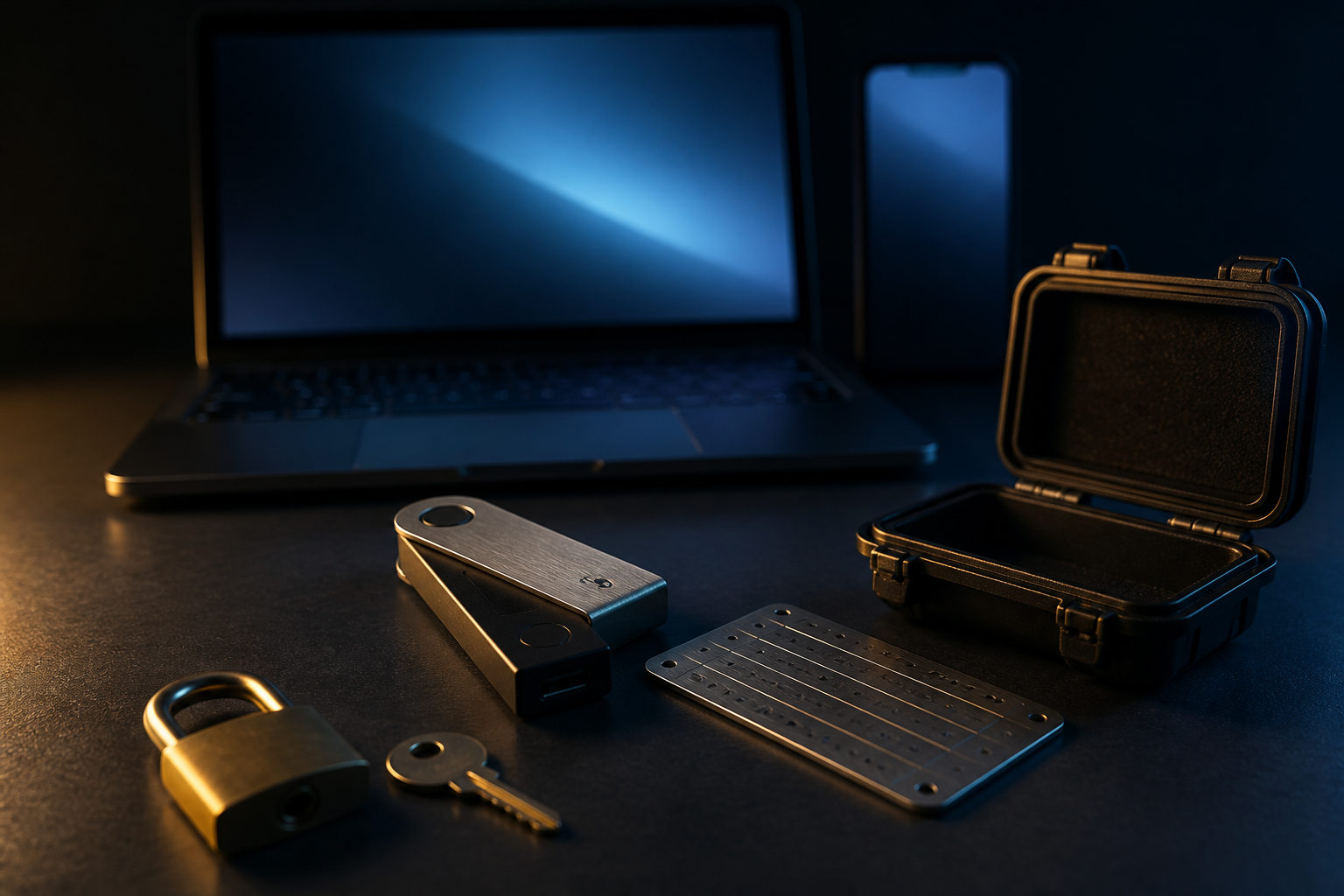
To protect your bitcoin, focus on key control, backups, and transaction habits. If your private keys and recovery words stay safe, your coins are usually still under your control.
What you are actually protecting
People often say they want to protect a bitcoin account, but the deeper issue is control over private keys, seed phrases, and signing authority. Since Bitcoin started with the genesis block on 2009-01-03, ownership has worked through cryptographic control: the party that can produce a valid signature can move the coins tied to that address.
That makes bitcoin security different from a normal web login. If you forget a shopping password, a company may let you reset it. With self-custody, losing the recovery phrase can mean losing access for good, and exposing it can let someone else spend your funds.
| Item | Purpose | Main risk |
|---|---|---|
| Seed phrase | Wallet recovery | Loss can lock you out; exposure can lead to theft |
| Private key | Signs transactions | Anyone with it can control the related coins |
| Device passcode | Blocks direct access to the device | A stolen device becomes easier to inspect |
| Transaction checks | Prevent address or amount mistakes | Bitcoin transfers are usually not reversible |
A practical way to think about this is to separate recovery power from everyday spending. Keep small working balances in a hot wallet, and store long-term holdings in a setup you touch less often. That one decision cuts a large share of avoidable risk.
Choose wallet security by use case
There is no single best wallet for every person. A trader, a casual spender, and a long-term holder face different trade-offs, so good protection starts with matching the tool to the job.
| Setup | Best for | Strength | Main weakness |
|---|---|---|---|
| Exchange custody | Beginners and frequent traders | Convenient access | Platform risk, account restrictions, phishing pages |
| Mobile or desktop hot wallet | Small balances and daily payments | Fast and easy to use | Malware, fake apps, stolen devices |
| Hardware wallet | Medium- to long-term holding | Keys usually stay away from direct internet exposure | Bad purchase sources, tampered setup process |
| Multisig | Family funds or shared treasury | One mistake does not instantly drain everything | More planning and more demanding recovery |
If you hold bitcoin for different reasons, split it into layers. A spending wallet can stay convenient. Savings can stay harder to reach. Shared funds can use multisig so one person or one device does not have full unilateral control.
It also helps to understand units before sending anything. One satoshi equals 0.00000001 BTC, so a wallet showing many decimal places is normal. Some mistakes happen because the sender reads satoshis as bitcoin or misses the displayed unit entirely.
Many losses happen off-chain, not inside Bitcoin itself
Bitcoin did not become valuable by offering a customer-service undo button. Blocks are produced about every 10 minutes, transactions are verified by the network, and finality is part of the design. Security failures for ordinary users usually come from phishing, fake software, social engineering, copied addresses, or careless signing.
- Use one trusted download path. Wallet apps, browser extensions, and companion tools should come from official sources. Random files from chat groups or copied pages are a common trap.
- Initialize devices yourself. A hardware wallet should create recovery information in your possession. If a device arrives with a seed phrase already written down, treat it as compromised.
- Verify every destination address. Clipboard hijacking malware can replace an address after you copy it. Check the first part, the last part, and the confirmation screen before you approve.
- Avoid screen sharing during sensitive actions. Recovery phrases, private keys, and signing prompts should never appear in a remote support session.
- Test large transfers with a small amount first. This confirms the address, wallet compatibility, and recipient instructions before the main transfer is sent.
Search behavior creates another weak point. People often type wallet names, support terms, or recovery tools into a search engine and assume the top result is legitimate. Criminals know that habit well. A polished fake page only needs one successful login or one exposed seed phrase.
Backups matter, but recovery readiness matters too
Writing down a seed phrase is only the first half of backup practice. You also need a storage method that does not create new exposure, and you need confidence that the backup can really restore access later.
| Backup method | Recommended | Why |
|---|---|---|
| Handwritten offline copy | Yes | Less exposed to syncing, scanning, and app access |
| Separate copies in different locations | Yes | Reduces single-point loss from fire, damage, or misplacement |
| Photo in phone gallery | No | Can be synced, indexed, backed up, or leaked by the device |
| Emailing the phrase to yourself | No | An email breach exposes the full recovery secret |
| Never checking the recovery record | No | You may discover spelling or order errors only when it is too late |
A recovery check does not mean moving your long-term holdings around again and again. It means confirming that the words are complete, in the right order, legible, and stored where you can reach them in an emergency. Careless “testing” can create more exposure than protection.
For shared funds, multisig can be useful because it reduces dependence on one person or one device. The benefit is operational, not cosmetic. If you choose it, document who holds each signing device, what the approval rule is, and how recovery works if one signer is unavailable.
Bitcoin’s fixed supply rules are part of the reason long-term holders take key management seriously. The total cap is 21,000,000 BTC, issuance falls every 210,000 blocks, and the current block subsidy is 3.125 BTC after the 2024-04-19 halving. Those numbers do not tell you how to store coins, but they explain why a simple backup mistake can have permanent consequences.
FAQ
Is it safe to keep bitcoin on an exchange
It can be acceptable for trading balances or small amounts you need often. For larger long-term holdings, exchange custody adds platform risk because you do not fully control the signing keys.
Where should I store my seed phrase
Offline storage is the usual starting point, and keeping copies in separate secure locations helps with physical loss. What matters most is avoiding cloud backups, photo galleries, chat apps, and any service that can silently copy the phrase elsewhere.
Is a hardware wallet always better than a phone wallet
For long-term storage, it usually provides stronger isolation because signing is kept away from everyday internet use. That advantage disappears quickly if the device was bought from a bad source or if you store the recovery phrase in a phone photo album.
What should I double-check before sending bitcoin
Check the destination address, the amount, and the displayed unit on the signing screen. For an important transfer, send a small test first and confirm receipt before sending the rest.
What if my computer may have malware
Stop entering sensitive information on that machine right away. Move to a trusted device for any wallet action, then review whether your hot wallet, browser extensions, or local files could have been exposed.
Start with actions you can finish today: separate spending funds from savings, review where your recovery words live, remove any backup stored in cloud-connected apps, and make “small test first” your standard rule for larger bitcoin transfers.