
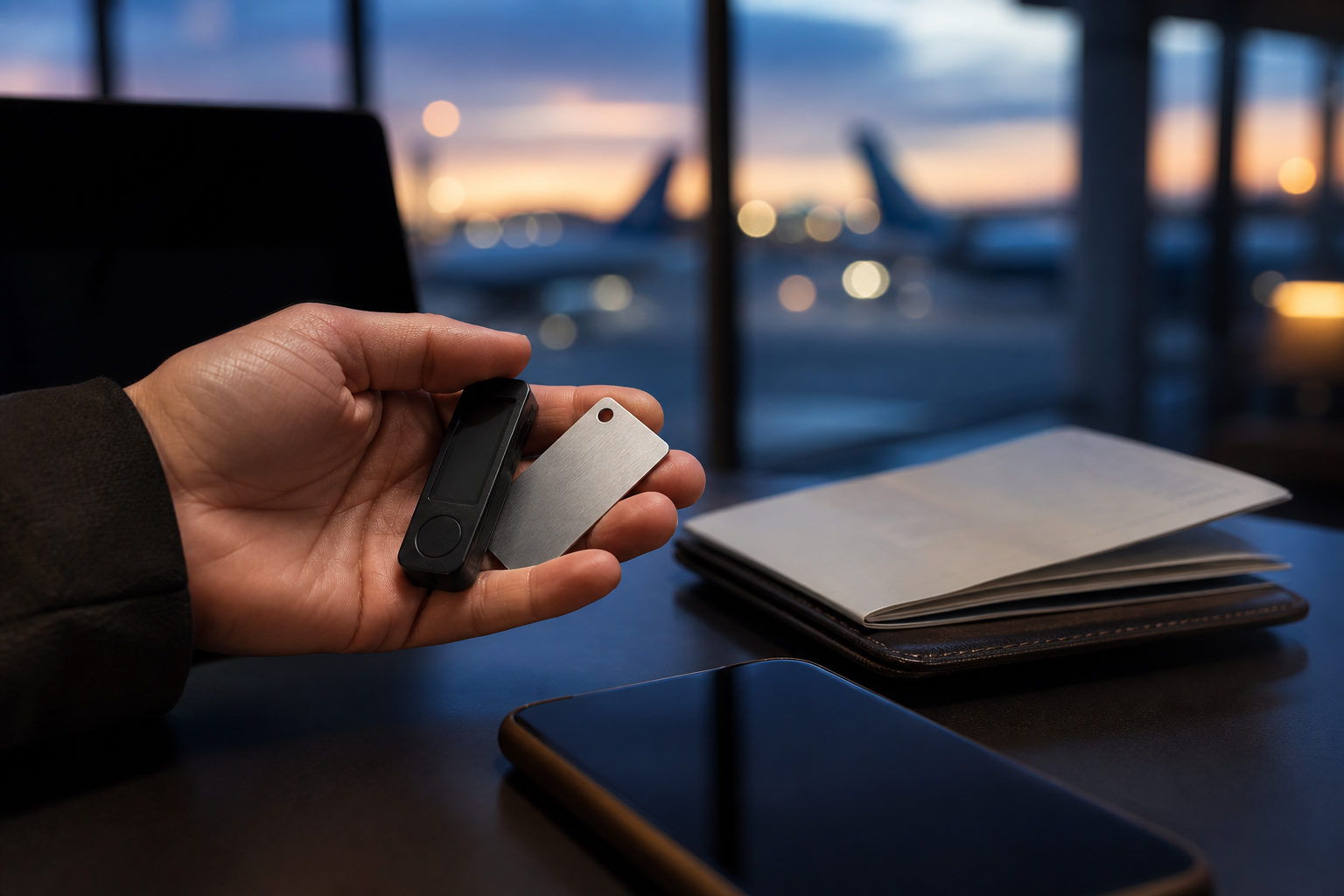
Yes, Bitcoin is portable, but what travels is not a coin stored on your phone. What you carry is the ability to control coins on the network through private keys or recovery words.
What “portable” means in Bitcoin
Bitcoin does not sit inside one device waiting to be physically moved. The balance exists on the Bitcoin network, and access depends on whoever can produce a valid signature.
That changes the meaning of portability. If your phone breaks, the Bitcoin is not automatically gone. Portability comes from the fact that control can be restored on another device, as long as the private key or seed phrase has been preserved correctly.
This is also why Bitcoin can be portable across borders in a way that physical valuables are not. A traveler does not need to move metal bars, paper notes, or a hard drive full of account records. The critical element is the recovery information and the ability to use it safely when needed.
Bitcoin is divisible down to 1 satoshi, which equals 0.00000001 BTC. That matters here because portability includes the ability to carry very small or very large amounts without changing the physical burden.
Where Bitcoin portability shows up in practice
| Situation | How portability appears | What it depends on |
|---|---|---|
| Replacing a phone | The wallet can be restored on the new device | An accurate seed phrase or private key backup |
| International travel | No need to transport physical cash or bullion | Internet access and a usable wallet environment |
| Using multiple devices | The same holdings can be viewed or managed elsewhere | Careful handling of credentials and permissions |
| Long-term storage | Access does not rely on one machine surviving forever | Durable offline backup |
| Emergency migration | Control can be moved to a fresh wallet setup | Either the old wallet still works or the backup can restore it |
Restoring a wallet is not the same as copying coins from one place to another; it is regaining the power to spend outputs that already exist on the chain.
Someone crossing a border can carry access to Bitcoin without transporting a visible store of value. That does not mean every transfer is frictionless. Network availability, wallet support, fee conditions, and the ability to sign securely all affect whether the portable asset is also convenient at that moment.
Different ways to “carry” Bitcoin
| Method | Portability | Main risk focus | Best fit |
|---|---|---|---|
| Mobile wallet | Very high | Device loss, malware, unsafe backups | Daily spending and smaller balances |
| Desktop wallet | Moderate | Computer security and file backup | Users who operate from one regular workstation |
| Hardware wallet | High | Device authenticity, recovery phrase storage, setup mistakes | People who want key isolation |
| Paper or metal backup | Depends on storage method | Fire, water, theft, readability, exposure to others | Long-term recovery storage |
A mobile wallet feels the most portable because it is always within reach. The trade-off is greater exposure because the same phone may also be used for messaging, browsing, downloads, and QR scanning.
A hardware wallet aims to keep private keys on a dedicated device and signs transactions there instead of exposing the key to a general-purpose computer or phone. That makes Bitcoin portable in a more controlled way, even if carrying a separate device is less convenient.
Paper and metal backups often hold the deepest layer of portability. If a wallet app disappears, a phone dies, or a hardware wallet stops working, the backup is what allows the owner to restore control somewhere else.
Portable does not mean effortless or risk-free
Bitcoin portability answers one question: can control move with you? It does not answer another: will that control remain secure the whole time? A person can make Bitcoin easy to carry and easy to steal at the same time if recovery words are stored carelessly.
| Item | What it really is | If it is lost or compromised |
|---|---|---|
| Wallet app | An interface for managing keys and transactions | Usually replaceable |
| Phone or computer | The device running the wallet | Replaceable, not the asset itself |
| Private key or seed phrase | The actual control mechanism | Loss can lock you out; exposure can let others spend funds |
| Blockchain record | The shared ledger of balances and transactions | It does not vanish because you switched devices |
Many beginners confuse account access with Bitcoin control. If coins sit on a custodial platform, what feels portable may simply be the platform account, not self-managed ownership on the chain. You may be able to log in from many places, yet still depend on a third party for withdrawals, policy checks, or access recovery.
Another practical limit is transaction timing. Bitcoin targets roughly 10 minutes per block, so moving value is not like dragging a file from one folder to another. You can broadcast a transaction quickly, but when it gets included and when the receiver treats it as final depends on network conditions and fee competition.
Bitcoin has a hard cap of 21,000,000 BTC, to be fully issued around 2140. That does not make it portable by itself, but it helps explain why no single institution has to reissue or re-register your units when you move. The network maintains the record, while you maintain access.
What reduces Bitcoin portability in real life
- Bad backups: a missing word, wrong order, or unreadable copy can make recovery fail.
- Single-device dependence: if one phone holds everything and there is no separate backup, portability disappears with the phone.
- Unsafe recovery environments: entering seed words on an untrusted device can expose control immediately.
- Custodial confusion: users may assume exchange balances are as portable as self-custodied Bitcoin, then discover platform rules shape access.
- No inheritance or handoff plan: an asset can be portable for the owner but unreachable for family or partners in an emergency.
Because Bitcoin is digital, people assume portability is automatic. It is not. Portability has to be designed through backup habits, wallet choice, and clear separation between everyday spending tools and long-term recovery material.
The current block reward is 3.125 BTC after the 2024-04-19 halving. The reward halves every 210,000 blocks, roughly every 4 years, and the next halving is expected around 2028. Those facts do not tell you whether Bitcoin is easy to carry in a backpack; they do show that the system is defined by protocol rules rather than by a vault physically shipping units from one place to another.
FAQ
Can Bitcoin be copied from one device to another like a file?
Not in the literal sense. What can be copied or restored is wallet data, a private key, or seed words, while the coins remain recorded on the blockchain.
If I memorize my seed phrase, am I carrying my Bitcoin with me?
In a control sense, yes, because the phrase can restore the wallet. The problem is that memory can fail, and entering the phrase in the wrong place can expose everything.
For most people, memory alone is not a strong recovery plan. An offline backup is usually safer.
Is Bitcoin on an exchange portable too?
It can feel portable because you can access the account from different devices. That convenience is account portability, which is different from holding your own keys.
If the platform controls withdrawals or account recovery, then your ability to move the asset depends on its rules and systems.
Is a hardware wallet always more portable than a phone wallet?
No. A phone wallet is often easier for frequent payments and quick checks. A hardware wallet is stronger when your goal is to keep signing separate from an internet-connected device.
The better option depends on what you mean by portable: fastest to use, or safer to carry over time.
Can I rely on Bitcoin portability while traveling abroad?
Yes, but only if the setup has been tested before the trip. You still need trusted devices, network access, and a recovery process you can execute without improvising under stress.
A portable asset becomes much less useful when the owner has never verified the backup or practiced restoration.
If you want Bitcoin to be portable in a way that actually helps you, start by checking whether your backup works, whether it exists outside a single device, and whether you can recover safely on new hardware. Without that, portability is only a slogan.