
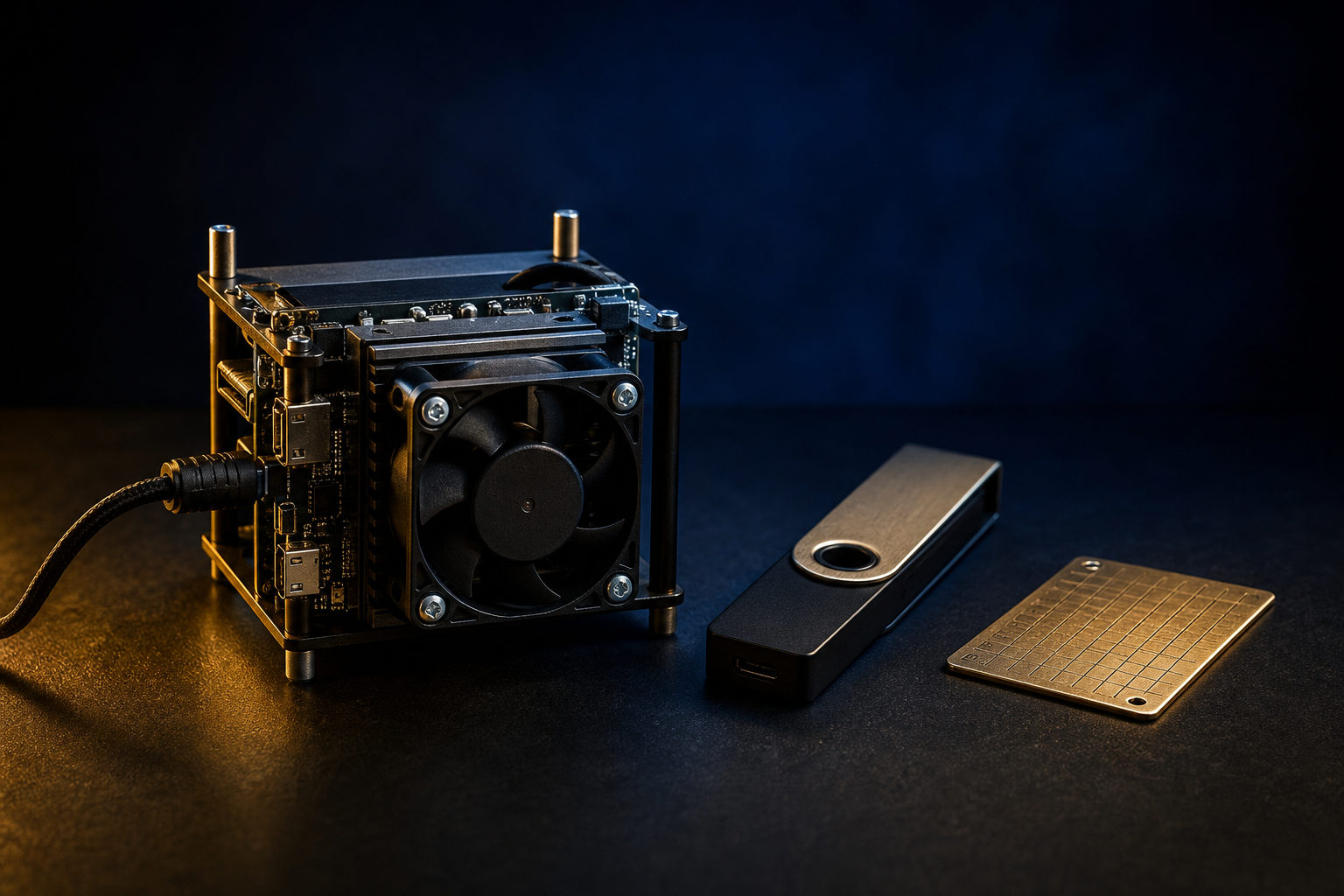
Does Bitaxe Gamma 602 store bitcoin? In most setups, no. The device may help you mine, but control over bitcoin depends on the private keys tied to the payout address, not on the miner itself.
This is where many beginners get tripped up. They see a mining dashboard, a pool balance, or a device settings page and assume the bitcoin is somehow sitting inside the machine. That is not how Bitcoin ownership works. Bitcoin is recorded on the blockchain, while wallets, apps, and devices deal with keys, signatures, and account access.
Put this warning first: if you enter the wrong payout address, send funds to an address you do not control, or expose your recovery phrase, the damage may be permanent. Bitcoin transactions are generally not reversible after confirmation.
What Bitaxe Gamma 602 does, and what it does not do
Bitaxe Gamma 602 is discussed as mining hardware, not as a custody product. Its job is tied to mining activity: running work, talking to a pool when used that way, and directing rewards based on your configuration.
That means the better question is not just whether Bitaxe Gamma 602 stores bitcoin. The better question is: where does the payout go, who created that receiving address, and who controls the private key for that address?
If the device only asks you for a payout address, that usually means it is directing proceeds to that address. If it does not generate and protect your private keys, then it should not be treated as your main bitcoin storage tool.
- A miner can be the source of mining rewards without being the place where you custody bitcoin.
- A pool account can show earnings without giving you direct self-custody.
- A wallet can display a balance, but what matters is whether you control the keys and can recover them.
That distinction matters because people often confuse visible balance with actual control. Seeing funds on a screen is not the same as holding the keys needed to spend them.
Bitcoin is not stored like a file inside one machine
Strictly speaking, bitcoin is not stored inside a miner the way a document is stored on a drive. The blockchain tracks which addresses hold bitcoin. A wallet manages the private keys that allow spending from those addresses. Some tools also help you view balances and create transactions, but ownership comes back to key control.
So when someone asks whether Bitaxe Gamma 602 stores bitcoin, the practical test is simple. Does it create your private key? Does it keep that key secure for you? Does it sign outgoing transactions on your behalf? Or does it only use a payout address that you supplied from another wallet?
In many real-world setups, the miner is not the final point of custody. It is part of the path that leads rewards to a destination you chose earlier. If the destination is your own wallet, your control depends on that wallet backup. If the destination is a platform account, your control depends on the platform's custody model and withdrawal process.
This is why experienced users keep repeating the same rule: whoever controls the private keys controls the bitcoin.
Where confusion usually happens in practice
Most mistakes come from mixing up three separate layers: miner settings, pool accounting, and wallet custody. Once you separate them, the answer becomes much clearer.
Miner settings: this is usually about routing payouts
When setting up Bitaxe Gamma 602, you may enter pool details, worker information, and a receiving address. The critical issue here is not whether the settings page looks like a wallet. The issue is whether the payout address belongs to a wallet you actually control.
If you copied the address from your own wallet, and you have the recovery phrase or private key stored safely, that is a good start. If you copied it from a message, a screenshot, an exchange deposit page you barely understand, or someone else sent it to you, then you are taking on avoidable risk.
The device will generally use what you entered. It will not verify that you truly control that address.
Pool balances: a dashboard is not the same as self-custody
A mining pool may show unpaid balance, pending rewards, or credited earnings. That can make it look as if the bitcoin is already in your possession. In reality, those numbers may be internal records until the pool pays out to an address you control.
If the funds remain within a hosted account, you are still relying on that service. You may have login access, but login access is not the same thing as holding private keys. If the service freezes withdrawals, changes account requirements, or you lose access to the account, your control is limited.
Wallet receipt: this is where ownership becomes real
The cleanest setup is usually to direct mining rewards to a wallet where you control the recovery phrase or private keys. That could be a hardware wallet or a software wallet you set up and backed up properly. The format matters less than the control model.
A simple test helps here: if your phone breaks, your computer fails, or the app disappears, can you recover the wallet from your backup? If yes, your custody is stronger. If no, you may only have convenience, not real control.
Private key responsibility: follow the control chain
If you want to know whether Bitaxe Gamma 602 is storing bitcoin in any meaningful sense, do not start with marketing language. Start with the control chain. Ask these questions one by one.
- Who generated the receiving address? If it came from your own wallet, the chain of responsibility is easier to understand. If it came from an exchange or another service, you need to know that custody model first.
- Who holds the recovery phrase or private key? If the answer is not you, then you do not have full self-custody.
- Where are transactions signed? If spending later requires your own wallet to sign, then the miner is not the thing securing your bitcoin.
- What happens if the device fails? If you can restore access using your wallet backup, then the wallet backup matters more than the miner. If you cannot explain the recovery path, that is a danger sign.
This way of thinking is more useful than asking whether the machine “stores” bitcoin in a casual sense. Many losses do not come from sophisticated attacks. They come from ordinary mistakes: wrong address, weak backup, no recovery plan, or false confidence in a platform account.
Another irreversible warning: if someone gets your recovery phrase or private key, they may be able to move your bitcoin. If you lose that information and have no backup, you may lose access yourself. Both outcomes are hard to fix.
A practical checklist before you run the device
If your goal is to mine with Bitaxe Gamma 602 safely, the best move is to set up the payout path before you focus on uptime or hashrate screens. Use this checklist as a working routine.
- Create or choose your wallet first. Do not paste in a receiving address just because it is available.
- Confirm who controls the keys. Make sure the payout address belongs to a wallet whose recovery phrase or private key is under your control.
- Copy the address from the wallet itself. Avoid using addresses from chat messages, screenshots, or old notes.
- Do not confuse an exchange deposit address with self-custody. A deposit address may receive funds, but it does not automatically mean you control the keys.
- Back up the recovery phrase offline. Do not keep sensitive recovery information in cloud storage, messaging apps, or other connected services.
- Record your settings before changing anything. If you reset the device, change firmware, or reconfigure the pool, your payout details may be overwritten.
- Verify with a small test workflow first. Make sure the pool recognizes your setup and the destination wallet can receive as expected before you leave the system running.
- Treat address changes as high-risk actions. Every time you edit payout details, check them as carefully as you would on day one.
That may sound basic, but basic mistakes are exactly what cause many avoidable losses. People often spend their energy on cooling, connectivity, and performance screens while paying too little attention to where the rewards are actually going.
FAQ
Does mined bitcoin stay inside Bitaxe Gamma 602?
Usually, no. In most setups, rewards are routed to a payout address or reflected first in pool records, while the device itself is not the main place of custody.
If I can log in to the mining pool, do I fully own the bitcoin there?
Not by itself. Account access and key ownership are different things, so you still need to confirm that payouts reach a wallet whose private keys you control.
Can I use an exchange deposit address as the payout address?
Some people do, but that means relying on a third-party custody model. If you want stronger control and clearer recovery, sending rewards to your own wallet is usually the safer route.
If the device breaks, do I lose my bitcoin?
That depends on where the private keys are. If the rewards were sent to a wallet you can restore from your backup, a broken miner does not mean lost bitcoin.
How can I tell whether I really hold the bitcoin myself?
The clearest test is whether you control the recovery phrase or private key for the receiving address and can restore the wallet when needed. A visible balance without recoverable key control is not full custody.
Before you spend time tuning Bitaxe Gamma 602, finish these four jobs first: choose the receiving wallet, verify the payout address, back up the recovery phrase, and understand the recovery path. If those pieces are in place, many irreversible mistakes can be avoided before mining even starts.
Disclaimer: This article is for informational and educational purposes only and is not investment, financial, or legal advice. Crypto assets are highly volatile and you could lose your entire investment. Do your own research and decide carefully.