
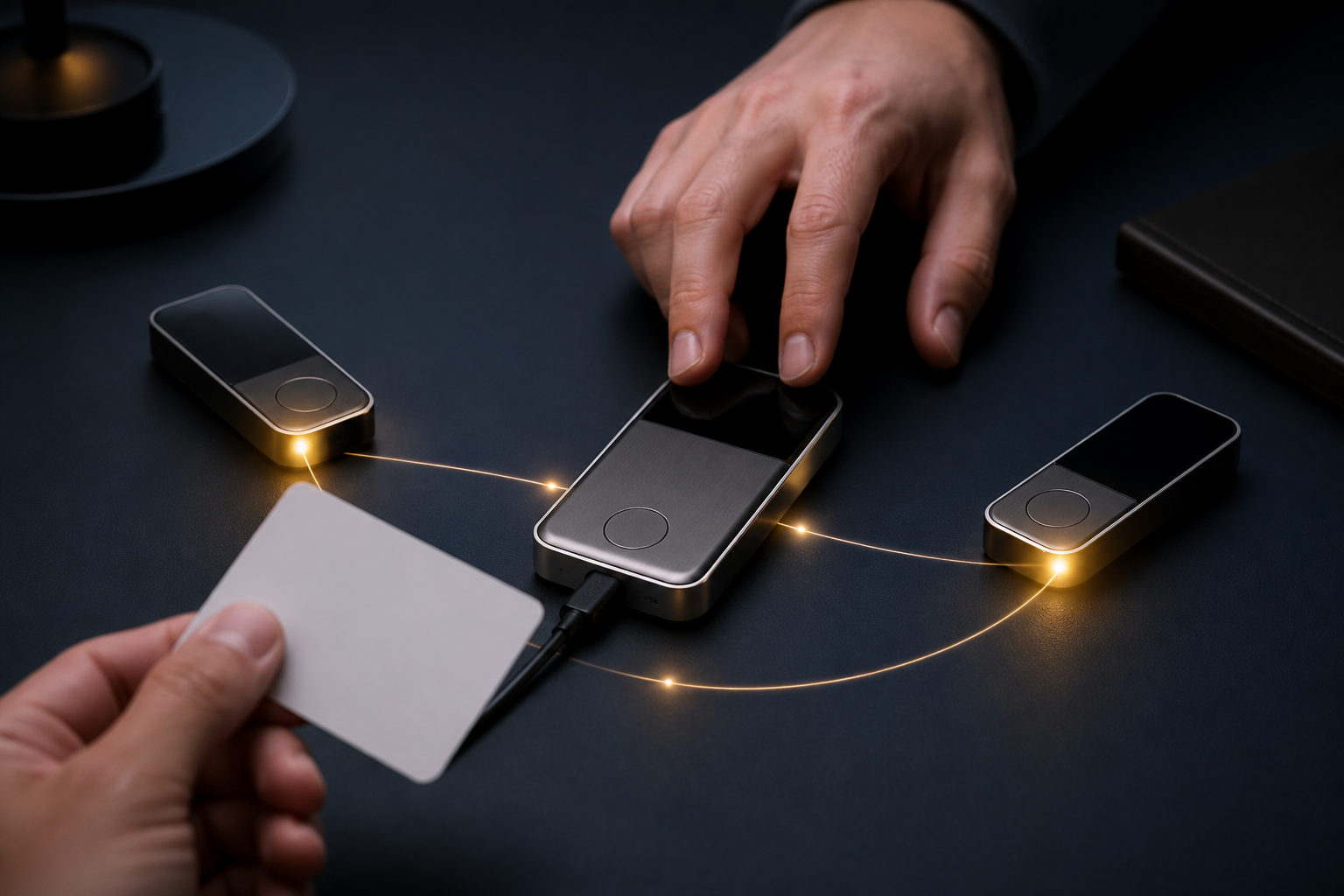
To use Bitcoin multisig, you create a wallet that needs several keys to approve spending, then you test receiving, signing, recovery, and address checks before storing meaningful funds.
What multisig changes compared with a normal Bitcoin wallet
A standard Bitcoin wallet usually depends on one private key for spending. If that key is exposed, stolen, or mishandled, the coins controlled by that wallet can be spent. A multisig wallet replaces that single point of failure with a shared approval rule, where spending needs signatures from several keys according to the setup you chose.
That matters because security problems in Bitcoin are often operational before they are technical. Phones get replaced, laptops get infected, backups get mixed together, and people approve transactions too quickly. Multisig does not remove human error, but it can limit the damage from one bad device or one compromised backup.
For an individual, multisig is often about long-term storage and error tolerance. For a family, it can support shared control. For a team or treasury, it can separate roles so that one person creates a transaction while others review and sign it. The value is not complexity for its own sake; the value is distributing control.
| Wallet type | Spending authority | Typical fit | Main weakness |
|---|---|---|---|
| Single-signature wallet | One private key can spend | Frequent small payments | One leak may expose the whole balance |
| Multisig wallet | Several keys must approve | Long-term storage, shared control | More setup, more backup discipline |
Bitcoin itself keeps running the same way in either case. The network still targets about one block every 10 minutes. Multisig changes who is allowed to authorize a transaction, not how blocks are produced or how supply works.
Plan the structure before you create anything
The safest multisig setup starts on paper, not on a screen. You need to decide who holds keys, where each key is stored, where backups live, who creates transactions, who verifies details, and how recovery works if a device fails or a participant is unavailable. If you skip that planning stage, you may end up with a wallet that looks distributed but is still vulnerable because everything important is concentrated in one place.
Many beginners focus only on seed phrases. That is too narrow for multisig. Recovery may also depend on wallet configuration details, shared public information, script policy, derivation details, or a wallet descriptor. If you keep only fragments, future recovery can become confusing even when you still have the keys.
Think in terms of failure paths. What happens if one device is lost? What happens if one backup is destroyed? What happens if one participant disappears? A good multisig design still lets legitimate owners recover and spend without relying on luck or memory.
| Planning item | Why it matters | What to watch for |
|---|---|---|
| Who holds keys | Defines real control | Avoid one person quietly holding every key |
| Storage locations | Reduces single-location risk | Do not keep a device and its backup together |
| Recovery records | Needed after loss or failure | Save complete information, not partial notes |
| Signing workflow | Prevents rushed mistakes | Set roles before the first real transaction |
| Test process | Shows whether the setup actually works | Use a tiny amount first |
If this is for personal cold storage, your focus may be separation and inheritance. If this is for a business or group treasury, your focus may be review procedures and internal controls. Those are different goals, so copying another person’s setup without understanding it is risky.
How to set up and test a Bitcoin multisig wallet
Start by generating the required keys in separate, trusted environments. Separation is the point. If every key is created and stored on the same internet-connected machine, the wallet may still have a serious single-device weakness even though it is technically multisig.
After that, combine the public information needed to build the shared wallet in software that supports Bitcoin multisig. Public information is what lets the wallet recognize incoming funds and prepare unsigned transactions. Secret recovery material should stay private and should not be sent through chat apps, cloud notes, or remote support sessions.
Once the wallet is assembled, verify that the receiving addresses shown to participants really come from the shared multisig setup. This is where many scams appear. A victim is told they are using multisig, but the deposit address is actually controlled by one attacker or by a different wallet entirely. If people do not verify addresses on their own devices, they may never notice the switch.
Do not move serious funds right away. Generate a receive address, send a very small amount to it, then try spending that amount. A test is successful only when you have confirmed the full cycle: receive, build a transaction, review it, collect signatures, broadcast it, and verify that recovery materials can re-create the wallet later.
| Stage | What to do | Why it matters | Typical mistake |
|---|---|---|---|
| Key generation | Create keys in separate environments | Limits common-cause exposure | Generating every key on one device |
| Wallet assembly | Share only the needed public information | Builds the common wallet without exposing secrets | Sending private recovery material to others |
| Address verification | Check receive addresses on actual devices | Blocks address substitution scams | Trusting screenshots or forwarded text |
| Small test | Run a full receive-and-spend cycle | Finds mistakes before real funds arrive | Skipping the test and depositing long-term savings |
When testing, you do not need a large amount. Bitcoin can be divided very finely: 1 satoshi equals 0.00000001 BTC. The goal is proof of process, not the size of the trial.
How to receive, spend, and back up funds without creating new risks
Receiving funds sounds simple, but address verification is one of the most important habits in Bitcoin. Malware can swap copied addresses, and social engineering can push people to trust a message instead of the device in front of them. In a multisig workflow, each relevant participant should confirm the receive address independently whenever practical.
Spending should be split into clear roles. One person can create the transaction, then the other key holders review the destination address, amount, fee choice, and change output before signing. The change output matters a lot. New users often inspect the payment address and amount, then ignore where the remainder goes. If the change output points to the wrong wallet, most of the money can be misdirected even when the payment amount looked correct.
Backups need the same level of care. Secret material used for signing and the records needed to rebuild the wallet structure should both be preserved, but they should not all sit in one place. If everything is together, one theft or one disaster can defeat the whole design. If records are incomplete, recovery can fail even though no attacker was involved.
| Task | Good practice | Risky practice |
|---|---|---|
| Receiving | Verify the address on the device itself | Relying on copied text alone |
| Spending | Review outputs and fees before signing | Signing as soon as the amount looks right |
| Change handling | Confirm change returns to your multisig wallet | Ignoring the change destination |
| Backups | Store secrets and recovery records offline and separately | Keeping the full set in one online account |
For long-term holders, discipline matters more than speed. Bitcoin has a hard cap of 21,000,000 BTC, expected to be fully issued around 2140, and block rewards halve every 210,000 blocks. The current block reward is 3.125 BTC after the 2024-04-19 halving. Those supply rules do not protect your wallet from sloppy handling. Multisig helps only when the operating habits around it are sound.
Common scams and failure modes to avoid
One of the oldest tricks is fake assistance. Someone offers to help you build a multisig wallet and asks for your seed phrase, recovery file, or screen share session so they can “check the setup.” That request alone is enough to stop. No legitimate security process needs all of your secret recovery material in one stranger’s hands.
Another trap is fake multisig. A service may market itself as shared custody or protected storage while hiding who truly controls the keys or how recovery works. You do not need to follow a brand recommendation from anyone, but you do need to answer two questions for yourself: are the signatures made by keys you control, and can the wallet be recovered without being trapped by one provider?
Internal confusion can be just as dangerous as outside attackers. In shared custody arrangements, trouble often starts when roles are only verbal. If nobody has documented who creates transactions, who verifies them, how identity is confirmed during urgent requests, and what happens when one signer is unavailable, the group becomes easy to pressure or impersonate.
| Risk | How it appears | How to spot it | Safer response |
|---|---|---|---|
| Seed phrase harvesting | “Support” asks for full recovery data | The request includes secret material, not just public info | Stop contact and review your setup offline |
| Address replacement | Copied address changes before sending | The device display does not match the message text | Trust device verification over chat text |
| Opaque control | You cannot tell who really holds spending power | Recovery depends heavily on one service | Prefer setups that can be rebuilt independently |
| Weak group process | People sign in a rush without fixed checks | No written signing or verification routine | Define roles and approval steps in advance |
Bitcoin’s base rules are predictable. The genesis block was mined on 2009-01-03, the white paper titled Bitcoin: A Peer-to-Peer Electronic Cash System was released on 2008-10-31 under the name Satoshi Nakamoto, and the network aims for roughly one block every 10 minutes. Wallet safety is different: it depends on operational decisions made by the owner. Multisig is a tool for those decisions, not a substitute for them.
FAQ
When does multisig make sense for a personal Bitcoin wallet?
It usually makes more sense for larger long-term holdings than for everyday spending. If you want better protection against one lost device or one exposed key, and you are willing to manage more careful backups, multisig is worth considering.
Is a multisig wallet always safer than a single-key wallet?
No. It reduces single-point failure, but it does not fix careless behavior. If all keys and backups are generated, stored, or revealed in one place, the practical security gain can shrink fast.
Can I hold all the keys myself and still use multisig?
Yes, that can still add separation between devices and backups. The improvement depends on whether those keys are actually independent in creation, storage, and recovery. If they all trace back to one weak point, the benefit is limited.
Will multisig make Bitcoin transactions much slower?
Network confirmation still follows Bitcoin’s normal rhythm, with a target of about one block every 10 minutes. The extra delay usually comes from human review and collecting signatures, which is why a clear workflow matters.
Is saving seed phrases enough to recover a multisig wallet later?
Not always. You may also need the wallet’s configuration records and shared public information to rebuild the same structure. A safer approach is to preserve both the secret key material and the recovery instructions, then test that recovery path with a small amount.
If you are about to adopt Bitcoin multisig, map out where each key lives, where each backup lives, and how recovery would work if one signer vanished, then prove the plan with a tiny end-to-end test before you store long-term funds.
Disclaimer: This article is for informational and educational purposes only and is not investment, financial, or legal advice. Crypto assets are highly volatile and you could lose your entire investment. Do your own research and decide carefully.