
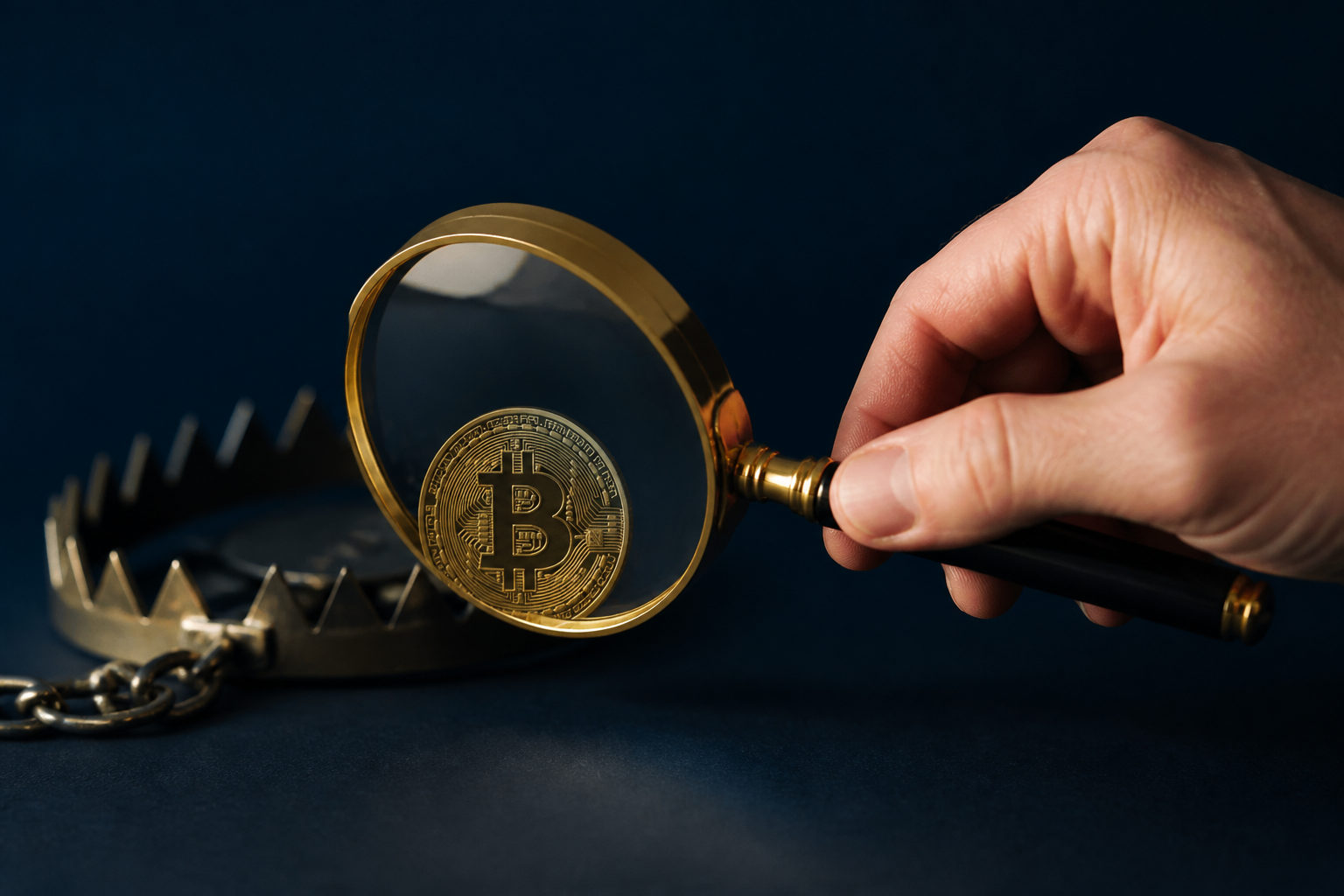
If you are asking whether Bitcoin Revolution is a scam, the safest short answer is this: treat it as highly suspicious until you can verify who runs it, how funds are handled, and whether it is pressuring you to deposit or share account access.
Bitcoin is not the same thing as “Bitcoin Revolution”
Bitcoin itself is an open blockchain network, not a branded sign-up page or a trading club. Its white paper, Bitcoin: A Peer-to-Peer Electronic Cash System, was published by Satoshi Nakamoto on 2008-10-31, and the genesis block followed on 2009-01-03. Those are public facts about the network.
“Bitcoin Revolution,” by contrast, usually refers to a marketing label attached to a website, ad funnel, chat-based sales pitch, or so-called automated trading system. The name borrows credibility from Bitcoin, then tries to move users into registration, deposits, software installs, or direct contact with a sales agent. That distinction matters, because people often blame Bitcoin for behavior that actually comes from a third-party operator using its name.
| Item | Bitcoin | “Bitcoin Revolution” style offer |
|---|---|---|
| What it is | An open blockchain network and digital asset | A branded service, page, or lead-generation system |
| Rules | Public and inspectable | Set by the operator |
| Profit claims | No built-in guarantee | Often framed as easy or automated income |
| Control of funds | Depends on your wallet or custodian | Often asks you to send money first |
| How trust is built | Protocol transparency and independent verification | Testimonials, urgency, and sales pressure |
Red flags that should stop you immediately
You do not need advanced trading knowledge to spot danger. In many cases, the warning signs are operational: pressure, secrecy, vague withdrawals, and requests for access that no legitimate service needs.
It uses fake news styling or celebrity-style endorsement
Many of these pages are designed to look like financial news or a feature story. The layout may mimic a media site, but the page keeps steering you toward one action: leave your phone number, open an account, or talk to an “advisor.”
A reliable financial service should be easy to identify. If the page has more emotional language than verifiable company details, fee disclosures, or service terms, that is a serious warning sign.
It sells “automatic profits” while hiding the risks
No real market can promise steady gains from a button click. When a platform claims the software trades for you, removes the need to learn anything, or makes losses sound remote, it is usually trying to lower your guard rather than explain the product.
Bitcoin does have transparent issuance rules, but those rules do not support income guarantees. The block reward halves every 210,000 blocks, roughly every four years. The target block interval is about ten minutes, and after the 2024-04-19 halving, the current block reward is 3.125 BTC until the next halving, expected around 2028. Those network facts are real; they do not prove that any branded platform can make you money.
It lets you “win” small before asking for more
This is a common pattern. A user sees profits on screen, or is allowed to withdraw a small amount early on. That first success creates trust, and trust creates a larger transfer later.
After that, the demands start: extra margin, tax clearance, account verification, release fees, or some other payment that must be made before withdrawal. If every payout request produces a new charge, you are likely dealing with a trap rather than a service.
It asks for remote access, codes, or account credentials
This is one of the clearest danger signals. A sales agent or “support” person may tell you they need to help you complete the process, then ask you to install remote desktop software, read out a text message code, or share your screen while logged in to banking or exchange apps.
At that point, the risk goes far beyond one deposit. They may reset passwords, bind new devices, or use your email account to take over other services. A fake investment workflow can turn into a broader account-compromise event very quickly.
Withdrawal rules stay vague until you try to leave
Many victims only realize something is wrong when they try to withdraw. Up front, the deposit process seems easy. Later, the platform suddenly introduces conditions that were never explained in plain terms.
Watch for phrases like “unlock fee,” “account freeze,” “compliance payment,” or “final verification transfer.” If the platform claims you have money in your account but still insists you must send a separate payment before receiving it, the logic is weak and the risk is high.
What to do if you already interacted with it
Do not waste time arguing with the operator. Your priority is to stop additional damage, preserve evidence, and lock down the accounts that may now be exposed.
| Your situation | Best next step | Why it matters |
|---|---|---|
| You only saw the ad | Leave the page and do not submit contact details | Prevents entry into the sales funnel |
| You registered but sent no money | Cut contact and check whether you reused a password | Limits spillover risk to other accounts |
| You already deposited | Save chats, payment proof, screenshots, and recipient details | Creates a record for complaints or reports |
| You shared a code or remote access | Change passwords, sign out of unknown sessions, secure your email | Helps stop account takeover |
| You paid through a bank or payment service | Contact the provider fast and report suspected fraud | Improves the chance of support and documented review |
| You sent crypto | Keep the transaction hash and receiving address | Useful for tracing and formal reporting |
If crypto was sent out, recovery is uncertain, but evidence still matters. Public blockchain records can help establish when the transfer happened, where it went, and how the conversation led to it.
Also check whether the same password was used across email, social apps, and financial accounts. Scam operations often aim for more than one payment. They use each piece of access to test the next door.
How to judge a Bitcoin-related service more safely
The right question is not whether the word “Bitcoin” appears on the page. The better question is whether you can independently verify the business model, the fee structure, the withdrawal rules, and the exact permissions the service wants from you.
| Checkpoint | Healthier sign | High-risk sign |
|---|---|---|
| Service description | Clear explanation of product, fees, and risk | Sales copy focused only on profits |
| Operator identity | Visible company details and terms | Only a chat handle or callback form |
| Funding process | You can follow each step yourself | You are rushed into sending money to a person or unknown address |
| Permissions | Only necessary verification is requested | Requests seed phrase, private keys, SMS codes, or remote control |
| Withdrawal policy | Conditions are explained in advance | Rules appear only when you try to cash out |
| Sales behavior | You are given time to think | Constant urgency and pressure |
One more point is easy to miss: Bitcoin is divisible down to 1 satoshi, which equals 0.00000001 BTC. That makes it simple for scammers to suggest a harmless “small test” amount. Small transfers can feel psychologically safe even when the workflow around them is clearly not.
If a site branded as Bitcoin Revolution avoids clear answers about custody, withdrawals, permissions, and responsibility, then the main product on offer may not be Bitcoin exposure at all. It may be your deposit, your data, or your account access.
FAQ
Is “Bitcoin Revolution” an official Bitcoin platform?
Usually no. Bitcoin does not have a single official company running sign-up programs under marketing names like this, so any such page should be treated as a separate private operator that needs independent checking.
Does this mean anything involving Bitcoin is a scam?
No. Bitcoin itself is an open network with public rules. The problem is that some businesses and fraudsters use its name to sell risky products, fake account openings, or deposit-first schemes.
I entered my phone number but did not deposit. Is that serious?
It can still lead to trouble, because contact details often trigger follow-up calls and messages from people posing as support staff or trading coaches. Stop replying, avoid links they send, and review whether you reused any login credentials.
The platform says I must pay a release fee before I can withdraw. Should I do it?
No. Save the screen, the chat, the payment instructions, and any transaction record you have. A demand for more money before releasing funds is a classic escalation pattern in online investment fraud.
Can stolen funds be recovered?
Sometimes there are reporting and dispute options, but outcomes depend on how the payment was made and how fast you act. What you can do right now is preserve evidence, contact the relevant payment provider, and secure your email and financial accounts.
If a “Bitcoin Revolution” agent is asking you to act right now, the practical move is simple: stop sending money, stop sharing your screen, stop giving codes, and verify the operator before doing anything else.
Disclaimer: This article is for informational and educational purposes only and is not investment, financial, or legal advice. Crypto assets are highly volatile and you could lose your entire investment. Do your own research and decide carefully.