
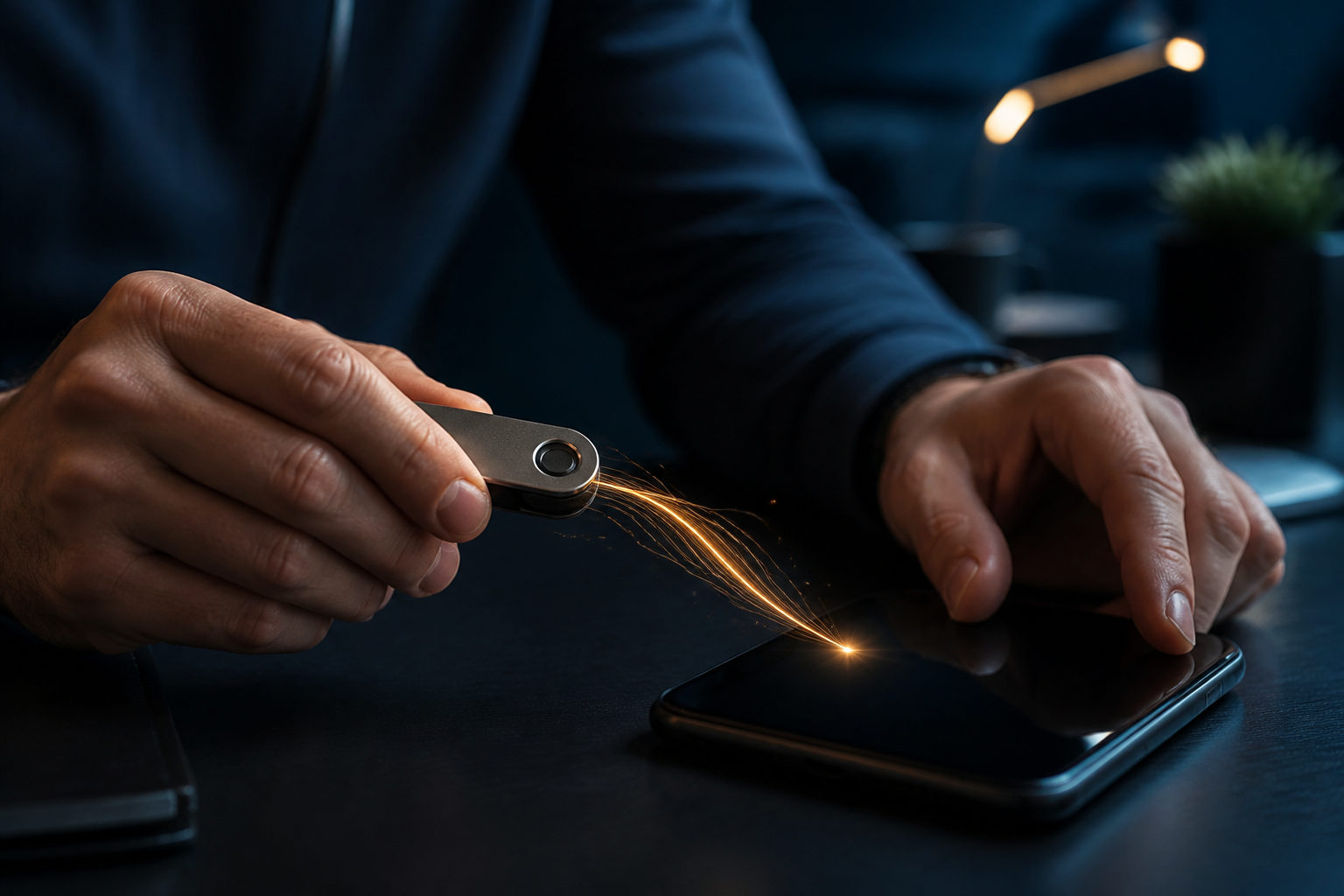
You can usually send bitcoin without identity verification if the coins are already in a wallet you control. The real issue is not paperwork at the moment of sending; it is whether you hold the private keys, can sign the transaction yourself, and understand that a broadcast transfer is hard to reverse.
First, separate sending from withdrawing
Sending bitcoin from a self-custody wallet is a Bitcoin network action. Withdrawing bitcoin from an exchange or another custodial service is a platform action governed by that company's account rules.
On the Bitcoin network, a valid transaction needs a correct signature from the relevant private key. The network checks the signature and the spend conditions; it does not ask for an ID document. If your coins are still inside a custodial account, the service may require verification, extra review, or withdrawal approval before it releases the coins.
| Situation | Is ID verification usually required? | Who controls the transfer? | Your main responsibility |
|---|---|---|---|
| Self-custody wallet send | Usually no at the sending stage | You hold the private keys | Backup, address checks, signing, fee choice |
| Exchange withdrawal | Often depends on platform policy | The platform executes the withdrawal | Meet account rules and wait for approval if needed |
| In-app custodial transfer | Depends on the service | The service may still control the keys | Confirm whether it is actually on-chain |
What you actually need: self-custody and signing control
If your goal is to send bitcoin without going through another identity check, self-custody is the practical route. In a self-custody wallet, the seed phrase or private keys are under your control, and the transaction is signed by your device rather than by a platform operator.
Whoever controls the private keys controls the coins. A wallet app is only the interface. It does not create ownership by itself, and a visible balance does not prove that you can recover the funds elsewhere.
Some apps look like wallets but act more like managed accounts. If you cannot export the seed phrase or private keys, and cannot restore the same funds in another wallet, then you may still be in a custodial setup even if the app uses wallet language.
Bitcoin uses a UTXO model rather than a bank-style account balance. When you send a payment, the wallet selects spendable outputs, builds the transaction, adds a change output if needed, and signs it. You do not need to build this manually, but it helps to know why the wallet may spend one amount and return the remainder to one of your own addresses.
Checks to complete before you send
- Make sure the app supports Bitcoin mainnet sending, not just buying, selling, or viewing balances.
- Back up the seed phrase offline and confirm that you understand the recovery process.
- Make sure the recipient gave you a Bitcoin address, not a deposit address for another chain.
- Confirm that your coins are actually available on-chain and not stuck in a platform's internal ledger.
How to send bitcoin without verification, step by step
Open the wallet, enter the recipient address, enter the amount, choose a fee, review the details, sign, and broadcast. Mistakes at any step can be permanent.
| Step | What to do | Main risk to watch |
|---|---|---|
| Get the address | Copy the Bitcoin address or scan the QR code | Typing errors or clipboard replacement malware |
| Enter the amount | Check whether the wallet shows BTC or sats | Unit mistakes; 1 sat = 0.00000001 BTC |
| Choose the fee | Select a speed option or enter a custom fee rate | Too low can delay confirmation; too high costs more |
| Review the transaction | Check the address, amount, network, fee, and total spend | Looking only at a label and not the actual address |
| Sign and broadcast | Approve the transaction with your private key | Assuming you can cancel it later like a bank transfer |
Once a Bitcoin transaction is broadcast and then confirmed by the network, reversing it is usually not a realistic option. Bitcoin targets about 10 minutes per block, and confirmation speed depends on network congestion and the fee you choose that day.
If this is your first self-directed transfer, send a small test amount first. After the recipient confirms that it arrived and you verify the details, send the rest. That extra step is often the cheapest way to catch an address mistake, an unsupported receiving setup, or your own misunderstanding of the wallet screen.
Cases that sound convenient but may keep you under someone else's control
A fast sign-up flow or a simple transfer screen does not guarantee that you are using Bitcoin in a self-custody way. Some services offer internal transfers between users that never touch the blockchain. That can be fine for convenience, but it is different from independently sending bitcoin from your own wallet.
| Convenient-looking method | Hidden issue | How to check it |
|---|---|---|
| Internal app transfer | May only move balances inside the service | Check whether there is an on-chain transaction record |
| Send by username only | The service likely still controls the funds | See whether you can export keys or a seed phrase |
| Browser-based wallet generator | Keys may be exposed in an online environment | Confirm that signing happens locally on a trusted device |
| Simple withdrawal page on a platform | Risk checks can still appear later | Read the withdrawal terms before moving funds there |
“Without verification” is not identical to complete anonymity. Bitcoin addresses do not automatically contain your legal name, but blockchain activity is public. Address clusters and transaction flows can still be analyzed over time, so avoiding an ID prompt at the sending stage does not erase traceability.
Private key responsibility matters more than the send button
Self-custody gives you independence, but it also removes the safety net of a managed account. If you lose the seed phrase, lose access to the device, or expose the private keys, there is usually no password reset path that restores control.
Keep the seed phrase offline. Do not store it in screenshots, cloud notes, chat messages, or email drafts. Anyone who asks for your seed phrase, private key, or recovery words is asking for spending control over your bitcoin.
Good sending habits also reduce avoidable losses. Separate wallets by purpose if you use bitcoin often. Check the first and last characters of the destination address before each send. Be careful with clipboard use, especially on devices that install software from untrusted sources.
For larger amounts, the device and signing environment deserve as much attention as the wallet brand. Fake wallet apps, phishing pages, and malware can replace addresses or steal recovery data. You do not need a complicated setup to be safer, but you do need a trusted installation source, a clean device, and a backup process you have actually thought through.
FAQ
Do I need ID verification to send bitcoin from my own wallet?
Usually no. If you control the private keys and the wallet can sign the transaction, sending on-chain normally does not require identity verification at that point.
Can I send bitcoin if I never completed exchange verification?
Yes, if the bitcoin is already in your self-custody wallet. If the coins are still inside an exchange account, the exchange decides whether an unverified user can withdraw.
How long does a bitcoin transfer take to arrive?
It depends on network conditions and the fee rate chosen for that transaction. Bitcoin targets about 10 minutes per block, but the recipient may also wait for one or more confirmations before treating the payment as final.
Can I cancel a bitcoin transaction after sending it?
Usually no once it has been broadcast and then confirmed. That is why address checks and a small test transaction are so useful before you send a larger amount.
What is the difference between sats and BTC in a wallet?
They are two units of the same asset. One sat equals 0.00000001 BTC, so unit confusion can cause major sending mistakes if you do not check the display carefully.
Does sending bitcoin without verification mean it is untraceable?
No. You may avoid an ID check at the sending stage, but on-chain transaction history remains public and can still be analyzed.
Before you send, verify three things: you control the wallet, the backup is stored offline, and the destination is a Bitcoin mainnet address. Then do a small test transfer before the full amount; that habit prevents many irreversible errors.
Disclaimer: This article is for informational and educational purposes only and is not investment, financial, or legal advice. Crypto assets are highly volatile and you could lose your entire investment. Do your own research and decide carefully.