
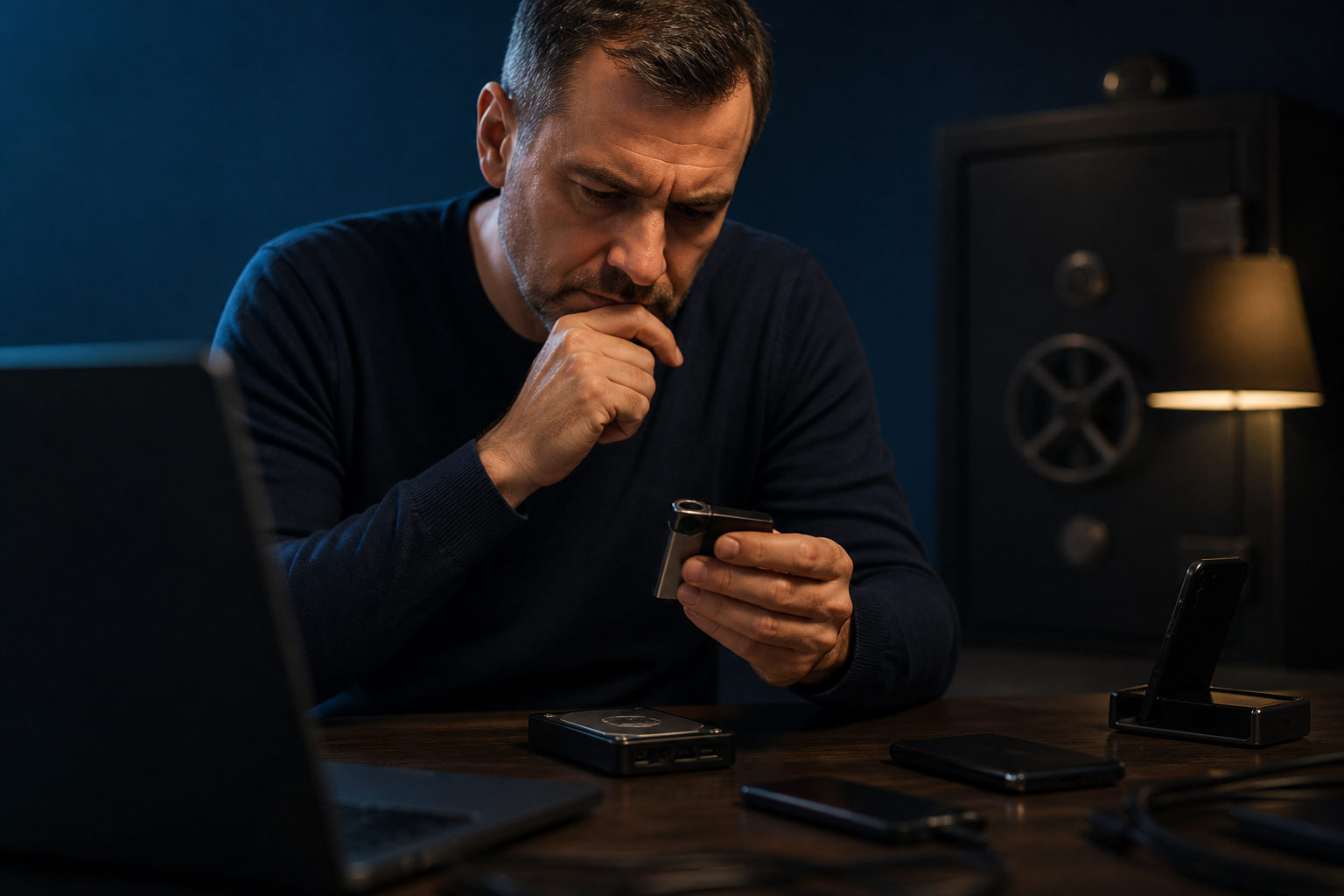
If you are asking, “did Stefan Thomas get his bitcoin,” the short answer is that there is no clear, publicly verifiable conclusion. For most readers, the useful takeaway is not the rumor itself but the process: how to assess a locked wallet situation, what to try first, and how to avoid handing your recovery path to a scammer.
Step 1: Identify what kind of access problem you actually have
People often compress very different situations into one phrase: “I lost my bitcoin.” That shortcut causes bad decisions. A forgotten wallet password, a damaged device, an unreadable backup, a wrong recovery phrase order, and a missing private key may look similar from the outside, but they call for different actions.
| Situation | First action | Why this comes first | Main caution |
|---|---|---|---|
| You still have the wallet file or device, but forgot the password | Work from your own password habits and test on copies | This may still be recoverable through careful local review | Do not send the file to strangers |
| You have a seed phrase, but restore fails | Check word order, spelling, and wallet standard | Small recording mistakes can break recovery | Never type seed words into random websites |
| Your old computer or drive is failing | Preserve the storage first, then inspect it | Direct use can make the damage worse | Avoid repeated boot attempts and new writes |
| You only remember buying bitcoin long ago | Review email, notes, bills, and old devices | You need to confirm what you actually controlled | Do not trust “asset lookup” services |
| You have no private key and no seed phrase | Assume your options are very limited | Control of bitcoin depends on key material | Anyone promising easy recovery deserves scrutiny |
Your first move should be simple: list what you definitely have, what you might have, and what you only remember vaguely. The reason is practical. Recovery work goes nowhere if the starting point is wrong. The caution here is to resist panic downloading tools before you even know which problem class you are dealing with.
Step 2: If the issue is a forgotten password, keep the process controlled
A wallet password problem triggers urgency, and urgency leads many people toward “recovery experts” too early. A safer path starts with preserving the original state, then narrowing the search using facts from your own history.
Preserve the original file, device, and notes
Set aside the wallet file, old computer, external drive, and any paper records. If you need to test something, do it on a duplicate, not on the only copy you have. This matters because accidental changes, software conflicts, or rushed edits can remove clues that were still useful.
The caution is straightforward: keep sensitive material off cloud drives, chat apps, and “free wallet checker” pages. Once a wallet file leaves your control, you do not know who has copied it.
Map your real password habits before guessing
Think in patterns, not random attempts. Did you often use certain symbols, a familiar abbreviation, a year, mixed case in a predictable way, or a slight variation of an older password? Most people do not create important passwords in a vacuum, and those habits can narrow the field.
The reason this helps is that memory often returns in fragments. A caution here: do not build a giant online note containing years of full passwords just to “organize your thoughts.” Record the pattern logic, not the full secrets.
Confirm which wallet type you used
“Bitcoin wallet” is a broad label. Some setups rely on a wallet file, some on a seed phrase, some are tied to a specific device flow, and some depend on old software formats. If you misidentify the wallet type, you can mistake a format issue for permanent loss.
The caution is to verify software sources carefully. Similar names and cloned interfaces are common traps, especially when someone is already stressed and searching fast.
Keep a clean attempt log
Write down what you tried, why you tried it, and what happened. This avoids circular guessing and helps you notice which ideas are getting closer. A clear log also protects you from trying the same dead-end path again after a few hours or days.
Be careful with what the log contains. It should describe categories and hints, not reveal complete sensitive entries in plain text.
Step 3: Seed phrase, private key, and device issues need different handling
Many readers jump from one recovery method to another because the problem feels emotionally similar. The better approach is to match the method to the failure point. If the obstacle is in the phrase, you inspect the phrase. If it is in the device, you preserve the device. If all you have is a public address, you treat that as a clue, not as control.
| Problem type | Priority action | Why it matters | Common mistake |
|---|---|---|---|
| Seed phrase is hard to read | Rebuild it offline and verify each word carefully | A few misread letters can block recovery | Sending photos to strangers for help |
| Seed phrase order may be wrong | Check how you originally recorded it | Order changes the recovery result | Testing on shared or public devices |
| Private key may still be on an old drive | Preserve the media before further work | You want to avoid additional writes | Reinstalling or overwriting the system |
| Wallet software no longer opens | Check compatibility before changing files | Software failure does not mean coins disappeared | Updating in a way that replaces data |
| You only know the bitcoin address | Treat it as evidence, not access | An address shows chain activity, not ownership control | Assuming address knowledge equals spending ability |
The reason for this discipline is simple: bitcoin ownership is tied to cryptographic control, not to memory alone. If you still have the right material, your task is to identify and preserve it. If you do not, no convincing story from a third party can create control out of thin air.
Your caution at this stage should be strict. Anyone who says they can “check whether the funds are still there” by having you enter the seed phrase is asking for the thing that controls the funds.
Step 4: Put scam prevention ahead of recovery optimism
This topic attracts fraud because locked-wallet stories produce panic, embarrassment, and urgency at the same time. Scammers know that people in this state are more likely to trust polished interfaces, technical language, and promises of special methods.
| Claim you may hear | Actual risk | Safer response |
|---|---|---|
| “Send the wallet file and we will inspect it” | Your file can be copied and kept | Do not share originals outside your control |
| “Enter the seed phrase so we can verify the wallet” | This is a request for control data | Use seed words only in a trusted self-directed restore flow |
| “Pay a fee first and we will begin recovery” | You may pay and hear nothing again | Question why payment comes before a clear method |
| “We have a special technique that bypasses limits” | The claim may be exaggerated or false | Ask exactly what they need from you; stop if it involves keys |
| “Open remote access and we will do it faster” | Your screen and entries may be exposed | Never type sensitive recovery data during screen sharing |
A good operating rule is this: the moment a recovery path requires your seed phrase, private key, original wallet file, or a shared screen while you enter sensitive information, stop. The reason is not abstract. Bitcoin can be moved by whoever controls the key material, and once that control is gone, ordinary customer support cannot reverse the transfer for you.
Be careful not to judge only by appearance. A polished site, smooth support chat, or technical vocabulary does not prove legitimacy.
Step 5: What this story should teach ordinary holders
Whether Stefan Thomas ultimately got his bitcoin back is less important than the lesson people should draw from the case. The real issue is access planning. Security that only works while your memory is perfect is weaker than it looks.
| Preventive practice | How to do it | Why it helps | Caution |
|---|---|---|---|
| Separate backup layers | Keep recovery data apart from everyday login habits | One mistake is less likely to wipe out everything | Do not store all critical elements together |
| Check readability over time | Review whether notes and media are still usable | Many failures come from fading, damage, or confusion | Do the review in a safe environment |
| Record wallet context | Note what wallet type you used and how it restores | Future troubleshooting starts from facts, not guesses | Do not keep this note with full key material |
| Leave limited guidance for trusted people | Explain where to start looking without giving everything away | This reduces the risk that only one person understands the setup | A guide should not be the complete secret |
| Remove temporary traces | Do not leave important data in screenshots, chat threads, or draft emails | Those places are easy to forget and easy to expose | Clean old copies after moving data |
The reason these habits matter is built into bitcoin itself. There is no platform reset button for true key control. If access is lost, your best chance comes from your own records, your own discipline, and the condition of the materials you already hold.
The caution is balance. Hiding information so well that future you cannot interpret it can create the same end result as weak security.
FAQ
Is there any confirmed public answer on whether Stefan Thomas recovered his bitcoin?
There is no clear public conclusion that can be treated as settled fact. If you see a strong claim, check whether it points to a direct, verifiable source rather than recycled commentary.
If I forgot my bitcoin wallet password, do I still have a chance?
That depends on what you still control. A forgotten password with an intact wallet file, device, or recovery clues is very different from having no private key material at all.
Can a bitcoin address prove the coins are mine?
A public address can show activity associated with that address, but it does not by itself prove current control. Spending power comes from the private key, seed phrase, or an equivalent recovery method.
Should I trust someone who says they can recover bitcoin from an old drive?
Start by asking what they need from you. If the process requires your seed phrase, private key, original wallet file, or remote access while you enter secrets, the risk may outweigh any possible benefit.
Why can’t a bitcoin wallet be reset like a normal online account?
Because bitcoin ownership is based on cryptographic control rather than a standard account-recovery system. In many setups, the wallet app is only a management tool, not a service that can restore control on your behalf.
What is the most useful thing I can do right now?
Make an inventory of old devices, notes, backups, email records, and anything else linked to the wallet, then classify the problem before trying solutions. Good recovery starts with knowing what evidence and access material you still have.
If you are facing a similar situation, stop sending screenshots, files, or recovery words to anyone before you sort the problem into one category: password, seed phrase, device, software, or missing key material. Once the category is right, the next decision becomes much clearer.