
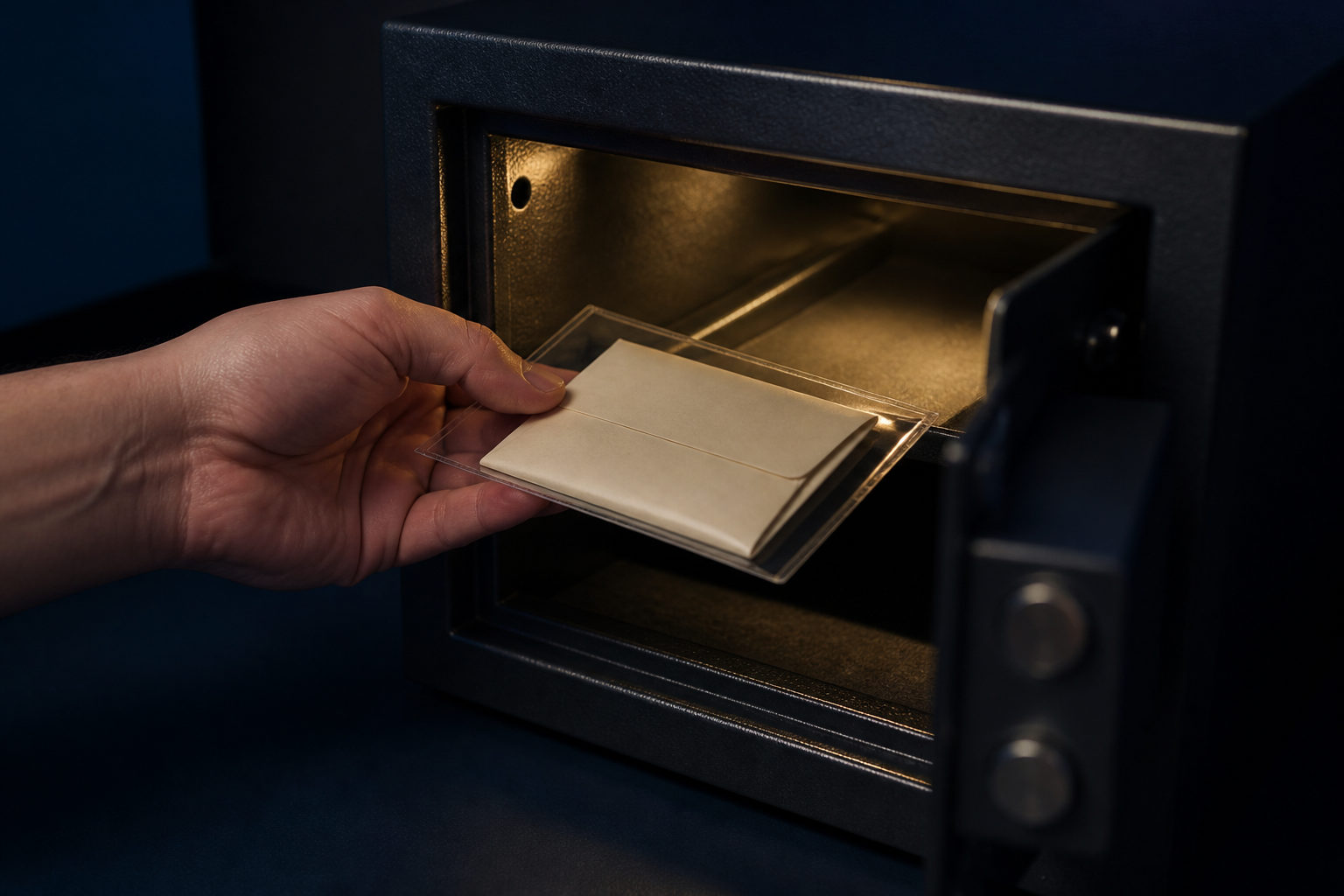
To store Bitcoin on paper, you are not putting coins into paper. You are writing down the secret that controls them, usually a private key or seed phrase, and keeping that secret offline. Done carefully, this can reduce online exposure. Done poorly, one typo, one photo, or one leak can make the funds impossible to recover or easy for someone else to steal.
What paper storage actually means
Bitcoin stays on the blockchain at all times. A paper backup is simply a physical record of the credentials that let you spend from a wallet or restore it later. If another person gets those credentials, they may be able to move the Bitcoin without your permission.
That is why the phrase “paper wallet” causes confusion. Some people mean an old-style single private key printed on paper. Others mean writing a modern wallet’s seed phrase on paper as an offline backup. Those are related ideas, but they do not behave the same way in practice.
| Paper record | What it does | Who it fits | Main risk |
|---|---|---|---|
| Private key | Controls one address directly | People managing a specific address | If exposed, anyone can spend the funds |
| Seed phrase | Restores a modern wallet | Most self-custody users | A wrong word or wrong order can break recovery |
| Receiving address | Lets others send Bitcoin to you | People collecting deposits | It does not give spending access |
If you only write down the receiving address, you have a place to receive Bitcoin but no way to spend it later. If you write down the private key or seed phrase, that paper becomes a direct target. Bitcoin is divisible down to 1 satoshi, which equals 0.00000001 BTC, so even a small-looking balance deserves the same care as a large one.
When paper storage makes sense, and when it does not
Paper storage works best for low-frequency use. It suits people who want offline backup, do not move funds often, and are willing to take full responsibility for storage and recovery. The main benefit is clear: malware, phishing pages, and remote attackers cannot read a sheet of paper sitting in a controlled physical location.
It is a poor fit for people who transact often or dislike careful verification. The risk does not end when you finish writing. It continues through the entire life of the backup: how the secret was created, whether it was copied into any connected device, whether the handwriting is readable, and how the funds will be accessed in the future.
| Use case | Paper storage fit | Why |
|---|---|---|
| Long-term cold storage | Good fit | Less routine exposure to internet-connected devices |
| Frequent spending | Weak fit | Each use can increase the chance of exposure |
| Shared family management | Mixed | One sheet of paper does not handle permissions well |
| First self-custody attempt | Use caution | New users often skip recovery testing |
For most people today, “store Bitcoin on paper” should mean “write down a seed phrase offline,” not “generate an old paper wallet and keep sending funds to one printed address forever.” Old paper wallet methods can create extra trouble when you finally try to spend the coins.
Step by step: how to store Bitcoin on paper
First, decide what you are recording. In most modern setups, that will be a seed phrase created by a wallet you control. If you plan to record a private key, confirm in advance that your future wallet software can import or sweep that format. A paper backup is only useful if you can restore from it later.
Second, create the wallet or recovery material in a controlled environment. The practical rule is simple: do not leave digital traces if you can avoid them. Do not take screenshots. Do not save the words in notes apps. Do not paste them into chat windows. Be careful with printers, cloud clipboards, photo backups, and input method sync. Those tools can quietly defeat the entire point of offline storage.
Third, write the information clearly and verify it line by line. Do not trust a quick glance. Check the order, spelling, spacing, and your own handwriting. A great many losses come from user error rather than theft. Years later, a smudged character or one missing word can be enough to block recovery.
Fourth, test the backup before sending any meaningful amount of Bitcoin to that wallet. Use the written record in a separate controlled environment and confirm that it restores as expected. If the recovered wallet behavior matches what you intended, only then should you treat the paper copy as a real backup. After the test, remove any temporary digital traces created during the check.
Fifth, store the paper so that authorized people can reach it when needed, but casual access is limited. That includes protection from water, fire, accidental disposal, and plain curiosity. A sheet that sits next to labeled account documents gives away too much context. A sheet hidden so well that even you cannot identify it later creates a different problem.
| Step | What to do | Common mistake |
|---|---|---|
| Choose the backup type | Pick seed phrase or private key | Not understanding what the record can restore |
| Create it offline | Use a controlled setup | Taking photos or syncing data |
| Write and verify | Check every word or character | Typos, bad handwriting, missing parts |
| Test recovery | Prove the paper works | Sending funds before any test |
| Store long term | Protect against damage and discovery | Keeping only one copy or labeling it too clearly |
Important irreversible warning: if your full private key or seed phrase is exposed to a camera, cloud service, messaging app, or untrusted software, you cannot undo that exposure. Deleting a file later does not prove that nobody copied it. If you suspect the secret has leaked, the safer response is usually to move the Bitcoin into a fresh wallet with new recovery material.
The risks are physical, human, and procedural
People often focus on hackers and ignore everything else. Paper can burn, fade, tear, get wet, or be thrown away during a move. Family members may not know what it is. Cleaners may treat it as scrap. A hidden backup that degrades over time is still a failed backup.
There is also a future-use problem. Will you remember which wallet type this belongs to? Will someone you trust understand how to use it if you cannot? A good paper plan balances secrecy with clarity. It should not read like a manual for thieves, but it should not become a puzzle that nobody can solve.
| Risk type | How it shows up | Practical response |
|---|---|---|
| Physical damage | Water, fire, fading ink | Use durable materials and separate backups |
| Privacy leak | Photos, cameras, people reading it | Reduce access and avoid digital copies |
| Writing error | Wrong word, wrong order, missing text | Verify carefully and test recovery |
| Use-time exposure | Importing the whole secret into software | Understand the recovery process before funds are needed |
| Inheritance failure | No one can identify or use the record | Leave limited guidance without revealing the secret |
If you plan to hold Bitcoin for a long time, think beyond hiding places. Decide how many backups you need, where they should live, and who should know enough to use them in an emergency. The goal is controlled recoverability, not theatrical secrecy.
FAQ
Is a paper wallet safer than a phone wallet?
It can be safer against online threats because the secret is not sitting on a daily-use device. That does not make it automatically safe. Poor generation, poor handwriting, or poor storage can ruin the setup just as easily.
Should I write down a seed phrase or a private key?
For most people, a seed phrase is easier to manage because modern wallets are built around it. A private key is more direct, but it can be awkward to use later and easier to expose in full when spending.
Do I need to test recovery if I already wrote everything down?
Yes. Writing is not proof. A recovery test is how you confirm that the paper record is complete, readable, and matched to the wallet you think it belongs to.
If the address receives Bitcoin, does that mean my backup is fine?
No. Receiving funds only proves that the address exists and that someone sent Bitcoin to it. It does not prove that you can restore the wallet or spend the funds later.
What should I do if I think someone saw my paper backup?
Treat the secret as compromised. The safer move is to transfer the Bitcoin to a new wallet with fresh recovery material, then retire the old paper backup.
Practical checklist before you call it done
Choose the right backup format, create it in a controlled offline setting, avoid screenshots and cloud sync, verify every word, and complete a recovery test before long-term storage. After that, store the backup where it is protected from damage and casual discovery. If your future self can restore it and an unauthorized person cannot use it at a glance, the paper plan is doing its job.