
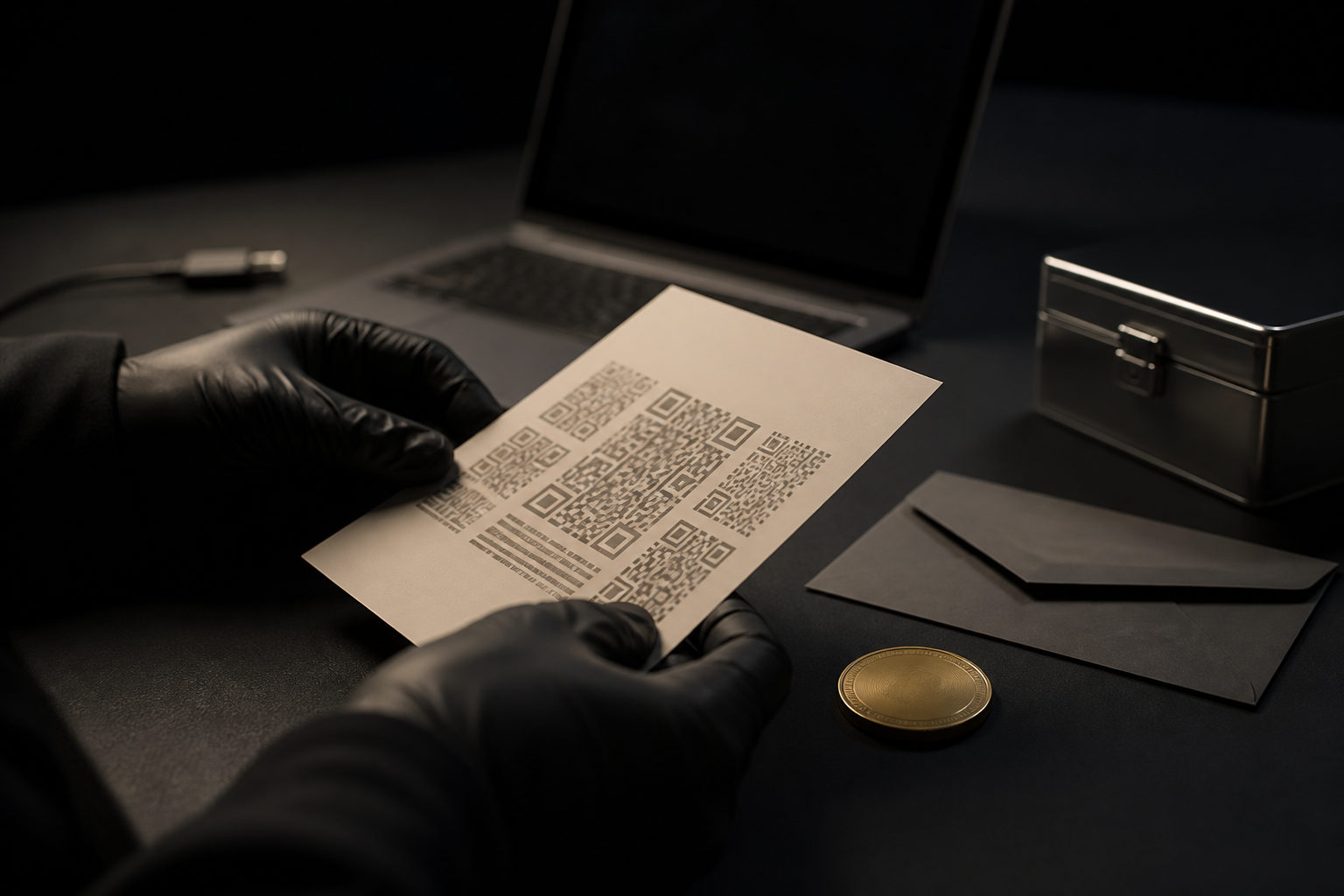
To create a bitcoin paper wallet safely, you need to generate the private key offline, record the receiving address without errors, and accept that lost or exposed key material usually means permanent loss of control.
What a bitcoin paper wallet actually is
A bitcoin paper wallet is usually a piece of paper that stores a private key, a corresponding bitcoin address, or other recovery information in physical form. People use it as a cold storage method because the spending key is kept away from devices that stay online.
That does not make paper automatically safe. The paper is only a container. Security depends on how the key is generated, whether the device is offline at the moment of creation, whether any photo or cloud backup exists, and how the wallet will be used later when you want to move the coins.
Decide first whether a paper wallet fits your use case
A paper wallet works best for static storage and careful owners who are comfortable taking direct responsibility for private keys. It is a poor fit for frequent spending, repeated deposits and withdrawals, or anyone who is still unclear on private key import, wallet recovery, or change outputs.
| Use case | Fit for a paper wallet | Why |
|---|---|---|
| Long-term storage with little movement | Often suitable | Offline storage can reduce exposure to internet-connected systems |
| Frequent payments or active use | Usually unsuitable | Each spend increases operational risk around key handling |
| Brand-new bitcoin user | Use caution | Small mistakes in recording or recovery can become serious |
| Shared custody by multiple people | Weak fit | A single paper record is hard to manage across roles |
Another common misunderstanding is privacy. A paper wallet may be offline, but activity tied to the address still exists on the blockchain. Physical storage does not erase transaction history or make on-chain activity invisible.
How to create a bitcoin paper wallet step by step
The practical goal is to create a keypair with as little exposure as possible, then preserve it in a form you can still read and use later. For a first attempt, treat the process as a drill. Do not start by placing important funds on the address.
| Step | What to do | What to verify |
|---|---|---|
| Prepare a device | Use a clean computer and disconnect it from the internet during creation | Turn off sync tools, screenshots, remote access, and automatic backups |
| Choose a tool | Use a wallet or key generator that can run offline | Make sure it supports bitcoin mainnet addresses and private key export |
| Generate offline | Create a new address and private key while the device is offline | Do not copy the key into chat apps, notes apps, or cloud services |
| Record the details | Write or print the address and private key | Check every character that could be confused with another |
| Run a readability check | Confirm that you can still identify what is what later | Label the address, the private key, and the intended use clearly |
| Test with a small amount | Send a small amount of bitcoin first | Confirm that the deposit appears in a wallet or block explorer |
| Store it properly | Keep the paper in a dry, safe place with limited access | Do not store it together with sensitive identity or asset records |
Be careful with browser-based paper wallet generators. If the device is online, the source is untrusted, or the browser environment is compromised, the private key could be exposed without any visible warning. For a paper wallet, the creation moment matters more than the paper itself.
What should be written on the paper
At minimum, separate the receiving address from the private key and label them clearly. Add a short note for yourself, such as storage purpose or whether the wallet is for testing. Years later, vague notes can be almost as dangerous as no notes at all.
If you are dealing with a seed phrase wallet and only writing down one derived address, that is a different setup from a classic single-key paper wallet. A seed phrase can control many addresses, and one error in the phrase can break recovery.
Handwritten or printed
| Method | Advantage | Risk point |
|---|---|---|
| Handwritten | No printer memory or job history to worry about | Bad handwriting, character mistakes, paper wear |
| Printed | Cleaner and easier to review | Printer cache, shared devices, someone seeing the output |
If you print, avoid office printers and public equipment. Some printers and attached systems may keep logs or stored jobs. If you cannot confirm how the device handles that data, do not assume printing kept the key fully offline.
The mistakes that cause the most damage
The biggest paper wallet failures often come from routine behavior rather than advanced attacks. One photo on a phone, one cloud-synced note, or one import into the wrong wallet can undo the entire point of offline storage.
| Common mistake | What can happen | Safer approach |
|---|---|---|
| Generating the key on an internet-connected machine | The key may be exposed | Generate in an offline environment |
| Photographing the paper for backup | The image may sync or leak | Keep it as paper only |
| Mixing the address and private key together | You may misread or misuse them later | Label each item clearly |
| Sending meaningful funds before testing | A small error becomes an expensive one | Start with a small test deposit |
| Reusing the same private key after spending | Exposure increases over time | Move funds into a fresh wallet for future management |
You also need to understand change. Some wallets will send the remaining balance from a spend to a newly created change address after the paper wallet key is imported or swept. If you do not know how your wallet handles that process, you may think funds vanished when they were simply moved according to wallet rules.
Physical damage is another real risk. Paper can fade, tear, get wet, burn, or be thrown away by mistake. A sleeve or laminated cover may help with wear, but it does not replace a storage plan. Access control, location choice, and periodic checks matter more than the appearance of the paper.
Private key responsibility is the main trade-off
With a paper wallet, you are the final authority and the final point of failure. Bitcoin transactions are generally irreversible, and a private key cannot be reset like an account password, so your storage plan needs to be settled before funds go in.
| Custody issue | Decision to make | Practical direction |
|---|---|---|
| Number of backups | Whether to create more than one paper copy | Only make as many as you can protect well |
| Storage location | Home, secure box, or another controlled place | Avoid heat, moisture, and easy access |
| Who knows about it | Who is aware the paper can spend funds | Keep that circle small |
| Inheritance or handoff | What happens if you cannot access it yourself | Leave clear but limited instructions |
If your goal is long-term storage with easier future access, other cold storage methods may be easier to manage. A paper wallet still has a place, but it asks for discipline at every stage, from creation to storage to eventual spending.
FAQ
Is a bitcoin paper wallet still a good option for beginners?
Usually not as a first choice. Beginners tend to make mistakes around setup, labeling, and recovery, so it is better to rehearse the full process with a small amount before trusting it with anything important.
Can I send bitcoin directly to the address on my paper wallet?
Yes, as long as the address is valid and you copied it correctly. A small test deposit is the safest way to confirm the setup before using it more seriously.
What should I watch for when spending from a paper wallet?
Check how the wallet you plan to use handles private key import or sweep, and where any remaining balance will go. After the key has been used, it should no longer be treated as a long-term cold storage secret.
Can I keep a photo of the private key on my phone or in cloud storage?
That adds major risk and defeats the main purpose of a paper wallet. Once the key enters a connected device or sync service, your offline storage model is broken.
If I lose the paper but still know the address, can I recover the bitcoin?
Knowing the address alone is generally not enough. The address is public receiving information; spending control depends on the private key or a complete recovery method.
Before placing meaningful bitcoin into any paper wallet, run the process once from start to finish: offline generation, clear recording, small test deposit, and a plan for safe future spending. If any part still feels uncertain, stop there and fix that part first.