
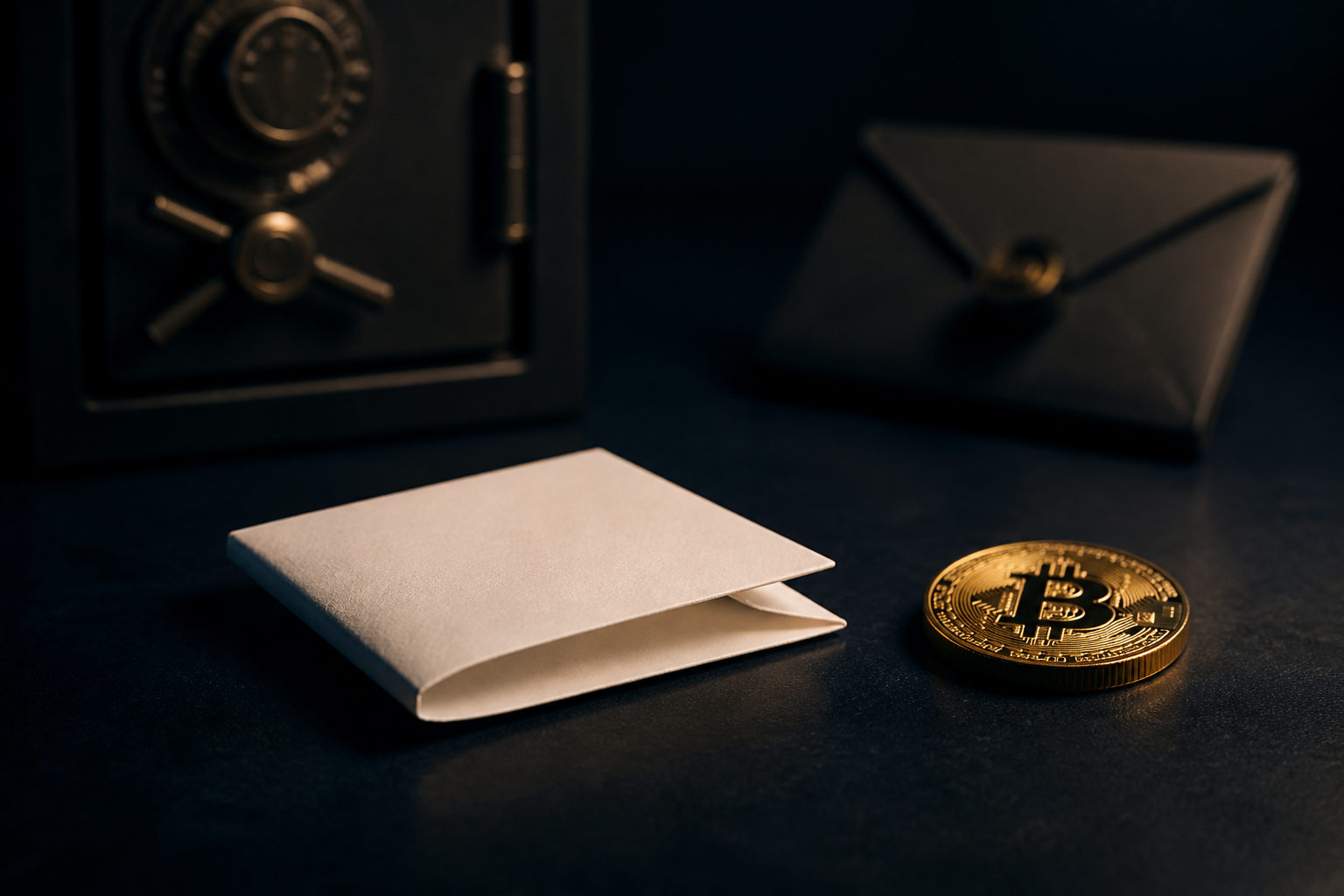
A bitcoin paper wallet is a piece of paper that holds a private key or other recovery data used to control bitcoin. It can keep that sensitive information away from internet-connected devices, but the trade-off is harsh: if the paper is lost, copied, photographed, or exposed during creation, control of the funds may be lost, and a later spend can create irreversible mistakes.
What a bitcoin paper wallet actually stores
The phrase sounds simple, but many people misunderstand the key point. A paper wallet is not mainly about the public address. The address is where bitcoin can be received. The private key is what allows a transaction to be signed and the coins to be moved.
That distinction matters because a sheet of paper with only an address is not enough to spend anything. A sheet of paper with a private key is powerful and dangerous at the same time. Anyone who gets a readable copy of that key may be able to take control of the associated balance.
In practice, people use the term “bitcoin paper wallet” for a few different formats. Some mean a printed or handwritten private key. Others mean paper that contains recovery data created by wallet software. The exact format is less important than the responsibility attached to it: the data must be created without leakage, stored without damage, and used without confusion later.
| Element | What may appear on paper | Purpose | Common misunderstanding |
|---|---|---|---|
| Public address | Text string or QR code | Receive bitcoin | Having the address means owning the coins |
| Private key | Secret text string or QR code | Authorize spending | Offline storage alone makes it fully safe |
| Recovery data | Wallet-specific recovery information | Restore control in compatible software | Any wallet app will read it the same way |
Why paper wallets appeal to some users, and why many people avoid them
The appeal is easy to see. Paper is offline. It does not depend on a phone battery, an app update, or a device staying in service for years. For someone worried about malware, remote access attacks, or general device hygiene, moving key material onto paper feels clean and direct.
Still, that only removes one class of risk. It adds others. Paper can burn, fade, tear, get wet, or be thrown away by accident. A printer can retain data. A camera in the room can capture the page. A quick “backup photo” on a phone can sync to cloud storage. The weak point is often the human process around the paper, not the paper itself.
That is why paper wallets are now a narrower tool than many beginners expect. They are better viewed as a cold-storage method for people who already understand private-key handling and want full control over every step. They are a poor fit for anyone looking for a casual, low-effort way to store bitcoin.
| Storage method | Main strength | Main weakness | Best fit |
|---|---|---|---|
| Paper wallet | Can be fully offline and low cost | Fragile storage and error-prone spending | Users comfortable with strict key handling |
| Software wallet | Fast and convenient for sending and receiving | Depends on device security | Everyday small balances |
| Hardware wallet | Good key isolation and clear transaction review | Requires a device and some setup work | Long-term self-custody with repeat use |
How to create one without creating new problems
The hardest part of a paper wallet is not printing it. The hard part is generating the key material without exposing it. If the private key appears on a normal daily-use computer, gets saved in screenshots, passes through a cloud-synced folder, or is sent through a printer workflow you do not control, the offline promise is already weakened before the page even exists.
A better approach is to treat creation as a controlled event. Use tools whose behavior you understand. Keep the process as isolated as practical. Once the information has been verified on paper, avoid keeping extra digital copies. No chat messages, no email drafts, no photo album backup, no notes app “just in case.” Those shortcuts often become the real attack surface.
Accuracy matters as much as secrecy. A single character written incorrectly can make later recovery fail. QR codes are convenient, but they should not replace human-readable verification. If the paper includes text and a code, both should be checked.
| Step | What to do | Why it matters | Typical mistake |
|---|---|---|---|
| Prepare the environment | Reduce network exposure and background syncing | Lowers the chance of silent copying | Using a normal everyday machine without thinking about data traces |
| Create the wallet data | Use tools you trust and understand | The source step determines later safety | Relying on a random website or unknown script |
| Record it on paper | Print or handwrite, then verify carefully | Recovery depends on exact accuracy | Checking only the QR code and skipping the text |
| Remove leftovers | Avoid photos, screenshots, and synced files | Digital traces leak more easily than paper | Keeping a phone photo for convenience |
| Test with a small amount | Send a tiny amount first and rehearse recovery | Finds compatibility and workflow issues early | Sending an important balance before testing |
One more point deserves emphasis. A paper wallet works best when it acts like sealed storage, not a day-to-day wallet. Every time it is scanned, shown, imported, or moved around, the chance of exposure rises.
Spending from a paper wallet: import vs sweep
This is where many costly mistakes happen. When you want to move bitcoin out of a paper wallet, wallet apps may offer two paths: import the private key or sweep the balance. They sound similar, but the security meaning is different.
Importing a private key usually means the old key remains active inside the new wallet environment. If that key was ever exposed during printing, display, storage, or transport, the risk does not disappear after import. Any future funds sent to that same old address may still be tied to that compromised history.
Sweeping is generally treated as a one-way move. The wallet creates a transaction that transfers the available balance from the old key into a fresh address controlled by your current wallet. That is often cleaner because it lets you retire the old paper wallet after use instead of continuing to depend on a key that may have been exposed in the past.
Another trap is change handling. Bitcoin transactions do not always leave the remainder sitting in the original address in a way that matches beginner intuition. A wallet may send leftover value to a different address that it controls. If you do not understand how the wallet handles change, you may think funds are still on the paper wallet when they have actually moved elsewhere under the wallet’s internal address structure.
| Method | Meaning | When people choose it | Risk reminder |
|---|---|---|---|
| Import | Add the old private key into a wallet | Quick access to the original address balance | The old key and its history remain relevant |
| Sweep | Move the balance to a new wallet address | Retire the paper wallet after use | Confirm the full move and understand fee and change behavior |
Important warning: once a paper wallet has been used for spending, it should generally stop being treated as clean long-term cold storage. A safer pattern is to move funds into a fresh wallet structure and manage them there.
Practical checklist before you trust a paper wallet
- Make sure you understand the difference between a public address and a private key.
- Use only tools whose recovery method you can explain to yourself clearly.
- Verify all text on paper, not just the QR code.
- Do not photograph the wallet or send its contents through messaging apps, email, or cloud storage.
- Store it in a way that protects against water, fire, accidental disposal, and unwanted discovery.
- Test the full process with a very small amount before relying on it.
- After spending from it, move to a fresh storage setup rather than continuing to reuse the same paper wallet.
FAQ
Is a bitcoin paper wallet safer than a software wallet?
It can be safer against some online threats because the key material can stay offline. That does not make it safer in every sense, since physical loss, copying, and spend mistakes become more serious.
Should I handwrite the private key or print it?
Handwriting reduces printer-related data traces but raises the chance of copying errors. Printing may be easier to read, yet it can create traces in devices or workflows you do not fully control.
Can a paper wallet hold bitcoin for a long time?
Yes, but only if the paper stays readable, secret, and physically intact, and only if you still know how to recover from it later. Long-term storage fails when people forget the recovery process as often as when the paper itself is damaged.
Can I keep receiving bitcoin to the same paper wallet address?
At a technical level, that is often possible. From a security point of view, it is a bad habit once the private key has been imported, displayed, or exposed in any uncertain way.
What if I lose the paper but think nobody can understand it?
That is not a reliable defense. If the paper contains a valid private key or usable recovery data, loss means you no longer know who may eventually gain control, so any accessible funds should be moved to a new setup as soon as you can act safely.
If you still want to use a bitcoin paper wallet, start with a tiny test amount and complete the whole cycle yourself: create, record, receive, recover, and sweep. If any step feels unclear, that is a sign to pause before larger sums are involved.
Disclaimer: This article is for informational and educational purposes only and is not investment, financial, or legal advice. Crypto assets are highly volatile and you could lose your entire investment. Do your own research and decide carefully.