
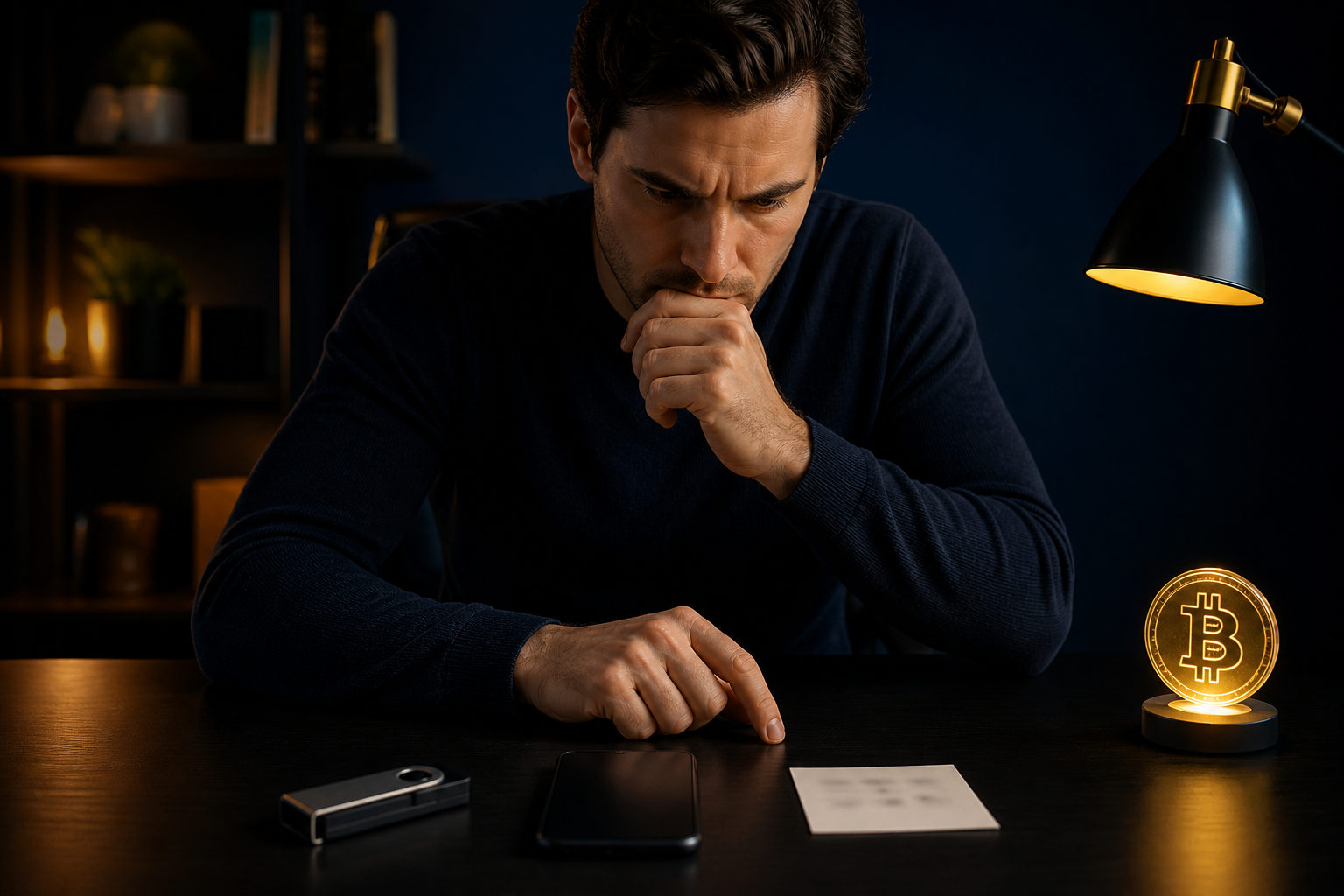
How to find bitcoin depends on what you actually lost: the coins are on the blockchain, but access may be tied to a wallet, an exchange account, or recovery words you no longer remember. Start by identifying where your bitcoin was held before you try to restore anything.
Know what you are really trying to recover
People often say they “lost bitcoin” when the real issue is different. In many cases, they lost access to an exchange login, forgot which wallet app they used, replaced a phone without restoring the wallet, or kept only an address without the private key.
That distinction matters. A bitcoin address can show activity and balance, but it does not give spending control by itself. Access usually comes from a private key, a seed phrase, a wallet backup, or a custodial account that still recognizes you.
Common situations
- Bitcoin held on an exchange: You need account recovery, not on-chain recovery.
- Bitcoin held in a self-custody wallet: Your focus should be the seed phrase, private key, wallet file, or device backup.
- Only an address is available: You can inspect the address, but that does not mean you can move the coins.
- Someone else held it for you: Recovery depends on whether that person still has control and is willing to cooperate.
A practical order for finding your bitcoin
If you are asking “how do I find my bitcoins,” the best approach is to work from the strongest evidence you still have. Do not begin by typing recovery words into random sites or installing every wallet app you can find.
- Reconstruct how you got the bitcoin: Did you buy it on an exchange, receive it from someone else, or use a wallet on a phone, computer, or hardware device?
- Search old records: Check email, notes, screenshots, cloud storage, app download history, messages, and account statements for terms such as BTC, Bitcoin, wallet, deposit, withdrawal, or seed phrase.
- Inspect old devices: An old laptop, phone, USB drive, or external drive may still contain a wallet app, a backup file, or a written record.
- Look for recovery words: A seed phrase is often the most direct path back into a self-custody wallet if the words and order are correct.
- Check the blockchain if you found an address: A block explorer can confirm whether the address still holds bitcoin and show outgoing or incoming transactions.
- Restore only after you identify the wallet type: Recovery is safer when you know which wallet you are dealing with and use its trusted interface.
This order saves time and reduces mistakes. It also lowers the chance of exposing sensitive information to fake support pages.
Where the bitcoin was stored changes the recovery method
If it was on an exchange
In this case, your goal is to recover the account. Think about the email address you used, the phone number linked to the account, any two-factor authentication you enabled, and which devices you used to sign in.
If you do not remember the exchange name, search your email first. Registration messages, login alerts, deposit notices, and withdrawal confirmations can point you to the platform you used.
If it was in a wallet you controlled
For a self-custody wallet, the key items are the seed phrase, private key, wallet backup file, and the original wallet app or device. Even if the app is gone from your phone, the bitcoin may still be recoverable if your backup information survives.
The reverse is also true. Seeing a wallet app icon does not prove the funds are still accessible there, especially if the app was never restored after a device change.
If you only found an address
This is where many people get confused. A bitcoin address works more like a public identifier than a password. It lets you verify activity on-chain, but it does not grant control over the coins.
If all you have is an address, a transaction ID, or an old screenshot, you may be able to confirm where the bitcoin went. You may not be able to get it back without the matching private key or seed phrase.
Mistakes that make recovery harder
- Entering a seed phrase on an unknown website: Wallet recovery should happen in a trusted wallet environment, not in a web form sent by a stranger.
- Mixing up different assets or networks: Bitcoin works differently from many other crypto assets, so guessing can lead to bad decisions.
- Using the wrong word order: A seed phrase can fail even when every word looks familiar.
- Resetting an old device too early: Back it up before changing software or wiping anything.
- Paying a “recovery service” too quickly: If someone asks for your seed phrase, private key, or remote access to your device, stop there.
Be patient. In bitcoin recovery, rushing usually creates fresh problems instead of solving the old one.
FAQ
How can I tell whether my bitcoin was on an exchange or in my own wallet?
Ask yourself whether you ever wrote down recovery words or saved a private key. If you mainly signed in with an email address and password, it was probably held in an exchange account.
If you used a dedicated wallet app or hardware wallet and kept recovery words yourself, it was more likely self-custodied.
Can I recover bitcoin if I only have the address?
You can check the address balance and transaction history with a block explorer. What you usually cannot do is spend the bitcoin without the private key or seed phrase tied to that address.
An address gives visibility, not control.
Why can’t I see my bitcoin after changing phones?
Many wallet apps do not automatically restore your old setup on a new phone. You often need to import the original seed phrase or backup before your balance appears.
That means the bitcoin may still be there, even if the new app looks empty at first.
How do I find bitcoin I bought years ago if I forgot the platform?
Start with your email inbox, app download history, bank records, screenshots, and any old notes. Those traces often reveal the exchange or wallet name faster than guessing from memory.
Once you identify the service, follow its account recovery steps instead of trying unrelated wallets.
Can I find bitcoins without a seed phrase?
Sometimes, yes, but it depends on where the bitcoin was stored. If it was on an exchange, account recovery may still work; if it was in a self-custody wallet, you may need a private key, a wallet backup, or access to the original device.
If none of those exist, the path gets much narrower. At that stage, protecting the information you still have becomes even more important.
What to do next
Make a simple list of account clues, device clues, and key-related clues. Then work through them one by one; if you locate a seed phrase, private key, or valid wallet backup, use it only inside a trusted wallet recovery screen and never share it through chat, email, or a random website.