
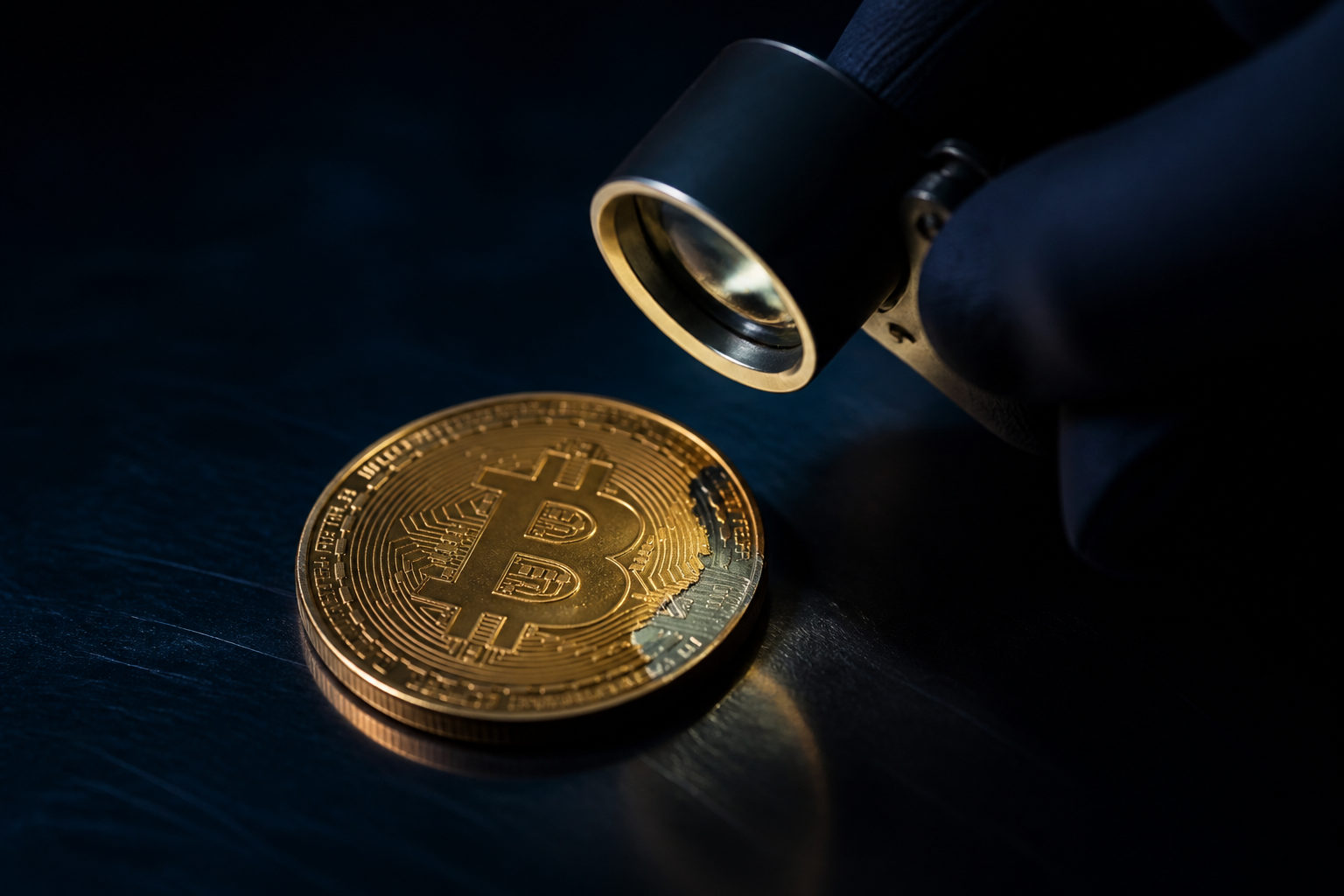
When people ask about making fake bitcoins, the real issue is usually fraud wrapped in Bitcoin branding, not someone creating valid BTC out of thin air on the Bitcoin network.
Why “fake bitcoin” usually means a scam, not counterfeit BTC
Bitcoin works through a public blockchain. A transfer counts only if the network accepts it and it can be verified independently. That matters because scammers often try to replace verifiable on-chain evidence with screenshots, edited videos, fake wallet balances, or a private dashboard that only they control.
So the first filter is simple. If someone claims they can generate BTC for you, duplicate coins, mint private bitcoins, or sell “special internal bitcoin,” the claim already conflicts with how Bitcoin is supposed to work. The trick is rarely a magical protocol exploit. It is usually social engineering, a fake product, or a fake record of payment.
Common forms of “fake bitcoin” fraud
| Type | What it looks like | What is really happening | First check |
|---|---|---|---|
| Fake token using BTC branding | Name or ticker includes Bitcoin or BTC | It may be a different token on another network, or only an internal balance | Check the network and whether it can move to a real Bitcoin wallet |
| Fake wallet or fake exchange | The app shows a balance and smooth account activity | The operator may control all displayed numbers | See whether you can withdraw to a wallet you control |
| Forged payment proof | Seller sends a screenshot, screen recording, or email notice | Images and recordings can be edited with ease | Ask for transaction details you can verify independently |
| In-person OTC switch or trap | Someone shows a hardware device, paper wallet, or preloaded wallet | The private key may already be copied | Test whether the funds can move to your own wallet on the spot |
| Custody scheme dressed up as BTC income | A platform shows daily bitcoin earnings | You may be looking at internal bookkeeping only | Check if withdrawals to an external wallet actually work |
| Fake support request | “Support” asks for seed phrase, private key, or wallet access | The goal is often theft of your real assets | Stop immediately if anyone asks for sensitive wallet credentials |
These setups differ in appearance, but they rely on the same weakness: the victim is pushed to trust a display rather than a verifiable transaction. If the other party controls the viewing environment, they can control the story.
Red flags that deserve immediate caution
One strong warning sign is closed-loop verification. You are told to look only at one app, one website, one support chat, or one account page. If you cannot cross-check the claim using tools and wallets outside that system, the balance on screen may mean very little.
Another warning sign is vague language about the asset itself. Terms like “bitcoin allocation,” “BTC share,” “mapped bitcoin,” or “custodial BTC slot” sound technical, yet they often avoid the basic question: what exactly is the asset, on which network does it exist, and can it move to a wallet you control?
Pressure is another major signal. A seller who keeps stressing urgency, secrecy, or a limited opening is trying to shorten your review time. In many cases, that pressure matters more than the pitch.
There is also the trust-building pattern. A scam may allow a small test to appear successful, then push for a much larger payment afterward. The early success does not prove safety. It may be part of the setup.
How to verify whether you actually received BTC
| Check | What to confirm | Why it matters |
|---|---|---|
| Asset identity | Confirm it is native Bitcoin, not a lookalike token | Names and logos are easy to copy |
| Wallet control | Use a receiving address generated by your own wallet | If the other party created the wallet, they may control it |
| Independent verification | Make sure the transfer can be checked outside the sender’s app | A private dashboard is not proof by itself |
| Ability to move funds | Try sending the BTC to another wallet you control | If you can view it but cannot move it, you may not own it |
| Fee logic | Watch for sudden release fees, unlock fees, or verification charges | Extra payment demands are common in layered scams |
A practical rule helps here: do not treat “visible in an account” as the same thing as “received.” The asset is far more credible when it reaches a wallet under your control and can be moved again through a normal process.
This is especially important in trades arranged through messaging apps, social groups, short video comments, or direct messages from strangers. Those channels make identity theater cheap and fast.
What to do if you suspect fake bitcoin fraud
Stop sending money at once. Do not install another app, do not follow a new link, and do not continue with a so-called recovery process run by the same person or platform. Many scams shift into a second stage once the victim becomes suspicious.
Preserve evidence before the trail changes. Save chat logs, payment records, account names, app names, screenshots, and any message that explains fees, withdrawal rules, or support instructions. Early records can help with reports and platform complaints later.
If you shared a seed phrase, private key, or wallet password, move faster. Create a fresh wallet in a safer environment and transfer any remaining real assets that you still control. A wallet exposed to a stranger should not be treated as secure afterward.
You can also report the account, app, store listing, social profile, or payment channel involved. A report does not guarantee recovery, but it may limit further abuse and create a trace that supports follow-up action.
FAQ
Can someone actually create fake BTC that works on the Bitcoin network?
In normal user scenarios, that claim should be treated as false. What people call fake bitcoin is usually a fake token, a fake platform balance, forged proof of payment, or stolen wallet access.
Does a coin count as Bitcoin if it uses the name BTC?
No. Branding proves nothing by itself. You need to confirm the asset’s network, whether it can move to a wallet you control, and whether the transfer can be checked independently.
Is a screenshot of a completed transfer enough proof?
No. Screenshots, emails, and recordings can all be manipulated. Useful proof comes from verifiable transaction information and real control over the receiving wallet.
Are face-to-face cash trades safer than online deals?
Not automatically. In-person trades can still involve swapped devices, precompromised wallets, or fake payment confirmation. The need for independent verification does not disappear offline.
What if I already gave my seed phrase to “support”?
Act quickly. Move any remaining real assets to a new wallet you control, then keep records of what happened for reporting and complaint purposes.
If something is presented as bitcoin but you cannot verify it independently in a wallet you control and cannot move it normally, treat it as not received.
Disclaimer: This article is for informational and educational purposes only and is not investment, financial, or legal advice. Crypto assets are highly volatile and you could lose your entire investment. Do your own research and decide carefully.