
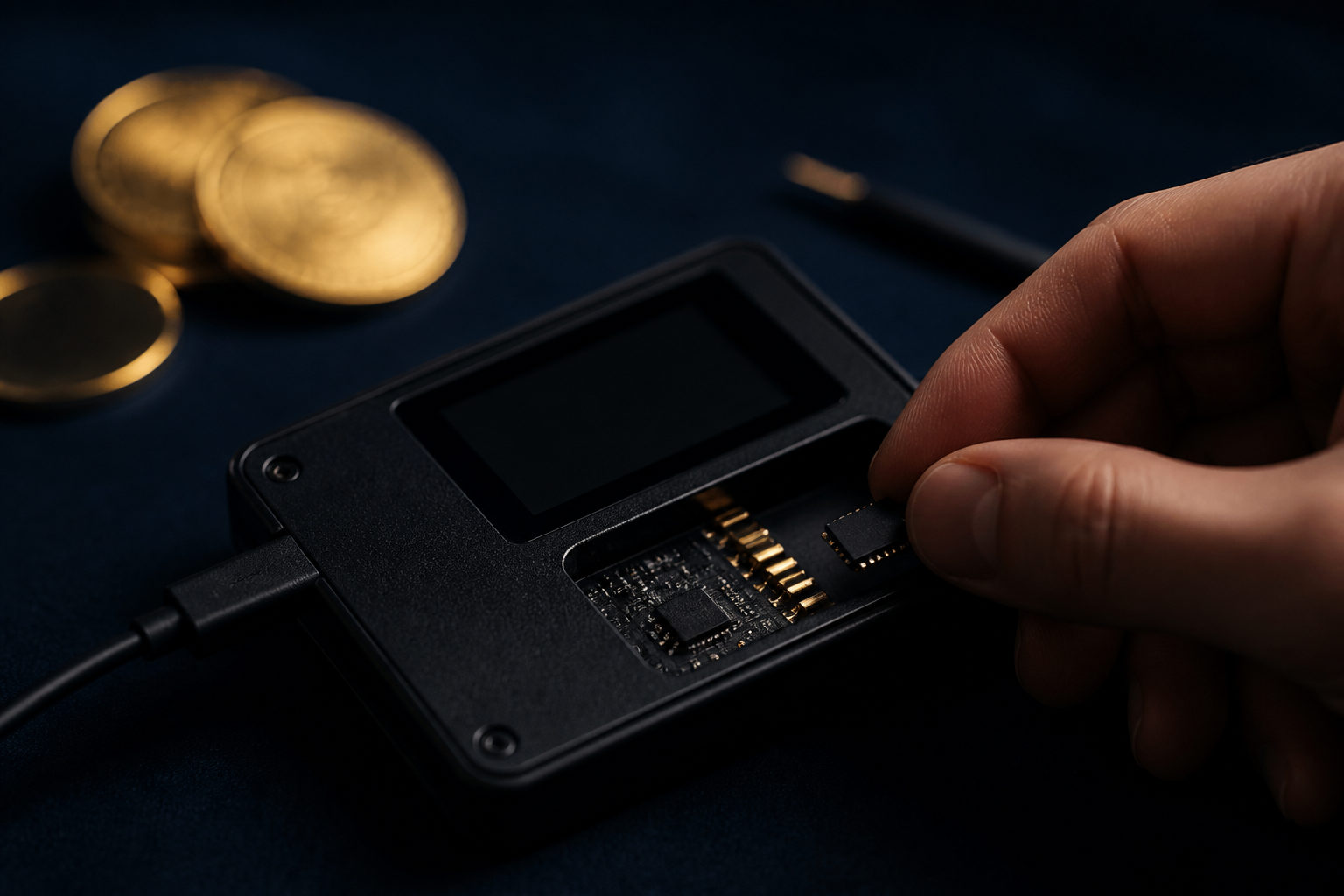
A minimal Bitcoin wallet is a stripped-down program for embedded devices that generates private keys, shows receiving addresses, and signs transactions without carrying much else. Its point is to keep key material on hardware you control while offloading everything else to ordinary computers.
What 'minimal' actually means
Embedded devices have limited memory, weak processors, and often no normal screen or keyboard. A wallet built for this environment has to drop nonessential features. It usually does not connect to the network on its own, does not download the blockchain, and does not track balances. Those jobs are left to a separate machine or a watch-only wallet.
A common misconception is that the only difference between an embedded wallet and a phone wallet is size. In practice the resource limits, trust model, and use pattern are all different.
| Aspect | Phone wallet | Minimal embedded wallet |
|---|---|---|
| Where it runs | Mobile operating system with ample resources | Microcontroller or restricted environment |
| Main job | Balances, rates, exchange, receive, and sometimes more | Key generation and transaction signing |
| Network | Usually online | Offline by default, connected on demand |
| Key storage | Depends on OS sandbox or secure hardware | Depends on device design and your backup method |
Where it fits and where it does not
A minimal embedded wallet works well when the job is long-term self-custody, occasional signing, or using the device as a hardware signing tool. It is less useful when you need instant transfers, frequent outgoing payments, or a built-in balance display.
Ask one question before choosing a tool: is this payment worth an extra minute of address verification and manual signing? If yes, the minimal wallet is a reasonable fit. If the payment is small, frequent, and you just want speed, a regular wallet or a custodial service is easier.
| Situation | Suitable? | Why |
|---|---|---|
| Holding Bitcoin you control | Yes | The private key stays in your hands |
| Frequent small payments | No | Each payment needs export, signing, and broadcast |
| Hardware signer paired with a watch-only wallet | Very suitable | The watch wallet tracks balances; the device just signs |
| Checking the balance on the spot | Not suitable | It does not maintain chain state |
How the workflow works
Whatever the device is, the workflow follows the same four stages: initialization, backup, signing, and broadcast.
First, generate randomness while the device is offline. If the device includes a true random number generator or a secure element, use that hardware path instead of pulling random bytes from a general-purpose computer.
Second, back up the seed phrase or private key on physical media. Metal or paper is fine. The important part is to make more than one copy and store them in separate places.
Third, prepare an unsigned transaction on an online machine, then move it to the embedded device. The device or a connected display should show the recipient address, amount, and fee. Sign only after those details match what you actually want to send.
Fourth, send the signed transaction back to an online machine and broadcast it to the Bitcoin network. Broadcasting is the point of no return.
Many minimal wallets use PSBT (Partially Signed Bitcoin Transactions) as the exchange format. An online wallet builds an unsigned PSBT, the embedded device signs it, and the online wallet broadcasts the result. This keeps the constrained device simple because it never has to understand the whole blockchain.
Private keys and irreversible actions
An embedded wallet gives you full control, and full control means full responsibility. If any of these things happens, there is no undo:
- Sending to a wrong address: once the transaction confirms, the payment is permanent.
- Leaking the seed phrase or private key: anyone who holds it can move the coins.
- Signing a malicious transaction: the signature is permission, and the network will not ask again.
- Losing a damaged backup: you usually find out during recovery, when it is too late.
| Stage | Do | Do not |
|---|---|---|
| Initial setup | Generate keys offline and prepare multiple backups | Photograph or screenshot the seed on a connected phone |
| Before signing | Check recipient, amount, and fee | Sign an imported file without inspecting it |
| After backup | Do a small test recovery before moving funds | Skip the test and store everything on the device |
Irreversible-action reminder: an already broadcast transaction, a private key that has been seen by someone else, and an overwritten backup all have exactly one chance.
FAQ
How is a minimal embedded wallet different from a hardware wallet?
The ideas overlap. Many hardware wallets are embedded devices, but they usually add a secure chip, physical buttons, and a screen. A minimal wallet can also run on a simple single-board computer; the real security depends on how keys are generated and stored.
How do you verify an address when there is no screen?
You need an external verification path: short-range transmission, a connected display, or an encrypted QR-code channel. The point is to have an independent way to check the data. Without one, that device should not sign high-value transactions.
Can an embedded device run a full node?
It can, but that is a different design target. A full node must download and validate the entire blockchain, which demands more storage and bandwidth. A minimal wallet stays light and lets a full node or watch-only wallet run somewhere else.
Is backing up the seed phrase enough?
Backup is only the start. You need to test whether the backup can restore a wallet, and you need to protect the process from cameras. Keeping several copies in different places also reduces the risk of a single failure.
Turn this into practical behavior: generate offline, verify before signing, test your recovery, then broadcast. Bitcoin has no help desk. Once a transaction goes out, the network treats it as final.