
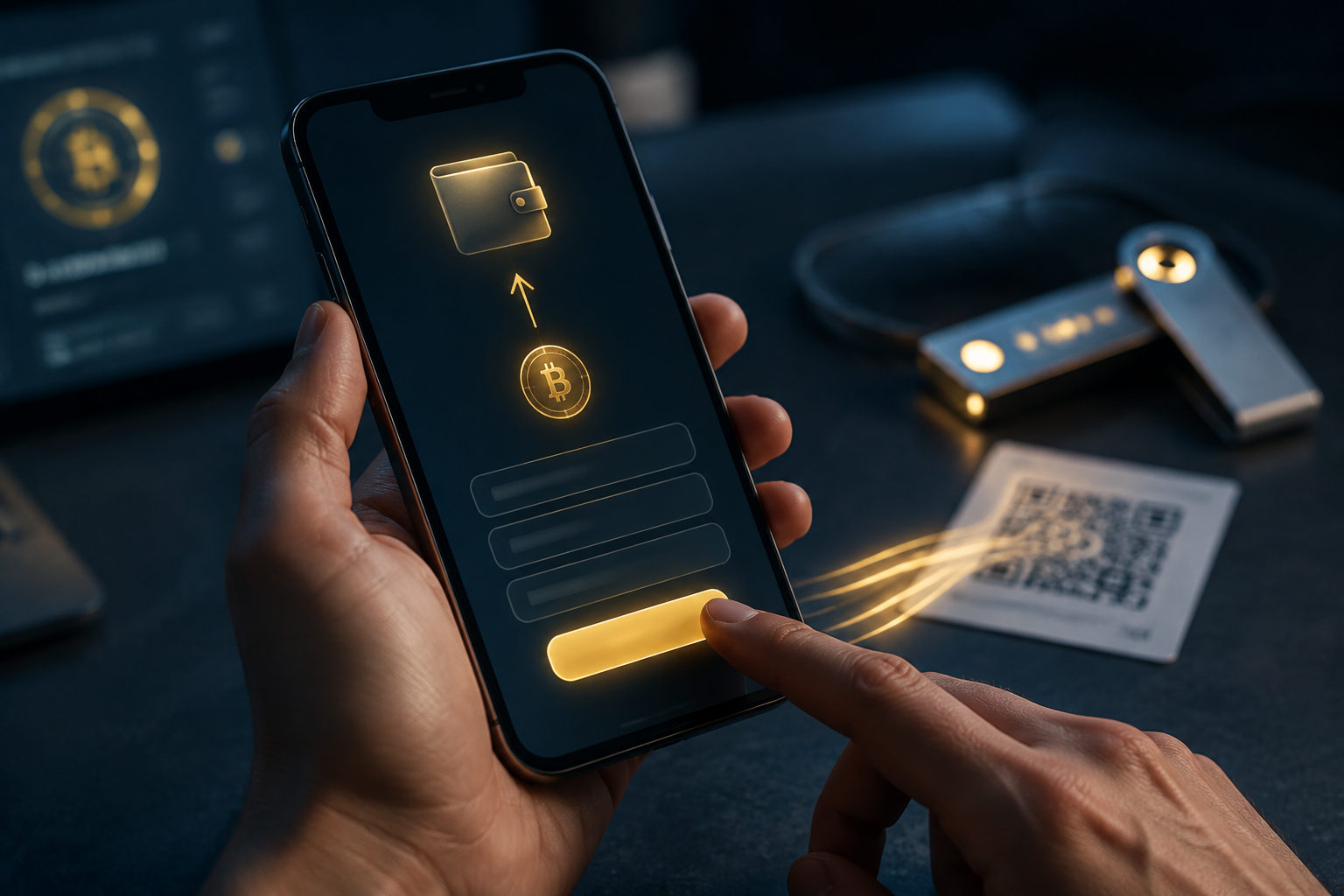
Many apps can send Bitcoin right away, including exchange apps, hosted crypto apps, and self-custody wallets. The real question is not which app has a send button; it is whether you understand who controls the private keys, whether the app supports the Bitcoin network you need, and that a Bitcoin transfer usually cannot be reversed after broadcast.
What “send instantly” actually means
An app can let you create and broadcast a Bitcoin transaction immediately. That does not mean the receiver will treat it as fully settled at once. Between the moment you tap send and the moment the recipient accepts the payment, there may be a wait for network processing and for the receiver’s own confirmation policy.
This distinction matters because many beginners read “sent” as “completed.” In practice, the app is only the tool used to sign and broadcast the transaction. Final acceptance depends on the Bitcoin network and on the wallet, merchant, or exchange on the receiving side.
The main app types that can send Bitcoin
Hosted apps
Hosted apps include exchanges and other custodial services where the provider holds the private keys for you. These apps are often simpler for beginners because login, device recovery, and account access feel familiar. If you lose your phone, access may still be restored through the provider’s account process.
The trade-off is control. A hosted app may place limits on withdrawals, apply review steps, or delay transfers for security checks. That does not make it bad, but it does mean your ability to move BTC depends partly on the platform’s rules.
Self-custody wallets
A self-custody wallet gives you direct control over your wallet credentials, usually through a seed phrase or private-key backup. These apps are often the cleanest answer for someone who wants to send Bitcoin directly on-chain without waiting for a platform’s withdrawal process.
That control comes with full responsibility. If your seed phrase is exposed, someone else can move the funds. If your backup is lost and your device fails, there may be no recovery path.
Hardware wallet companion apps
Some people send Bitcoin through a mobile or desktop app linked to a hardware wallet. In that setup, the app prepares the transaction, while the hardware device approves the signing step. This can reduce the risk of signing from a general-purpose phone alone, though it adds one more device to manage.
For routine spending, this setup may feel slower than a phone wallet. For larger holdings, many users prefer the extra signing barrier.
How to judge whether an app is suitable
Check who holds the keys
If the app lets you back up a seed phrase or export wallet credentials, it usually gives you more direct control. If the app works only through account registration and login, with no wallet recovery phrase under your control, it is usually custodial.
This is the first filter because it defines your responsibility. In one model, the provider helps manage access. In the other, you do.
Confirm that it supports native Bitcoin sends
Some apps show BTC in the interface but still require you to choose a network or may involve an internal transfer system. Before sending, make sure the recipient gave you a Bitcoin address meant for the Bitcoin network and that your app is about to send on that same network path.
Do not rely on the asset label alone. Read the send screen, network selector, and the recipient’s deposit instructions carefully.
Look for clear fee settings
Bitcoin transactions compete for block space, so the fee level affects how quickly the network may process the transfer. Some apps keep this simple with presets. Others let you choose a higher or lower fee manually.
You do not need to become an expert in fee management to send BTC well. You do need to understand whether your app hides the fee logic, gives only a default option, or lets you choose a speed preference that matches your purpose.
Pay attention to the confirmation screen
A good send flow makes the destination address, amount, network, and fee easy to inspect before you approve. Some apps also support saved addresses or basic address-format checks. These design choices reduce error, especially when you are moving funds in a hurry.
If the final screen is vague or compressed, that is a warning sign. Bitcoin transfers reward careful review, and the app should make review easy rather than obscure.
What to do before pressing send
Start by confirming what the recipient actually needs. If you are paying a person, ask whether the address is a Bitcoin address for on-chain BTC. If you are sending to an exchange or service, read the deposit page and follow its instructions exactly.
Next, verify the full address. Many people glance at the first and last few characters and stop there. That is not enough. A copied address should be checked again after pasting, especially when moving data between devices.
Then confirm the unit shown in the app. Some wallets display amounts in BTC, while others may switch to sats. One satoshi is one hundred millionth of a BTC. A unit mistake can turn into a payment mistake very quickly.
After that, review the fee choice. If you are paying a merchant or trying to meet a time-sensitive need, a low fee may create unnecessary delay. If the app offers a recommended setting and you do not understand manual tuning, the recommended option is often the safer choice.
For any new address or new app, send a small test first. This one habit catches the largest share of avoidable mistakes. Once the recipient confirms that the test arrived as expected, you can proceed with the remaining amount.
Finally, check whether the receiver requires anything beyond the address. On the Bitcoin base chain, the address is usually the key item, but a service may still have its own deposit handling process. If you skip the instructions on the receiving side, the transaction may exist on-chain while the service has not yet credited it in your account view.
Common mistakes behind the idea of “instant”
The first mistake is confusing “broadcast” with “settled.” Your app may show success because the transaction has been created and sent to the network, while the receiver still sees it as pending. Both views can be true at the same time.
The second mistake is treating fast internal transfers on a platform as if they were the same as an on-chain Bitcoin transaction. When two users move balances inside the same service, the provider may update its own records quickly. A withdrawal to an external Bitcoin address follows the public network process instead.
The third mistake is trusting QR scanning as if it solves every risk. A QR code helps reduce typing errors, but it does not confirm that the address belongs to the intended recipient, that the network is correct, or that the amount and fee make sense.
Private-key responsibility changes the right answer
If you use a custodial app, your main security job is account protection. That means a strong password, reliable two-factor authentication, safe email access, and a secure device. This route can work well for people who want simplicity and are comfortable relying on a platform to hold the wallet credentials.
If you use a self-custody wallet, your main security job shifts to seed phrase handling and recovery planning. A seed phrase stored in cloud notes, chat messages, or screenshots creates unnecessary exposure. Your wallet is only as safe as the backup process behind it.
It also helps to understand what the wallet app is doing. The app is not a container where Bitcoin physically sits. It manages keys and signs transactions, while the balance is represented on the blockchain. Losing a phone does not automatically mean losing BTC if recovery information is safe and usable. Keeping the phone does not guarantee safety if the critical wallet credentials have already leaked.
FAQ
Which app sends Bitcoin the fastest?
No app can force the Bitcoin network to treat every transaction the same way. What usually matters more is whether the app broadcasts properly, what fee level is used, and how the recipient defines a completed payment.
Can an exchange app send Bitcoin directly to another wallet?
Usually yes, as long as withdrawals are available and you choose the correct Bitcoin network option. Before sending, confirm that the destination is an actual BTC address and not a different network or service format.
Why does my app show sent while the receiver says nothing arrived?
The transaction may still be pending, the fee may be slow for current conditions, or the receiving service may wait for additional confirmations before crediting the deposit. A network or address mismatch is another possibility, so both sides should review the transaction details carefully.
Is a self-custody wallet always better for sending Bitcoin?
It is often better for users who want direct control and understand backup responsibility. If you are not ready to protect a seed phrase properly, a custodial app may be easier to manage day to day.
Can I cancel a Bitcoin transfer if I sent it to the wrong address?
In most cases, no. Once a Bitcoin transaction is broadcast and accepted by the network, reversal is usually not available, which is why address review matters more than trying to fix an error later.
Use this short checklist before every send
Confirm that the recipient wants on-chain BTC, verify the full address, check the unit, review the fee, and test with a small amount when the destination is new. If any one of those points is unclear, stop there and verify it first. That pause is often the difference between a routine transfer and an irreversible mistake.
Disclaimer: This article is for informational and educational purposes only and is not investment, financial, or legal advice. Crypto assets are highly volatile and you could lose your entire investment. Do your own research and decide carefully.