
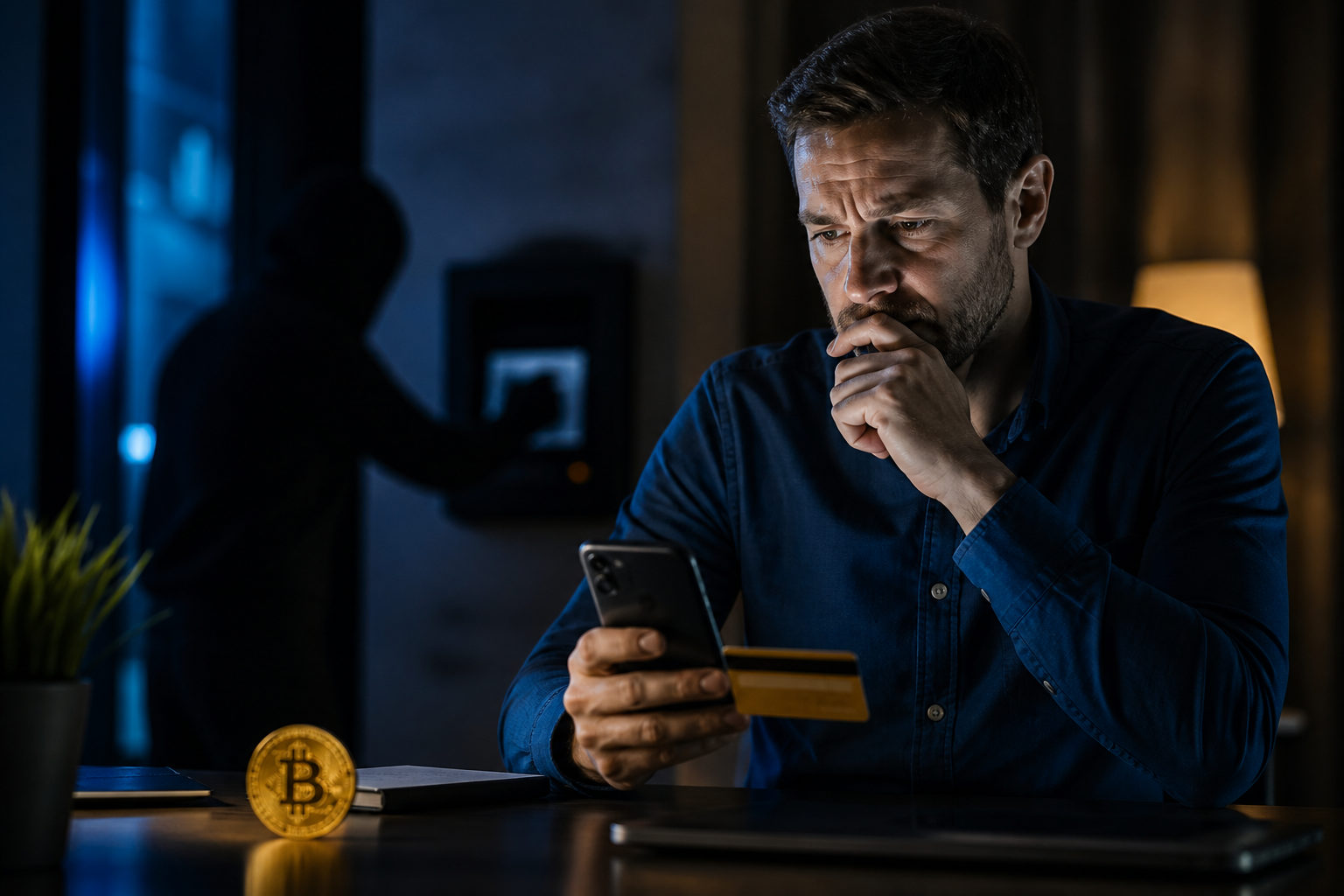
Bitcoin skimming usually means someone moves or steals your bitcoin without permission by abusing wallet access, account credentials, payment steps, or your trust.
What people mean by “bitcoin skimming”
The phrase is not a formal technical term in Bitcoin. Most readers use it as a catch-all label for cases where BTC disappears because a scammer got control of the transaction, the wallet, or the account tied to it.
That broad use matters because Bitcoin does not work like a bank card. A confirmed bitcoin transaction usually cannot be reversed by calling a bank or filing a simple chargeback claim. In many reported cases, the network was not “charging” the victim on its own; the victim was tricked into signing, logging in on a fake page, or sending funds to the wrong address.
| Common phrase | What it usually means | Main risk |
|---|---|---|
| Wallet skimming | Seed phrase, private key, or signing access was exposed | An attacker can send BTC directly |
| Exchange account skimming | An exchange account was accessed and withdrawal control was abused | Account takeover |
| Payment skimming | The receiving address or QR code was changed | Funds go to the wrong recipient |
| Investment skimming | A fake support page or scam campaign pushed the user into a bad action | User was manipulated into authorizing the loss |
How it differs from card fraud
With card fraud, the weak point is often the card number, a code, or a merchant payment flow. Bitcoin runs on cryptographic control. If a valid signature is made with the right key, the network treats it as authorized.
That leads to a different kind of risk model. Whoever controls the private key, seed phrase, or a live withdrawal session is close to controlling the asset itself. If a transaction is confirmed on-chain, there is usually no central party that can force it back.
| Point of comparison | Card fraud | Bitcoin skimming cases |
|---|---|---|
| Core control | Card and bank account system | Private key, seed phrase, signing power |
| Reversal options | Sometimes possible through disputes | Usually not reversible after confirmation |
| Common entry point | Card details, one-time codes, stored payment access | Fake wallet pages, account takeover, address swap, malicious signing |
| User responsibility | Shared with banks and merchants | Much heavier on the holder |
The most common ways bitcoin gets “skimmed”
Fake wallets and fake login pages
A scammer copies the look of a wallet app, browser extension, or exchange page and waits for the victim to enter a seed phrase, password, or code. Once that information is exposed, moving funds can be very fast.
This is one reason beginners should care about where software comes from. In Bitcoin, a clean-looking interface does not prove trust.
Address replacement during a transfer
Some malware watches the clipboard. You copy a bitcoin address, paste it into the send field, and the software silently swaps it for another one controlled by the attacker.
QR codes can be changed too. A payment can look routine while the destination has already been altered.
Fake support and impersonation scams
Many losses come from social engineering rather than a direct technical break-in. Someone claims to be support staff, a project admin, or even a friend, then asks you to “verify” a wallet, connect it to a page, or send a test payment.
The pressure is usually emotional: account problem, urgent reward, blocked withdrawal, expired claim. Once the victim follows the script, the attacker gets what is needed to drain funds.
Malicious signing requests
Not every wallet prompt is a transfer request. Some pages ask for a signature, and a beginner may not know whether it is a harmless login check or part of a risky approval path.
That confusion is enough for many scams. If the page is unfamiliar and the request is unclear, approving it just to move faster is a bad trade.
What should not be called bitcoin skimming
Clear boundaries help. If you willingly send BTC to a stranger in an off-platform deal and the other party disappears, that is closer to payment fraud. If you type the wrong receiving address yourself, that is an operational mistake. If you send coins to a fake investment scheme after believing a return promise, that is an investment scam.
People often group all of these under “skimming” because the outcome feels the same: the bitcoin is gone. Still, naming the event properly matters when you review what failed and decide what to fix first.
| Situation | Better label | How to judge it |
|---|---|---|
| Seed phrase leaked and BTC was moved | Wallet theft | Control credentials were exposed |
| Fake support convinced you to send funds | Scam | You were manipulated into paying |
| Copied address changed before sending | Payment hijack | The destination was altered |
| Exchange account logged in by someone else | Account takeover | Platform security was breached |
| You entered the wrong address | User error | No outsider stole control |
What to do if you suspect bitcoin skimming
Stop using the suspicious page or app right away. Do not keep following instructions from a chat account, pop-up, or support contact you did not verify through an official channel.
If the issue is tied to an exchange account, change the password from a trusted device, review recent logins and withdrawal settings, and contact platform support through its official interface. If you suspect your seed phrase, private key, or wallet signing environment has been exposed, create a new wallet in a safer environment and move any remaining funds you still control.
Keep records of what happened: transaction hash, screenshots, email alerts, chat history, and the exact page or app involved. That may not recover the bitcoin, but it can help with reporting, internal review, and platform investigation.
FAQ
Does bitcoin skimming mean Bitcoin itself has a flaw?
Usually no. Most cases start with a fake interface, stolen credentials, a malicious device, or a scam that pushed the user into a bad action.
For a beginner, the useful question is not whether Bitcoin “broke,” but where the signing or payment path was compromised.
Can a bitcoin transfer be canceled after it is sent?
In most cases, no. Once a valid transaction is confirmed on-chain, there is usually no central authority that can reverse it for you.
That is why fast damage control matters more than waiting for a refund process that may not exist.
If I never shared my seed phrase, am I safe?
Not automatically. Address replacement, fake exchange logins, account takeover, and misleading signature prompts can still cause losses.
The seed phrase is a major risk point, but it is not the only one in a real payment flow.
Does a hardware wallet remove the risk?
It reduces exposure, especially for long-term storage, but it does not erase human error. If you confirm the wrong transaction or trust a fake setup process, damage can still happen.
A hardware wallet improves security posture. It does not replace careful review.
Is a small test transfer worth doing?
Yes, especially when the address is new or the amount matters. A test transfer can catch a wrong address, the wrong network, or a broken payment flow before the full amount is sent.
It still does not remove the need to check the address again before the final transfer.
The practical defense is simple: separate long-term storage from everyday browsing, verify where wallet software comes from, treat every signing prompt as a decision, and check the destination before sending. Those habits block a large share of what people casually call bitcoin skimming.
Disclaimer: This article is for informational and educational purposes only and is not investment, financial, or legal advice. Crypto assets are highly volatile and you could lose your entire investment. Do your own research and decide carefully.