
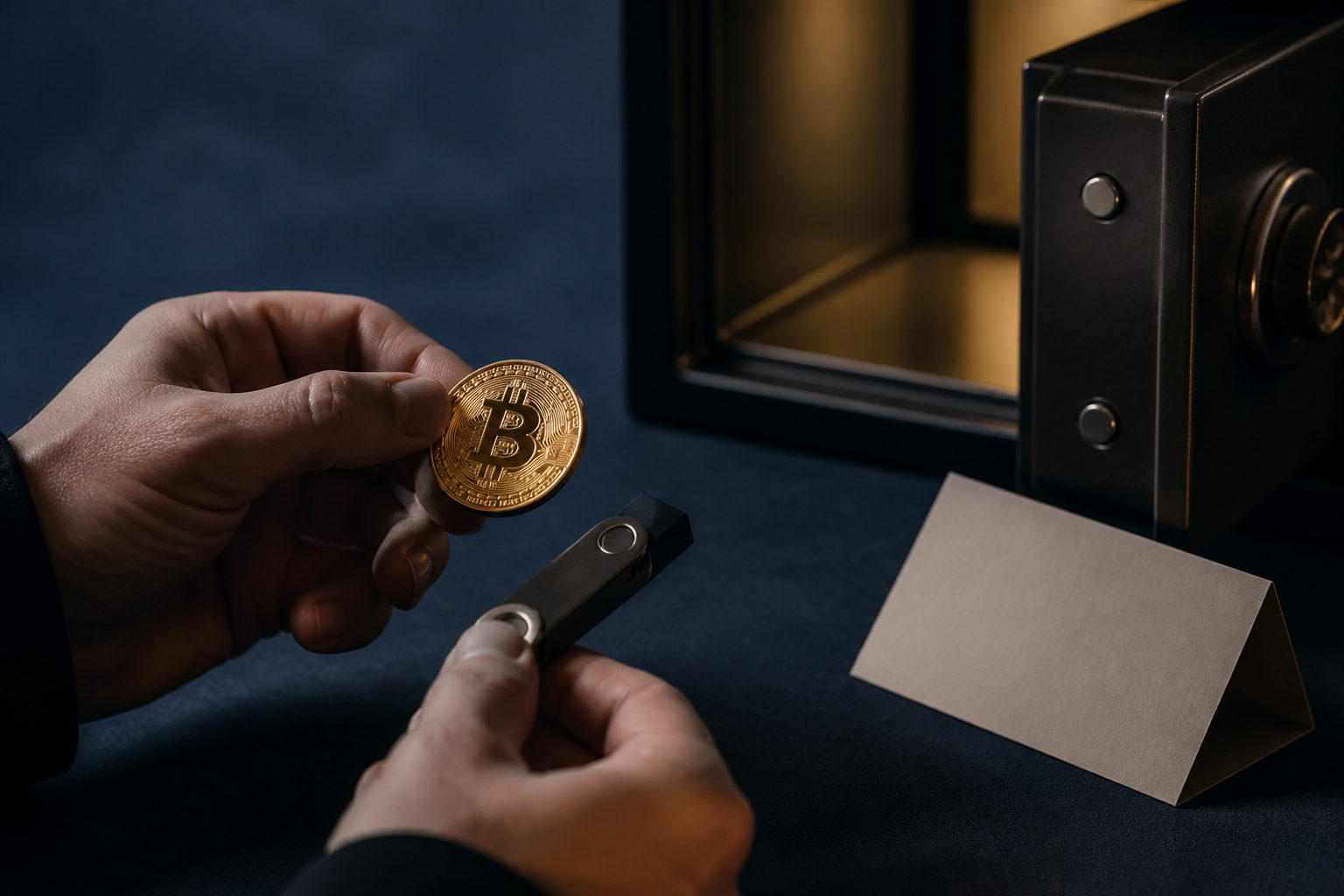
How do users control bitcoin funds? In practice, control comes from holding the private keys, or the recovery phrase that can recreate them, and using that authority to sign valid transactions.
What “control” means in Bitcoin
Bitcoin does not work like a bank account with a central party deciding ownership. The network checks whether a transaction is authorized by the right cryptographic keys. If the signature is valid, the transfer can be accepted by the network.
That means users do not control bitcoin funds by merely seeing a balance on a screen. They control them by holding the ability to spend specific outputs recorded on the blockchain. Wallet apps make this easier to manage, but the app itself is not the source of authority.
| Item | Main role | Does it equal control? |
|---|---|---|
| Balance display | Shows visible funds | No |
| Wallet software | Builds transactions and manages addresses | No, it is a tool |
| Private key | Signs transactions | Yes |
| Recovery phrase | Restores wallet keys | Usually yes |
| Exchange login | Accesses a custodial account | Usually not final on-chain control |
Private keys, seed phrases, and wallets do different jobs
A common misunderstanding is that bitcoin sits inside a phone or laptop. It does not. The blockchain holds the transaction history, while the wallet manages the credentials that let a user prove spending authority.
The private key is the direct spending credential. If it is exposed, someone else may be able to authorize a transfer. The recovery phrase, often called a seed phrase, is a human-manageable way to restore a wallet structure and its keys. For many users, protecting that phrase is the same as protecting future access.
Public addresses are different. They are meant to be shared for receiving bitcoin and checking activity. A public address can reveal privacy patterns, but it does not by itself let someone spend funds. The hard boundary is simple: addresses may be shared when needed; private keys and recovery phrases should not be shared.
| Element | Can it be shared? | Purpose | Risk if exposed |
|---|---|---|---|
| Address | Yes | Receive funds and view records | Privacy may weaken |
| Public key | Depends on context | Supports signature verification | Usually not immediate fund loss |
| Private key | No | Authorize spending | Fund control may be lost |
| Recovery phrase | No | Restore wallet access | Another party may rebuild the wallet |
Custodial and self-custodial setups give users very different control
When someone says they own bitcoin, the next question should be where and how it is held. If the coins are in a self-custodial wallet and only the user controls the keys, the user has direct control. If the coins remain on an exchange or another custodial service, the user usually controls account access, not the on-chain signing authority.
That distinction matters because convenience and control are not the same thing. Custodial services can make buying, selling, and account recovery easier. Self-custody gives the user direct authority, but it also shifts backup, device security, and error prevention onto the user.
| Holding method | Who holds signing authority | User experience | Main risk area |
|---|---|---|---|
| Exchange custody | The platform | Easy trading access | Withdrawal rules, account security, platform dependence |
| Self-custodial mobile or desktop wallet | The user | Often simpler to start with | Malware, deletion, weak backups |
| Hardware wallet | The user | More deliberate workflow | Bad backup practice, untrusted device source |
| Shared control arrangement | Multiple parties under set rules | Useful for group management | Coordination mistakes and recovery complexity |
What users must actually do to control bitcoin funds
Real control is operational, not theoretical. A user should be able to create or receive wallet credentials in a way that keeps them private. If someone else can view or copy the recovery material during setup, control is already diluted.
A user should also be able to restore the wallet without depending on the original device. If a phone breaks, an app is removed, or a computer is replaced, the bitcoin should still remain accessible through a proper recovery process. Without restoration ability, control is incomplete.
Another part of control is verifying what gets signed. Before sending bitcoin, the wallet will present transaction details such as the destination address and fees. If the user approves transactions without checking those fields, practical control slips toward habit, interface trust, or blind clicking.
Backup design matters too. A screenshot of a recovery phrase stored on a connected device may feel convenient, yet it expands the attack surface. Stronger practice usually means storing recovery material in a form that is less exposed to syncing, sharing, or remote compromise, and keeping it separate from daily-use devices.
Users also need to understand the difference between harmless-looking actions. Some services ask for a wallet connection, some request a signed message, and some ask for a transaction signature. Those are not interchangeable. Misreading that prompt can lead to approving something far more sensitive than intended.
| Action | Why it matters | If ignored |
|---|---|---|
| Keep a valid recovery backup | Preserves restoration ability | Lost device may mean lost access |
| Check destination addresses | Prevents misdirected transfers | Funds may go to the wrong address |
| Review details before signing | Confirms the scope of approval | A user may authorize an unwanted transfer |
| Separate backups from daily devices | Reduces single-point exposure | One compromise may expose full control |
| Test the recovery process | Verifies backup quality | Problems may appear only in an emergency |
Cases where users think they are in control but are not
Seeing a balance is not the same as being able to spend it. A portfolio app, a block explorer, or a watch-only wallet can show bitcoin associated with an address, yet none of those views prove the user holds the signing keys.
Another weak point appears when a third party keeps the recovery phrase while the user keeps only the login credentials. From a daily-use perspective, the setup may feel normal. At the authority level, the final power remains elsewhere.
Unverified backups create a quieter problem. A user may have written down the phrase, but with a spelling mistake, a wrong order, or incomplete records. Everything can seem fine until the original device is gone. That is when the difference between assumed control and tested control becomes obvious.
Shared-control structures can help, especially where no single person should hold full authority. They still require clear rules, clear custody of recovery materials, and a known signing process. If the structure only makes sense to one person, it may fail exactly when it is needed.
FAQ
Do I control bitcoin funds if my coins are on an exchange?
Usually not in the full on-chain sense. You control access to the exchange account and can request withdrawals, but the platform commonly controls the keys that sign blockchain transactions.
Users who want direct authority usually move funds to a wallet where they hold the recovery phrase or private keys themselves.
Can I still access my bitcoin if I lost the wallet app but still have the recovery phrase?
In many cases, yes. The recovery phrase is designed to restore the wallet structure and let the user regain access through compatible wallet software.
The key question is whether the phrase is correct, complete, and still private, not whether the original app remains installed.
Is the recovery phrase more important than the wallet password?
For most self-custodial setups, yes. A wallet password may protect one device or app session, while the recovery phrase can often recreate the wallet itself.
That is why users should treat the phrase as top-level sensitive information rather than as a routine note.
If someone knows my bitcoin address, can they take my funds?
Knowing an address alone usually does not let anyone spend from it. Spending requires the right private key or another valid signing path.
The bigger issue is privacy. Reusing the same address can make it easier for others to map incoming and outgoing activity.
How can I tell whether I truly control my bitcoin?
A practical test is whether you can restore the wallet on your own and sign a transaction without depending on a platform, support team, or outside custodian. If you cannot complete those steps independently, your control is limited.
Users should also ask who holds the recovery material and whether they understand the exact content shown before each signature prompt.
If you want a real check on control, review who holds the keys, verify that your backup can restore the wallet, and read every signing prompt before approval. Those three habits reveal whether your bitcoin is actually under your authority or only appears to be.