
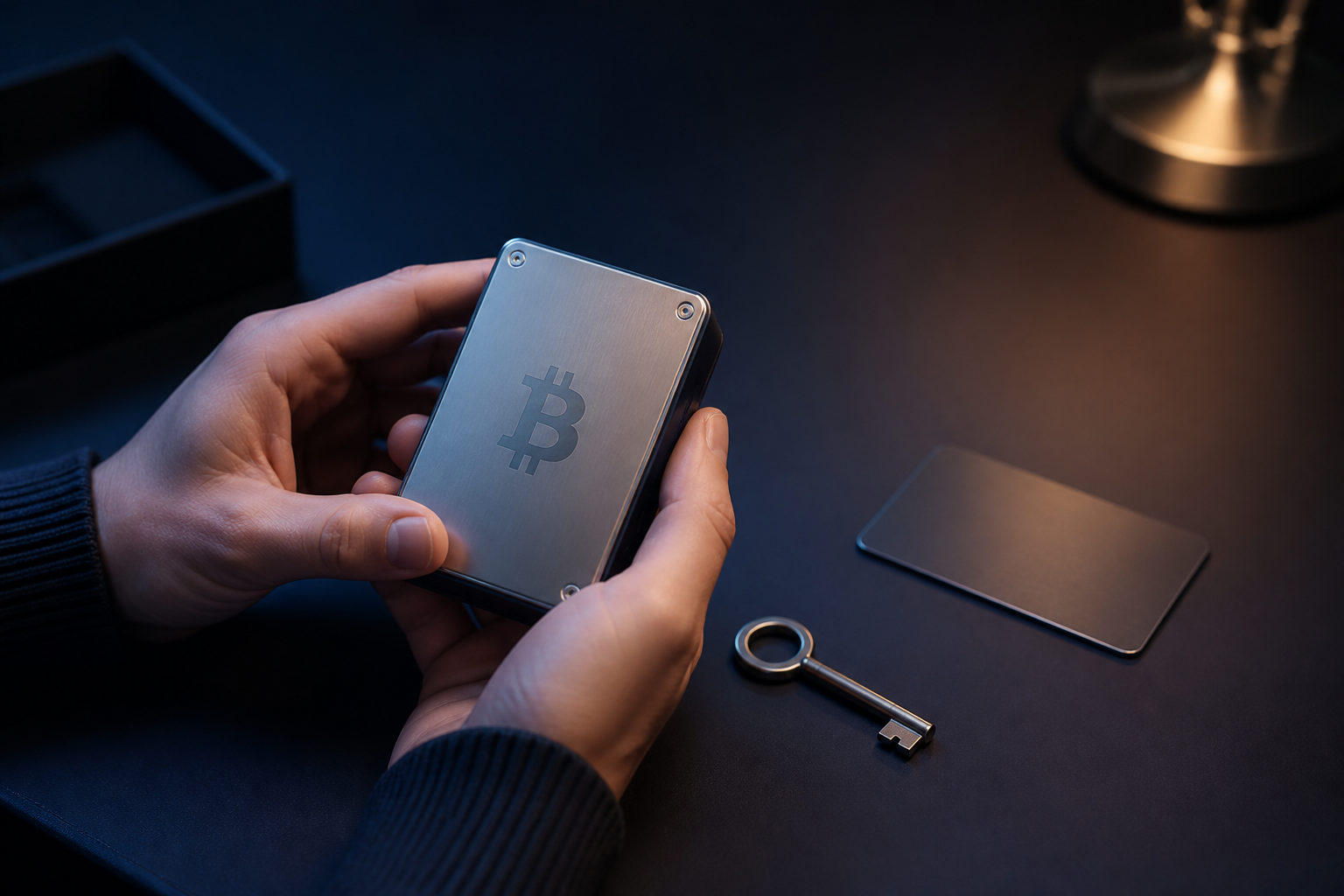
The most secure Bitcoin wallet is usually the one that gives you direct control of your private keys, keeps backups offline, and fits a workflow you can use without making costly mistakes.
Security starts with private keys, not the app name
People often talk about a Bitcoin wallet as if it stores coins inside a device or an app. What it really controls is the private key that authorizes spending. Your BTC remains on the Bitcoin network; the wallet is the tool that helps you generate keys, receive funds, and sign transactions.
That is why there is no single universal answer to the question of the most secure Bitcoin wallet. A well-known hardware wallet can still become unsafe if the recovery phrase is photographed, uploaded to cloud storage, or typed into a fake support page. A simpler wallet can be safer in practice if the keys stay isolated and the owner follows good habits.
One warning belongs near the top: Bitcoin transactions are generally irreversible. If you send funds to the wrong address or approve a malicious transaction, there is rarely a practical way to reverse it later. Wallet security is partly about technology, but it is also about reducing human error.
Comparing wallet types: where the trade-offs really sit
| Wallet type | Who controls the private keys | Connection profile | Main strength | Main risk | Best fit |
|---|---|---|---|---|---|
| Exchange custodial wallet | The platform | Managed online by the exchange | Easy to buy, sell, and access | You do not hold the keys directly; platform and account risk remain | Short-term traders |
| Mobile wallet | The user | Usually online | Convenient for payments and daily use | Fake apps, malware, phone theft | Small active balances |
| Desktop wallet | The user | Usually online | More detailed control and features | Malware, clipboard replacement, fake downloads | Users with some experience |
| Hardware wallet | The user | Keys kept apart from general internet use | Good for long-term storage | Tampered devices, bad setup, leaked seed phrase | Long-term holders |
| Paper or offline backup | The user | Can stay fully offline | Very small online attack surface | Loss, fire, water damage, transcription errors | Cold storage focused users |
| Multisig wallet | Shared across people or devices | Depends on setup | Reduces single-point failure | More complex setup and recovery | Larger holdings, families, teams |
In theory, cold storage and multisig can provide a higher security ceiling because a single mistake does not always lead to immediate loss. In real life, many losses happen for simpler reasons: a seed phrase saved in a notes app, a recovery step never tested, or a rushed transfer approved on the wrong screen.
So the best wallet depends on the job. Someone who spends BTC regularly needs a practical setup. Someone holding for the long run should think much harder about self-custody, recovery, and physical backup security.
The three factors that matter most
1. Direct control of the keys
The first question is whether the wallet is custodial or self-custodial. With a custodial wallet, a company manages access on your behalf. That may be convenient, but it means your ability to move funds depends on a third party. With self-custody, you hold the keys yourself and gain full control, along with full responsibility.
For long-term Bitcoin storage, key ownership is usually the starting point. If a service never gives you a recovery phrase or another clear way to restore the wallet independently, you are relying on someone else to protect access.
2. Offline backups that you can actually restore
The recovery phrase is often the weakest point because people treat it casually. Saving it as a screenshot, putting it in email, or storing it in cloud notes creates unnecessary exposure. A phone gallery sync or a compromised account can turn a shortcut into a complete loss.
A better method is an offline handwritten backup stored in a place only you can access. Some users also choose a more durable physical medium for backup, especially if they worry about paper damage. The material matters less than the result: the words must be correct, protected from other people, and available when you need them.
There is another step many people skip. A backup is only proven when you understand how recovery works. If your wallet device fails, your phone is lost, or your app stops working, you should know how to restore access from the recovery phrase in a trusted environment. An untested backup can fail at the worst possible time.
3. Manual verification before every transaction
Many wallet attacks target the moment right before you send BTC. Malware can swap a copied address. A phishing site can imitate a wallet interface. A fake support account can ask you to “verify” your seed phrase. None of this needs advanced code to work if the user is distracted.
Good habits make a big difference: check the first and last characters of the destination address, confirm you are using the correct asset and receiving method, and send a small test transaction when moving funds to a new address. If you use a hardware wallet, review the address and amount on the device screen itself instead of trusting only your computer or phone display.
How to choose the right setup for your situation
| Situation | Practical wallet choice | Why it fits | What you still need to do |
|---|---|---|---|
| New to Bitcoin | A reputable self-custody mobile wallet with a small balance | Easy way to learn addresses, backups, and basic transfers | Write down the recovery phrase offline and keep it out of messaging apps |
| Daily spending | Mobile wallet for a limited amount | Fast access for regular payments | Secure the phone and avoid unknown software sources |
| Long-term holding | Hardware wallet plus offline backup | Separates signing from normal internet use | Create a fresh recovery phrase during setup and store it safely |
| Larger holdings | Multisig or tiered storage | Reduces the damage from one lost device or one bad action | Document recovery steps before an emergency happens |
| Shared family control | Multisig with keys stored in different places | Avoids concentrating control in one person | Define who holds each key and who keeps each backup |
For many people, the most secure answer is not one wallet but a layered approach. Keep a small active balance in a hot wallet for routine use. Store long-term holdings in a hardware wallet or another cold storage arrangement. Add multisig when the amount or governance needs justify extra complexity.
If you want one broad rule, hardware wallets are often the first choice for serious long-term self-custody. That said, the device alone does not create safety. Security comes from the whole chain: trusted purchase source, proper initialization, clean recovery phrase handling, and careful transaction review.
An action checklist you can use right away
| Stage | Action | Why it matters |
|---|---|---|
| Before buying | Buy only from trusted official or authorized sources | Reduces the chance of tampered or preconfigured devices |
| During setup | Make sure the wallet generates a new recovery phrase for you | Prevents use of a seed phrase already known to someone else |
| While backing up | Write the phrase by hand and verify every word and order | Improves the odds of successful recovery later |
| During storage | Keep the device and the backup in separate places | A single theft or accident will not expose everything at once |
| Before sending | Review address, amount, fees, and destination details carefully | Helps avoid irreversible transfer mistakes |
| First transfer | Use a small test transaction first | Confirms the path before moving a larger amount |
| If something goes wrong | Recover only in an environment you trust and ignore private-message “support” requests | Avoids phishing and seed phrase theft |
One red flag is simple and absolute: no legitimate self-custody recovery process requires you to send your seed phrase to another person. If anyone asks for it through chat, email, or a web form you did not independently verify, treat that as a danger sign.
Bitcoin’s supply is capped at 21,000,000 BTC, with issuance continuing until about 2140, and the smallest unit is 1 satoshi, or 0.00000001 BTC. Those protocol rules are stable, but they do not protect your keys for you. Wallet security remains a matter of custody design and personal discipline.
FAQ
Is an exchange wallet safe enough for long-term Bitcoin storage?
It can be fine for temporary holding or active trading because it is easy to use. For long-term storage, many users prefer self-custody because exchange access depends on the platform, its policies, and the security of your account.
Is a hardware wallet always safer than a mobile wallet?
For long-term storage, it is often safer because the private keys can stay apart from everyday online activity. That advantage shrinks fast if the device source is untrusted or the recovery phrase is exposed during setup or backup.
What happens if I lose my seed phrase?
If you have no other valid backup, you will usually lose access permanently. The Bitcoin network does not reset ownership because a user forgot a recovery phrase.
Can one wallet be both the easiest and the most secure option?
Usually not across every use case. A split setup is more realistic: convenience for spending, stronger isolation for savings, and more advanced arrangements for larger holdings.
Should beginners use multisig right away?
Not always. Multisig can be excellent for larger balances, but it adds more moving parts to setup, backup, and recovery. Beginners often do better by mastering a simple self-custody wallet first.
If you are choosing a wallet today, start with a setup you can back up and recover on your own, then turn two habits into rules: keep the recovery phrase offline and verify every transfer before you approve it. Those steps protect Bitcoin far better than chasing a wallet name alone.
Disclaimer: This article is for informational and educational purposes only and is not investment, financial, or legal advice. Crypto assets are highly volatile and you could lose your entire investment. Do your own research and decide carefully.