


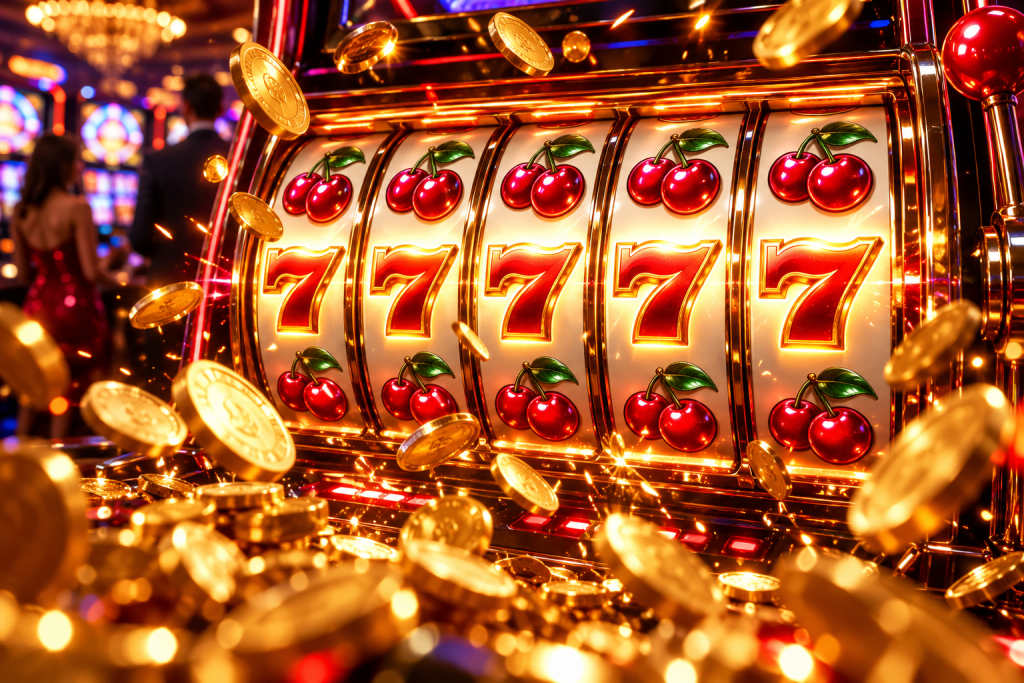
The spin you see is a display, not a draw
When you press the spin button on a 5-reel fruit slot, the reels are not spinning toward an outcome. The outcome already exists. The game's random number generator has selected a result, and the animation you watch is a presentation of that result. The cherries, lemons and bells are not falling into place; they are being shown to you in a sequence that makes the result legible.
This matters because it changes how you should read the game. Nothing about the speed of your press, the timing between spins, or the pattern of previous symbols influences the next result. Each spin is an independent event drawn from the same programmed distribution.
What the RNG does
A random number generator is the algorithm that determines game outcomes. It produces a stream of numbers at high speed, and each spin maps the next number in that stream to a position on each reel. The mapping is fixed in the game's design: a given number always corresponds to the same reel position. What varies is which number arrives, and therefore which symbols land.
Independent testing laboratories are commonly used to certify RNG behaviour. That certification covers game mechanics, not an operator's financial conduct. When a game displays an RNG certificate or testing-laboratory reference, it is telling you that the outcome distribution matches the game's published parameters. It is not a comment on whether the operator pays withdrawals on time or holds funds.
The practical consequence is that a slot has no memory. A reel that has shown three lemons in a row is not more or less likely to show a lemon on the next spin. The machine is not due, hot, or loose. Those are descriptions players attach to sequences after the fact, not properties of the game.
Reel mapping and why the paytable matters
A 5-reel fruit slot is built around a reel map: a table that assigns each possible RNG output to a specific symbol position on each reel. The visible reel strips are longer than the five symbols you see, and every position on the strip has a defined probability. High-paying symbols typically occupy fewer positions than low-paying symbols, which is how the game's return is shaped.
The paytable is the document that tells you what each combination pays. It lists the symbols, their values, and the conditions under which a win is formed. Before you stake anything, open the paytable and check three things: what the highest-paying symbol is, whether any symbol pays only on certain reels, and whether the game uses fixed paylines or a ways-to-win format.
Return to Player, or RTP, is a theoretical percentage of total wagered money a game returns to players over a very large number of spins or hands. It is a long-run statistical average, not a per-session guarantee. The same game can return far more or far less than its RTP over any single session, because the average is built from millions of outcomes.
Paylines versus ways-to-win
Two 5-reel fruit slots can look similar and resolve wins differently. The distinction sits in how paying combinations are formed.
| Feature | Fixed paylines | Ways-to-win |
|---|---|---|
| How a win forms | Symbols must land on one of the active lines | Adjacent symbols from left to right, any position |
| Stake structure | Usually requires betting all lines | Single stake covers all combinations |
| Win count per spin | Multiple lines can pay at once | Multiple ways can pay at once |
| Paytable display | Shows line patterns and per-line values | Shows symbol values and total ways |
A fixed-payline game requires betting all lines, which means your stake is divided across them. A ways-to-win format pays on adjacent-symbol combinations instead of fixed lines, so the same symbol appearing anywhere on consecutive reels can form a win. Neither format is inherently better; each simply distributes the same underlying return across a different win structure.
Read the game's information panel to see which format applies. The panel usually states the number of paylines or ways, the coin value, the total stake, and the RTP. If the panel shows a line count, you are on a fixed-payline game. If it shows a ways figure, you are on a ways-to-win game.
What volatility does and does not change
Volatility, also called variance, describes how payouts are distributed over time. High volatility means rarer but larger payouts; low volatility means more frequent but smaller ones. Volatility does not change a game's RTP. Two games can have identical RTP and very different volatility profiles.
A high-volatility 5-reel fruit slot will spend long stretches returning nothing or small amounts, then deliver a larger payout. A low-volatility game will return small amounts regularly, but rarely anything substantial. The choice between them is a choice about session shape, not about expected return. The long-run cost of play is the same if the RTP is the same.
Stake size also does not change the programmed return. Betting more per spin scales the size of wins and losses proportionally, but it does not alter the house edge on the game. A player staking larger amounts on a high-volatility game is simply compressing more variance into fewer spins.
Fixed and progressive jackpots on fruit slots
Some 5-reel fruit slots carry a jackpot, and the type of jackpot changes how the game behaves.
| Feature | Fixed jackpot | Progressive jackpot |
|---|---|---|
| Payout amount | Set amount, printed in the paytable | Grows from a share of qualifying wagers |
| Funding source | Part of the game's standard return | Typically taken out of the game's return |
| Reset behaviour | Does not reset | Resets to a seed amount after a win |
| Qualification | Usually any stake | Some require a maximum-stake bet |
A fixed jackpot pays a set amount and is simply another line on the paytable. A progressive jackpot grows from a share of qualifying wagers and resets after a win. Progressive contributions are typically taken out of the game's return, which means the base game pays slightly less to fund the growing top prize. Some progressives require a maximum-stake bet to qualify, so check the jackpot rules before assuming your stake is eligible.
How to read a game's information panel
Every modern slot carries an information panel or help screen, usually opened with an "i" or "?" button. This panel is the authoritative source for the figures that matter to your session. It typically contains the RTP, the volatility rating if the operator publishes one, the payline or ways count, the stake range, and the jackpot rules.
When you open the panel, read it in this order. First, confirm the RTP. Second, check the volatility label if present. Third, confirm whether the game uses paylines or ways-to-win. Fourth, open the paytable and look at the highest-paying symbol and any special symbols such as wilds or scatters. Fifth, check the jackpot section if one exists, and note whether a maximum stake is required.
If a figure you want is not in the panel, it is not a figure you should guess. The operator's terms page and the game developer's published documentation are the other places where RTP and rule details appear. A figure that appears nowhere in those sources is not a figure you can rely on.
What no play pattern can change
The programmed return on a slot is fixed in its design. No sequence of stakes, no stopping rule, no pattern of when you press spin, and no reading of previous outcomes alters the house edge. The RNG draws from the same distribution on every spin, and the reel map assigns the same probabilities to every symbol position regardless of what came before.
What you control is narrower and entirely structural: which game you play, what stake you set, how many spins you make, and when you stop. Choosing a game with a higher published RTP changes the expected rate of loss. Choosing a lower-volatility game changes how your session is likely to feel. Neither choice changes the fact that the edge stays with the house on every bet, and that long-run results converge on the published RTP.
FAQ
Do 5-reel fruit slots pay better than 3-reel ones?
Not inherently. The number of reels changes the complexity of the reel map and the variety of win structures, but it does not set the RTP. Two games with different reel counts can have identical published returns, and the paytable is the only place to see what a specific game is configured to return over the long run.
Can I tell when a fruit slot is about to pay out?
No. Each spin is an independent draw from the same programmed distribution. The symbols that appeared on previous spins do not change the probability of what appears next, and no visible pattern on the reels signals an upcoming payout. A machine that has not paid recently is not due to pay.
Does betting the maximum improve my odds?
It depends on the game's rules, not on any change to the underlying odds. On some progressive jackpot slots, a maximum-stake bet is required to qualify for the top prize, which changes what you are eligible to win but does not change the base-game return. On games without that requirement, staking more simply scales wins and losses proportionally.
Play responsibly. If you or someone you know has a gambling problem, call the helpline printed in the footer below for confidential support.
Play responsibly
Gambling should be treated as paid entertainment, never as a way to earn income or recover losses. 1-800-MY-RESET (1-800-697-3738)
18+ or 21+ depending on where you are; follow the minimum age that applies to you.
This article is general information about how these mechanics work. It is not legal advice and not a recommendation to gamble or to use any particular operator. Availability and legality differ by jurisdiction — check the rules that apply where you are.