


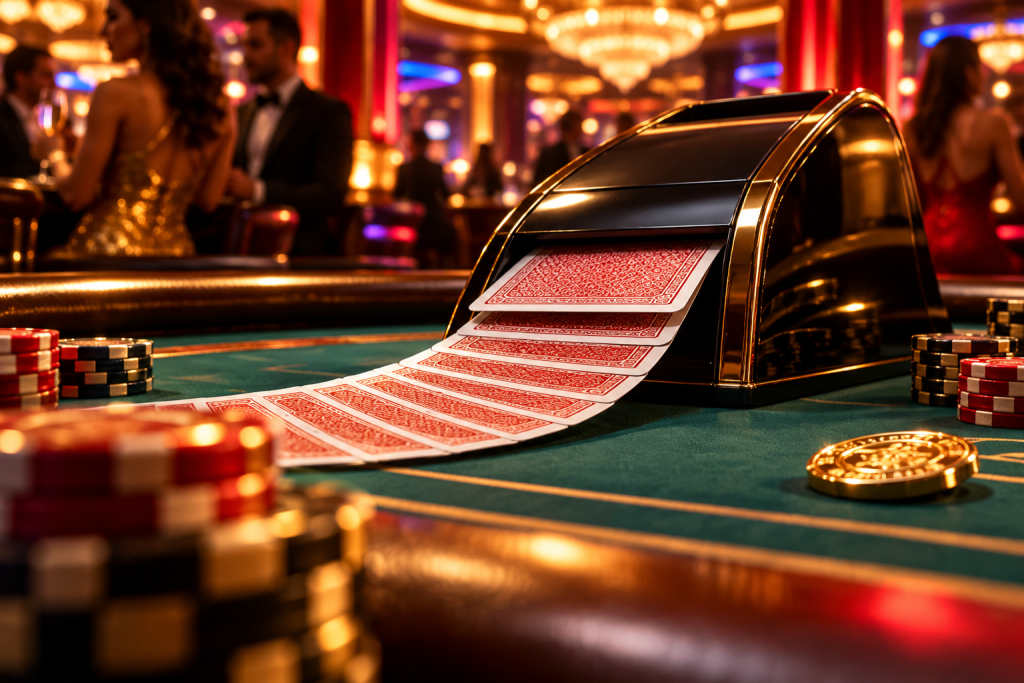
The first thing to understand is that the shoe is not the game
A dealing shoe is a box, usually plastic or wood, that holds a stack of cards and lets the dealer pull them out one at a time without touching the deck. The shoe itself has no rules and no memory. It does not change the value of a ten or the order of the cards. What it changes is how many cards are in play before anyone shuffles, and that single fact reshapes how a blackjack table runs.
When a blackjack table uses a shoe, it normally means the game is being dealt from more than one deck. The shoe exists so the dealer can handle four, six, or eight decks without a stack of cards tipping over or being palmed. A single-deck game is usually dealt from the dealer's hand. A shoe game is dealt from the box, and the box is refilled only when the cards run low.
This matters to a player for one practical reason: the number of decks in the shoe is printed on the table layout or on a placard beside the shoe. Before you buy in, look at that number. It tells you which published basic-strategy chart applies, because those charts are built for a specific deck count and a specific set of table rules.
What the shoe does during a round
The shoe's job is mechanical. The dealer slides the next card out of the front opening, face down for the players' first cards and face up for most subsequent cards, depending on the table's dealing style. The shoe keeps the cards in a fixed order between shuffles and makes it harder for a card to be accidentally exposed or deliberately manipulated. It also speeds up the game, because the dealer's hand movement is shorter than reaching into a hand-held deck.
From the player's side, the shoe changes two visible things. First, you will not be asked to cut a hand-held deck in the same way; instead, a coloured plastic cut card is inserted into the stack by a player, and the dealer places the shoe's contents behind that card. Second, the dealer will not shuffle after every round. Play continues until the cut card appears, and then the remaining cards are gathered and shuffled.
The cut card is the quiet part of the mechanism. It sits somewhere near the back of the shoe, and when the dealer reaches it, the round finishes and a new shuffle begins. Where that card is placed determines how many cards are dealt before the shuffle, and that placement is set by house procedure, not by the player.
How a shoe game round moves from buy-in to settlement
You sit down, place cash on the felt, and the dealer spreads it out and calls to the floor supervisor. The cash is exchanged for chips, and you put a wager in the betting circle before the dealer begins the hand. In a shoe game, the dealer then draws cards from the shoe rather than from a deck held in hand.
Each player receives two cards, and the dealer takes two, with one dealer card face up in most common formats. Decisions then move around the table. You may stand, hit, double down, or split pairs, depending on what the table rules allow and what your two cards are. Each decision is a signal, usually a hand motion, because the shoe table is watched by cameras and the dealer must be able to see and call every action clearly.
When all players have acted, the dealer plays the dealer hand according to a fixed procedure printed on the table, usually drawing to a specified total and standing beyond it. Winning bets are paid at even money, a blackjack is paid at the table's posted rate, and losing bets are collected. The cards go to the discard tray, and the next round begins from the shoe without a shuffle.
Bet types and how their edges differ
Blackjack is unusual among table games because the player's decisions change the expected loss on a hand. The main bet is the original wager in the circle, and its edge depends on the rule set in force and on how accurately the player follows the basic strategy for that rule set. Side bets, where offered, are separate wagers with their own edges, and those edges are generally higher than the main game.
| Bet or decision | What it is | What changes the edge |
|---|---|---|
| Main wager | The bet placed before cards are dealt | Deck count, dealer stand rules, doubling and splitting rules, and the player's strategy accuracy |
| Double down | An additional wager equal to the original, taken with exactly one more card | Allowed on which totals, and whether allowed after splitting |
| Split | Separating a paired hand into two hands, each with its own wager | Whether re-splitting is allowed, and whether doubling after split is allowed |
| Side bets | Optional extra wagers on events such as pairs or card combinations | Each side bet has its own pay table and its own house edge, usually higher than the main game |
The table above is a comparison of decision types, not a set of numbers. The actual house edge on the main wager is not a single figure that travels from casino to casino. It is a function of the specific rule set: how many decks are in the shoe, whether the dealer stands or hits on a soft total, whether doubling after splitting is allowed, and how blackjack is paid. Published basic-strategy charts derive from exactly that rule set, which is why a chart for a single-deck game is not the correct chart for an eight-deck shoe game.
What the shoe means for card counting and shuffle timing
A shoe holds more cards than a hand, so the composition of the remaining cards changes more slowly from round to round. That is the entire reason casinos moved to shoe games decades ago. A player who tracks the proportion of high cards to low cards gets less information from a six-deck shoe than from a single deck, because removing one ten from six decks changes the remaining mix less than removing one ten from one deck.
The shuffle point also matters. The cut card is placed by house procedure, and its position determines how many cards are never dealt. A deeper cut means more cards in play before the shuffle; a shallower cut means fewer. The player does not choose this. The table's dealing procedure does.
None of this changes the basic arithmetic of the game. The shoe does not make blackjack fairer or less fair by itself. It changes the rate at which information about the remaining cards becomes useful, and it changes which strategy chart is the right one to follow.
Procedural mistakes new players make at a shoe table
The first mistake is touching the cards. In a hand-held single-deck game, players sometimes hold their cards. In a shoe game, the cards stay on the felt, and the player signals decisions with hand motions. Reaching toward the shoe or picking up a card will draw an immediate correction from the dealer, because the cameras need a clean view of every card and every action.
The second mistake is using the wrong strategy chart. A player who memorised a single-deck chart and sits down at an eight-deck shoe game is making decisions that do not match the rule set in front of them. The fix is simple: read the placard on the table, confirm the deck count and the dealer stand rule, and use the chart that matches those conditions.
The third mistake is treating a side bet as part of the main game. Side bets settle on their own conditions and carry their own edges. Betting the main wager correctly and then adding a side bet on every hand changes the overall expected loss, because the side bet's edge is applied to every unit placed on it, regardless of how well the main hand is played.
How to read a shoe game before you sit down
Stand behind the table for a minute and look at three things. First, the placard or layout print that states the number of decks in the shoe. Second, the table rules for the dealer's draw, doubling, and splitting, which are usually printed on the felt or available from the dealer on request. Third, the payout for a blackjack, because a lower payout on a natural changes the edge on the main game.
Those three pieces of information are the entire rule set you need to select the correct basic-strategy chart. The shoe itself is just the container. The rules printed around it are what determine how the game should be played.
FAQ
How many decks are in a blackjack dealer's shoe?
The number is set by the individual table and is printed on the table layout or a placard beside the shoe. Common configurations include four, six, and eight decks, but the only number that matters is the one posted at the table where you are playing. The deck count determines which published basic-strategy chart applies.
Why do some blackjack games use a shoe and others do not?
A shoe is used when the game is dealt from multiple decks, because a large stack of cards is easier to handle and protect inside a dealing box. Single-deck games are usually dealt from the dealer's hand. The shoe also slows the rate at which the remaining card composition changes, which is why multi-deck shoe games became the standard format in many venues.
Does the shoe change the odds of blackjack?
The shoe itself does not change the odds. The number of decks in the shoe is one of the rule variables that affects the house edge on the main wager, along with the dealer's draw rule, doubling and splitting permissions, and the blackjack payout. A player changes the expected loss on a hand by matching decisions to the correct basic-strategy chart for that rule set.
Gambling involves risk. Please gamble responsibly. If you or someone you know needs support, contact a local helpline or support service in your area.
Play responsibly
Gambling should be treated as paid entertainment, never as a way to earn income or recover losses. 1-800-MY-RESET (1-800-697-3738)
18+ or 21+ depending on where you are; follow the minimum age that applies to you.
This article is general information about how these mechanics work. It is not legal advice and not a recommendation to gamble or to use any particular operator. Availability and legality differ by jurisdiction — check the rules that apply where you are.