


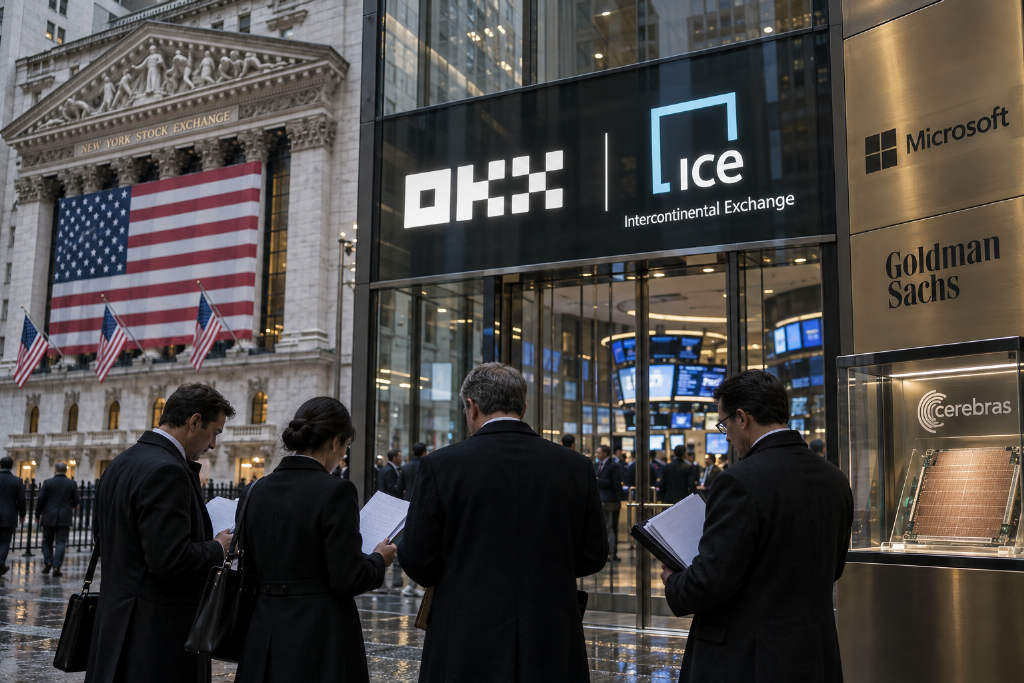
Microsoft, Goldman Sachs and other companies have filed objection notices against OKXICE’s plan to issue and trade third-party stock tokens on its platform, but those filings do not mean they oppose stock tokenization as a whole.
As of Oct. 19, OKXICE had disclosed 16 companies that submitted objections, seven more than the previous week. Fifteen of them were part of the platform’s proposed list of 62 companies whose shares could be tokenized, while AI chip company Cerebras also objected despite not being on that list.
OKXICE is a joint platform involving crypto exchange OKX and Intercontinental Exchange, the parent company of the New York Stock Exchange. It plans to enable 24-hour onchain trading of tokenized shares tied to 62 U.S.-listed companies.
In its first notice on Oct. 4, OKXICE listed 63 ticker symbols representing 62 companies, with Alphabet appearing under two tickers. Of the 16 companies that have objected so far, 15 were on that list, or about 24%, while 47 had not disclosed objections. Cerebras was the 16th company to object.
The list expanded quickly over 15 days. AppLovin and two other companies were added on Oct. 8. By Oct. 15, the total had reached nine, including Broadcom, Verizon and UnitedHealth. On Oct. 19, Microsoft, Alphabet, Goldman Sachs, Qualcomm, Caterpillar, McDonald’s and Western Digital were added.
The public notices did not explain why the companies objected. According to The Block, Applied Optoelectronics said its objection was tied to uncertainty around price, liquidity and volatility.
How the SEC exemption gives issuers a veto on specific platforms
On Sept. 17, the U.S. Securities and Exchange Commission released a five-year “innovation exemption” that created two conditional exemptions. A qualified tokenized securities venue, or TSV, would not be treated as an “exchange” under the Securities Exchange Act, and certain firms providing liquidity to such venues would not be treated as “dealers.”
The framework applies to tokenized versions of stocks listed on U.S. exchanges and some ETFs. Trading is limited to permissioned automated market makers and liquidity pools. Synthetic third-party tokens are excluded. The token must carry the same economic rights and voting rights as the underlying share. The exemption also imposes limits on the number of assets and trading volume, along with public notice, recordkeeping and synchronized trading halts with the underlying stock.
The SEC also made clear that the exemption only addresses the “exchange” and “dealer” definitions. Anti-fraud provisions and registration or exemption requirements for token issuance still apply.
One condition directly affects issuers. If a token is issued by a third party unrelated to the company, the platform must first provide written notice to the issuer and wait 30 days. If the issuer submits a written objection during that period, the platform cannot list that stock token. If the issuer does not respond, the platform may treat that as no objection.
That rule has three important limits. It applies only to third-party-issued tokens, not to tokens issued by the company itself or by an authorized party. The objection applies only to the platform that sent the notice, so a different platform would need to restart the 30-day process. The objection must also be publicly disclosed.
The SEC said issuers may worry about how shareholder records would be maintained once shares move onchain and whether token prices could diverge from the underlying stock. The framework itself recognizes that issuers retain a say in how tokenization is carried out.
Objections to OKXICE have not stopped other tokenization efforts
The companies objecting to OKXICE have not fully stepped away from tokenization.
On July 15, about 40 institutions completed live transactions using tokenized versions of assets held through DTC, the securities depository operated by the Depository Trust & Clearing Corporation. Goldman Sachs was among the participants. The assets involved included Microsoft shares, shares of USDC issuer Circle, the Nasdaq-100 ETF QQQ, the S&P 500 ETF SPY and U.S. Treasuries.
Settlement took place on Besu, the private network used by DTCC, and on Canton, a blockchain built for regulated finance. DTCC said the tokens preserved the same rights and ownership as the original assets. Its full tokenization service is expected to launch in October for DTC participants.
Nasdaq rejected the OKXICE model while backing its own framework
Nasdaq is not among the 16 companies on the objection list, but it separately said it would not allow its stock to be tokenized under the OKXICE framework.
A Nasdaq spokesperson told The Wall Street Journal that the exchange does not want its stock trading on a platform that does not display the best bid and offer in real time, does not report trades to the consolidated tape and does not maintain an order book. Under the SEC exemption, qualified venues are not subject to Regulation NMS, and OKXICE’s own disclosure says the platform has no order book.
At the same time, Nasdaq is moving ahead with its own tokenization route. Nasdaq previously said its venture arm, Nasdaq Ventures, agreed to invest $100 million in Payward, the parent company of Kraken, to advance a Nasdaq Equity Token framework centered on issuers.
What OKXICE says about the objections
Andrew Cuomo, co-chair of OKXICE and former governor of New York, said the notices were “not objections” and that some companies simply want to watch how the tokenized stock model works before deciding. He also described the project as a limited experiment with caps on the number of assets and trading volume.
According to OKXICE’s notice, for stocks classified in Tier 1 under the limit up-limit down, or LULD, mechanism, the platform may offer no more than 75 assets, and daily trading volume in each stock may not exceed 0.25% of that stock’s average daily trading volume in the prior month.
Carlos Domingo, chief executive of tokenization company Securitize, said issuers have different ways to participate, including issuer-led structures. For OKX, that points to another possible route: acting as a distribution layer for tokenized shares that issuers are willing to authorize, rather than rushing to issue them first.
DTCC’s tokenization service is expected to go live this month. If Microsoft shares eventually appear both as officially channeled tokens and as tokens on a third-party platform, questions over price reference and holder rights would remain central.
This article is for reference only and does not constitute investment advice. Markets involve risk, and caution is advised.