


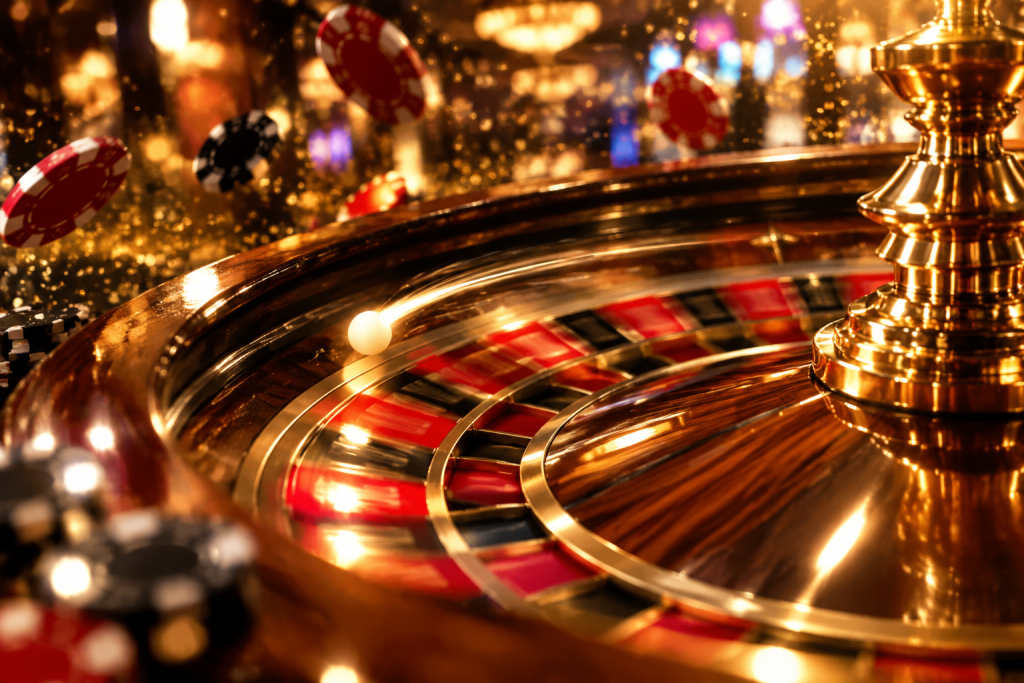
The wheel does not remember the last spin
A roulette wheel has no memory. The ball does not know it landed on red three times in a row, and the pockets do not get used up. Each spin is an independent event, which means the probability of any given number appearing is the same on the next spin as it was on the first, no matter what happened before. A run of five blacks does not make red more likely on the sixth spin. The wheel is not balancing a ledger.
What changes between spins is not the odds but what the player notices. Human beings are pattern-seeking. When the same colour or section appears several times in a row, it feels significant, but in a sequence of independent events, streaks are not only possible, they are expected to occur with some regularity. A sequence with no streaks at all would be the surprising one.
Random does not mean every number is equally likely on every wheel
The word random is doing two different jobs in this question. One job is about independence: no spin influences the next. The other job is about distribution: whether every possible outcome has the same chance of occurring. On a fair wheel, every pocket is equally likely on any given spin, but the number of pockets depends on the wheel type.
| Wheel type | Pockets | Zero pockets | What that does to a single-number bet |
|---|---|---|---|
| European | 37 | One (0) | One winning pocket out of 37 equally likely outcomes |
| American | 38 | Two (0 and 00) | One winning pocket out of 38 equally likely outcomes |
The extra zero pocket on the American layout does not make any individual number more or less random. It adds one more losing pocket for most bets, which changes the house edge. The numbers are still drawn from a fixed set of equally likely pockets; the set is just larger, and the extra pocket favours the house.
Where the house edge lives on a single-number bet
A single-number bet pays at odds that do not match the true odds of winning. On a European wheel, a straight-up bet has one winning pocket out of 37, so the true odds against winning are 36 to 1. The standard payout is 35 to 1. That one-unit shortfall, repeated across a very large number of spins, is the house edge.
The relationship between return to player and house edge is a complement: they sum to 100% for the same bet under the same rule set. If a game returns a given percentage to players over the long run, the house keeps the rest. The house edge is not a fee deducted from each spin, and it is not a force that changes the outcome of any individual spin. It is a statistical property that emerges from the payout being slightly smaller than the true odds would justify.
Suppose a European wheel pays 35 to 1 on a straight-up bet. The probability of winning is 1 in 37. Over a very large number of spins, the expected return per unit wagered can be worked out from those two numbers, and the result is less than one unit. The shortfall is the house edge. The same arithmetic applies to every other bet on the layout, because every payout is set relative to the number of pockets that win and the number that lose.
Short sessions look nothing like the long-run average
The house edge only shows up clearly across a very large number of spins. In a short session, variance dominates. A player might win on their first spin, or lose ten spins in a row, and neither outcome tells them anything reliable about the underlying edge. The long-run average is a property of the game; the short-run result is a property of luck.
This is why a player can leave a table ahead even though the game has a built-in house edge. The edge is small on any single spin, and the range of possible short-term outcomes is wide. Over enough spins, the actual result tends to track the expected result, but the path there is noisy. The number of spins played in one sitting is usually far too small for the long-run average to assert itself.
What decisions per hour do to total exposure
The house edge is expressed as a percentage of each wager, which means the total expected loss depends on how much is wagered in total. That total is a function of three things: the size of each bet, the number of bets placed, and the speed at which they are placed. A player who bets more per spin, or plays more spins per hour, or plays for more hours, wagers more in total, and therefore exposes more money to the same percentage edge.
This is not a strategy observation. It is arithmetic. The edge does not change when the player bets faster or slower. What changes is the amount of money that passes through the game, and therefore the expected loss measured in absolute terms. A slower game with smaller bets produces a smaller expected loss over the same period, not because the game is fairer, but because less money has been wagered.
Why progression systems redistribute outcomes instead of removing the edge
A progression system is a betting pattern that changes the stake after wins or losses. The most familiar version doubles the bet after a loss, on the theory that a win will eventually recover all previous losses plus a small profit. The pattern feels like it should work, because a win does eventually arrive, and when it does, the larger bet covers the earlier losses.
The problem is that the edge is still there on every spin, including the spins where the bet has been doubled. No betting pattern changes the probability of any pocket, and no pattern changes the payout odds. What a progression does is shift the distribution of outcomes: it produces many small wins and a small number of large losses. The large losses arrive when a losing streak runs long enough that the required bet becomes very large, or hits the table maximum. The expected loss across all outcomes is the same as it would be with flat betting, because the total amount wagered and the edge per unit wagered are unchanged.
Suppose a player doubles their bet after every loss, starting from one unit, and the table has a maximum bet. A losing streak of a handful of spins pushes the required bet past the maximum, and at that point the progression can no longer recover the accumulated losses in a single win. The system has not removed the edge; it has concentrated the losses into the rare event of a long streak.
Physical wheels, RNG wheels, and what random means in each
A physical roulette wheel is a mechanical device. The ball is spun in one direction, the wheel in the other, and the outcome depends on the speed of both, the position of the ball when it is released, the tilt of the wheel, and the physical imperfections of the pockets and frets. In principle, a physical wheel could have a bias if it is worn or manufactured unevenly, and some players have attempted to detect such biases by recording thousands of spins. In practice, modern wheels are maintained and tested to keep the pockets as uniform as possible, and any bias large enough to exploit would be difficult to detect before the venue notices it too.
An online roulette game uses a random number generator, which is an algorithm that produces outcomes. The algorithm is designed to produce a sequence of numbers that passes statistical tests for randomness, and independent testing laboratories commonly certify that the RNG behaves as intended. That certification covers the mechanics of the game, not the financial conduct of the operator, and it does not mean the game has no house edge. The edge is built into the payout table, not the RNG.
What a fair wheel does and does not promise
A fair wheel promises that every pocket has the same chance of appearing on any given spin, and that no spin influences the next. It does not promise that every number will appear equally often in a short session, and it does not promise that a player will win back what they have lost. The house edge remains on every bet, and the short-run results remain noisy. The randomness is real, but it is randomness with a built-in tilt toward the house, expressed not in any single spin but in the payout odds across all spins.
FAQ
Can a roulette wheel be biased?
A physical wheel can in principle have a bias if it is worn, tilted, or manufactured unevenly, and some players have tried to detect such biases by recording large numbers of spins. Modern wheels are maintained and tested to keep the pockets uniform, and any bias large enough to matter would be difficult to find before the venue notices it as well. An RNG-based game is tested for statistical uniformity, but that certification covers the mechanics, not the operator's finances.
Does the previous spin affect the next spin in roulette?
No. Each spin is an independent event. The probability of any number appearing is the same on every spin, regardless of what happened before. Streaks of the same colour or section are expected in a sequence of independent events and do not change the odds of the next spin.
Why does the house edge not show up in every session?
The house edge is a long-run statistical property that emerges over a very large number of spins. In a short session, variance dominates, and the range of possible outcomes is wide enough that a player can finish ahead or behind by an amount that has little to do with the edge. The edge is always present, but it is small on any single spin, and the noise of short-run results hides it.
Play responsibly
Gambling should be treated as paid entertainment, never as a way to earn income or recover losses. 1-800-MY-RESET (1-800-697-3738)
18+ or 21+ depending on where you are; follow the minimum age that applies to you.
This article is general information about how these mechanics work. It is not legal advice and not a recommendation to gamble or to use any particular operator. Availability and legality differ by jurisdiction — check the rules that apply where you are.