


The question behind the question
A reader asking whether a slot machine can detect fake money is usually asking one of two things: whether a counterfeit bill will be caught at the machine itself, and what happens after it is caught. Both answers sit inside a layered validation process that has been standard in the gaming equipment industry for decades, and neither answer depends on the machine being especially clever. The machine is a checkpoint, not a forensic lab.
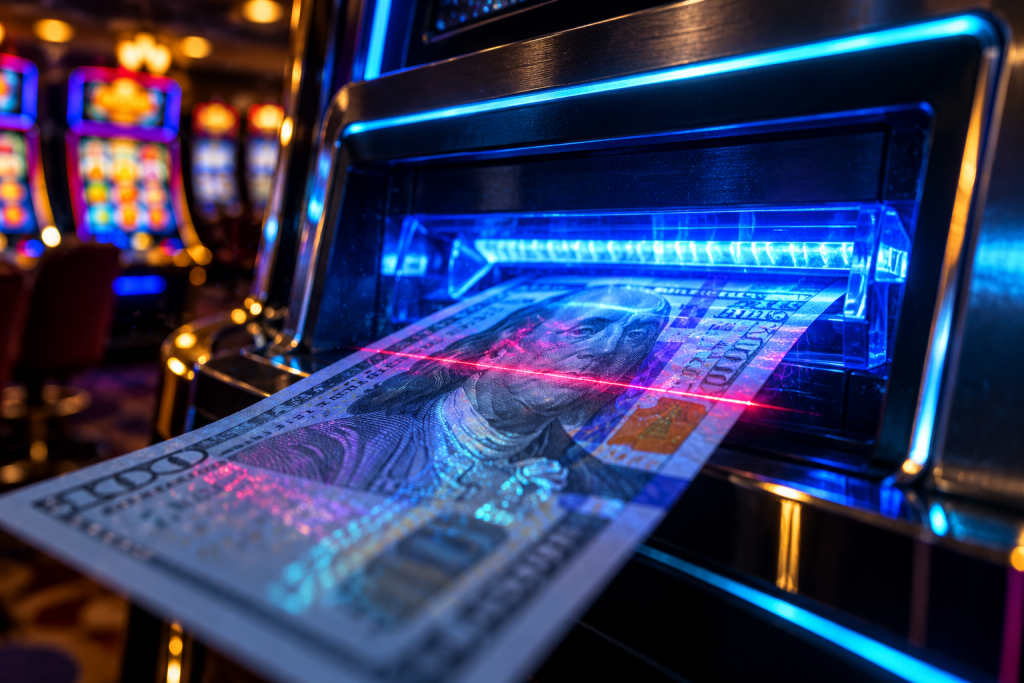
Slot machines do not visually inspect a bill the way a person does. They pass the note through a validator that measures physical and optical properties against a stored profile of genuine currency. The validator is a separate component inside the machine, and it is the part that makes the accept-or-reject decision before the machine ever registers a credit.
What the validator measures
A modern bill validator checks several properties at once, and the exact combination varies by manufacturer and by the currency the machine is configured to accept. The most common checks are optical, magnetic, and dimensional. No single check is decisive on its own; the validator combines them and compares the result against a tolerance range for the denomination being tested.
- Optical scanning reads the printed pattern under specific wavelengths of light, including infrared and ultraviolet, because genuine currency paper and ink respond differently from ordinary paper and toner.
- Magnetic sensing looks for the magnetic signature in the ink or embedded security thread, where one exists in the genuine note.
- Dimensional and thickness measurement rejects notes that are the wrong size, the wrong weight, or unevenly thick.
- Some validators also check for the presence and position of a watermark or a security thread by measuring how light passes through the paper.
The validator does not need to know why a note is fake. It only needs to find that the measured profile falls outside the accepted range for a genuine note of that denomination. When that happens, the note is returned or diverted, and no credit is issued.
What the machine cannot do
A validator is only as good as the profile it has been loaded with and the sensors it contains. A counterfeit that reproduces every measured property closely enough to fall inside the tolerance range will pass. This is not a failure of the machine in any meaningful sense; it is the boundary of what a mechanical check can do. The validator is comparing a physical object to a stored model, not establishing legal authenticity.
The machine also does not identify the person who inserted the note. It records the event, and the casino's surveillance and cage procedures handle the rest, but the validator itself makes no judgment about intent. A person can insert a counterfeit bill without knowing it is counterfeit, and the machine's response is the same either way: accept it if the profile matches, reject it if it does not.
What happens after a rejection
When a validator rejects a note, the machine typically returns it through the same slot or holds it in a divert bin for later inspection. The exact behavior is set by the machine's configuration and the casino's own procedures, not by any universal rule. A rejected note is not automatically reported to law enforcement by the machine itself. The venue's staff and its own policies determine what happens next, and those policies are not published in any single place a reader can check.
If a note is accepted and later found to be counterfeit during a count or bank deposit, the loss is handled through the casino's own cash-handling and reporting procedures. The machine has already done its job; the question has moved from the validator to the venue's back office.
Why the same bill can pass one machine and fail another
Validators are not all running the same software, the same sensor set, or the same tolerance settings. A machine configured for an older currency series may not have the profile for a newer security feature, and a machine with dirty or worn sensors may read a genuine note as suspect. The result is that the same bill can be accepted by one machine and rejected by another, not because one machine is better, but because they are calibrated differently.
Currency itself changes over time. When a central bank introduces a new series with new security features, validator manufacturers release updated profiles, and operators decide when to install them. There is always a window in which machines vary in what they recognize. This is a maintenance and configuration issue, not a fixed property of slot machines as a category.
| Validation layer | What it checks | What it cannot establish |
|---|---|---|
| Optical scanning | Printed pattern, ink response under infrared and ultraviolet light | Whether the note is legally genuine |
| Magnetic sensing | Magnetic signature in ink or security thread | Whether the person knew the note was fake |
| Dimensional check | Size, thickness, weight against stored tolerance | Whether a good forgery will pass |
| Profile comparison | Match to a stored model for the denomination and series | Whether the profile itself is current |
How the validator is maintained and updated
The validator is a field-replaceable component. Casinos and route operators swap units, clean sensors, and load updated currency profiles as part of routine machine maintenance. The machine's main processor does not make the accept-or-reject decision; the validator does, and it reports the result to the machine. This division of labor matters because it means the counterfeit-detection capability of a slot machine can be changed without changing the machine itself.
Regulators and manufacturers publish technical standards for validators, but those standards describe performance requirements and test methods, not a guarantee that every counterfeit will be caught. A reader who wants the current specification for a particular validator model should consult the manufacturer's published documentation for that model, which is the authoritative source for what that unit measures and how it is calibrated.
The role of the casino beyond the machine
The validator is only the first layer. Casinos also run cash-handling procedures, surveillance coverage, and staff training that operate independently of any single machine. A counterfeit note that passes the validator still has to survive a count, a bank deposit, and a possible audit. The machine's role is to stop the obvious cases at the point of insertion; the venue's procedures exist to catch what the machine misses.
None of this is specific to any one casino or any one machine manufacturer. The same validator technology appears across the gaming industry and in vending, transit, and retail equipment. The question of whether a slot machine can detect fake money is really a question about bill-validator technology in general, and the answer is that it can reject most counterfeits through mechanical profile matching, but it cannot establish authenticity in any legal or absolute sense.
What to confirm before you go
If a reader is concerned about counterfeit currency at a specific venue, the useful questions are operational, not technical. The venue's own policies on rejected notes, its reporting procedures, and its cash-handling practices are set locally and change over time. The authoritative source for those policies is the venue's own guest services or cage staff, not any published list.
A reader who wants to know what a particular machine model's validator checks should look for the manufacturer's published specification sheet for that validator model. A reader who wants to know how a specific jurisdiction handles counterfeit currency incidents should consult the gaming authority or law enforcement agency for that jurisdiction. These are separate questions with separate authoritative sources, and no single article can answer all three.
FAQ
Do all slot machines use the same counterfeit detection?
No. Different machines carry different validator models with different sensor sets and software profiles. A note that passes one machine can fail another because the validators are calibrated differently or loaded with different currency profiles. The machine itself only records what the validator reports.
What happens if a slot machine accepts a fake bill?
If the validator's profile match falls inside tolerance, the machine issues credit and the note enters the casino's cash flow. The counterfeit is typically caught later during a count or bank deposit, at which point the venue's own reporting and loss procedures take over. The machine has no further role.
Can a slot machine tell if a bill is washed or reprinted?
A validator checks physical and optical properties against a stored profile, so a washed or reprinted note that no longer matches the genuine profile will be rejected. A forgery that reproduces enough of the measured properties to fall within tolerance will pass. The validator measures, it does not authenticate.
Play responsibly
Gambling should be treated as paid entertainment, never as a way to earn income or recover losses. 1-800-MY-RESET (1-800-697-3738)
18+ or 21+ depending on where you are; follow the minimum age that applies to you.
This article is general information about how these mechanics work. It is not legal advice and not a recommendation to gamble or to use any particular operator. Availability and legality differ by jurisdiction — check the rules that apply where you are.