


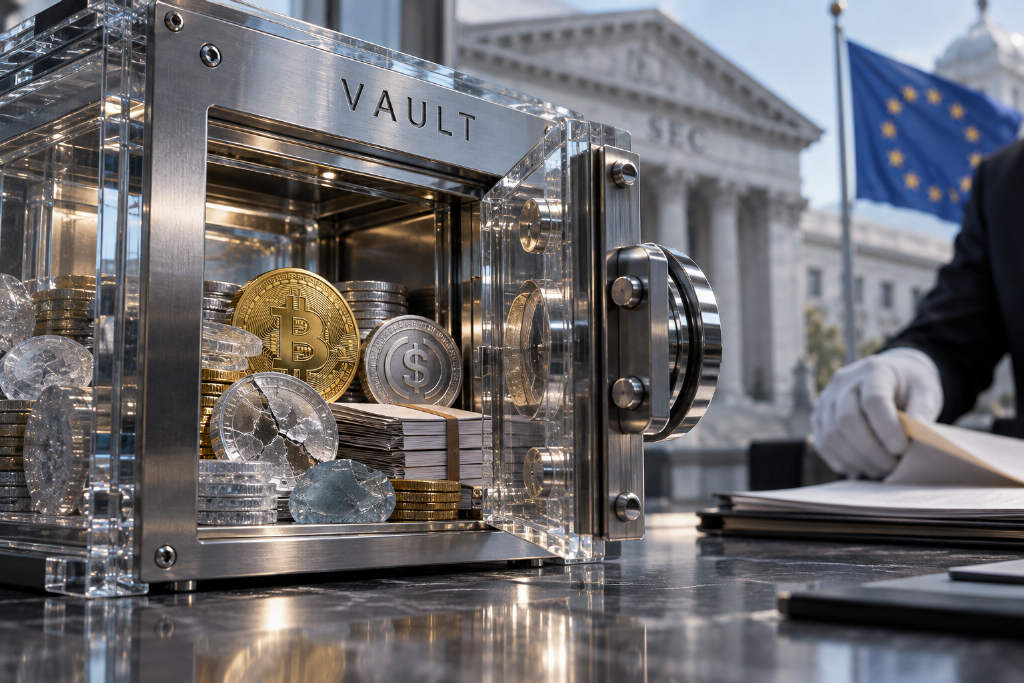
Crypto lending vaults have expanded rapidly, with deposits rising from $4 billion at the start of 2025 to more than $10 billion this year, according to a Financial Times report cited by BlockTempo. The capital is coming from fintech firms, digital asset treasury companies and hedge funds that are looking for yield rather than leaving tokens idle in wallets.
Curators run the strategy, while yields range from 3% to above 20%
These vaults are deployed through smart contracts on DeFi platforms. Each one is typically overseen by a curator, a role that resembles a fund manager in traditional finance. The curator selects lending strategies, sets risk limits and takes a fee from the interest generated by the vault.
For depositors, the structure is relatively simple. They place stablecoins or other tokens into a vault and receive an annualized return. Standard strategies usually offer yields in the 3% to 10% range. Higher-risk vaults can reach 20% or more.
That can make the product look like a DeFi version of a yield product, but the underlying assets are less transparent than those in a traditional fund. Smart contract code may be public, yet many depositors mainly see the headline yield and may not fully understand who is borrowing the funds, what collateral backs the loans or how liquidation works when markets weaken.
Collateral quality and liquidity sit at the center of the risk
The Financial Times report said collateral accepted by these lending protocols can include highly illiquid tokens, crypto-backed stablecoins and tokenized private credit. If markets fall or the collateral becomes difficult to sell, depositors are directly exposed to losses.
Automatic liquidation is designed as a safeguard for lenders, but in thin markets it can also intensify declines. Forced selling of collateral can push prices lower, trigger more liquidations and create a chain reaction. The report pointed to earlier examples in the 2022 LUNA collapse and the BendDAO NFT liquidation episode.
There are other risks as well. Smart contract vulnerabilities, faulty pricing mechanisms and hacker attacks all mean vault deposits are not risk-free. Public code does not mean a protocol has been fully audited, and it does not guarantee that losses cannot occur.
Two Prime launches a bitcoin lending vault for institutional flows
Firms with traditional finance backgrounds have already started moving into the segment. Bitcoin lending firm Two Prime launched a bitcoin lending vault in September on the Pareto protocol, targeting annualized returns of 1.5% to 2%. The capital is intended for institutional-grade loans.
The vault accepts wrapped bitcoin, or WBTC, and requires a minimum deposit of 5 WBTC. BlockTempo said Two Prime also committed about $10 million of its own capital to absorb early losses.
The move suggests institutional players are using the vault model to turn idle BTC holdings into yield, while also positioning the structure as a bridge between traditional finance and DeFi.
SEC and European regulators are both watching the sector
As vault assets grow, regulators are paying closer attention. The U.S. Securities and Exchange Commission has raised questions over whether vaults would need to comply with securities laws if the collateral they hold includes tokens that are classified as securities.
In Europe, policymakers have gone a step further. A proposal would bring intermediated services that provide access to DeFi within the regulatory perimeter.
That could leave vault curators and platform operators facing KYC and AML requirements, fund manager registration obligations and disclosure rules. For DeFi, the long-running tension between decentralization and compliance is back in focus.
A $10 billion market now faces a test of structure and oversight
At more than $10 billion, vaults are no longer an early-stage experiment. They are now a meaningful pool of capital. If regulatory rules become clearer and collateral and liquidation processes become more transparent, the model could serve as a route for DeFi to connect more directly with mainstream finance, giving both retail and institutional participants a lower-friction way to access crypto lending markets.
But the report also makes clear that higher returns come with embedded risk. If markets turn bearish and collateral liquidity dries up, vaults could become another point of stress, with losses that may echo the scale of DeFi failures seen in 2022.
For investors in Taiwan, the article noted that these products are still mainly offered through offshore platforms and do not come with local regulatory protection. That makes it important to understand who the curator is, what collateral is being used and how liquidation works, rather than focusing only on the headline yield.