


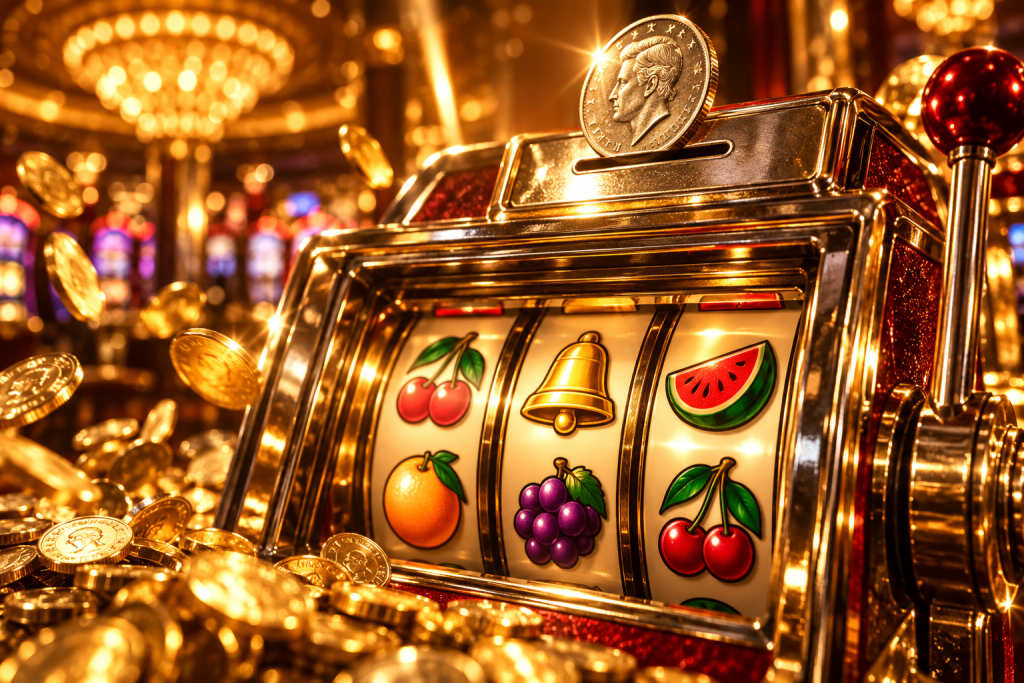
The question behind the coin slot
A reader asking whether slot machines took 50-cent pieces is usually picturing a specific machine, a specific era, or a specific casino floor. The honest first answer is that some did and some did not, and the difference comes down to the coin acceptor hardware installed on the machine, not to any universal rule about slots.
A slot machine accepts whatever its coin mechanism is built or configured to accept. That mechanism is a physical or electronic validator that checks a coin's diameter, thickness, weight, and metal signature before registering a credit. If a 50-cent piece matched the parameters the machine was set for, the machine took it. If it did not, the coin fell through to the reject tray.
This article explains how coin acceptance worked, why the 50-cent piece occupied a particular niche, and where a reader can confirm what a given machine accepts today.
How a coin slot decides what to take
Older electromechanical machines used a coin comparator. The inserted coin passed a magnet and a set of physical gates sized to the expected coin. A coin that was too light, too thick, or made of the wrong alloy tripped the reject path. A coin that matched the reference coin opened the credit switch.
Modern machines replaced the comparator with an electronic coin acceptor that stores reference signatures for one or more denominations. The operator can enable or disable specific denominations through a settings menu. The same physical slot can therefore accept a quarter on one machine and a half-dollar on the next, because the acceptance list is a configuration choice rather than a property of the slot itself.
What this means for the 50-cent piece is straightforward: the coin was accepted only on machines whose acceptors were programmed or built for half-dollar specifications. Many were. Many were not.
Why the 50-cent piece was a special case
The half-dollar was a higher-denomination coin than the quarter, which dominated slot play for decades. A machine set for quarters could not take a half-dollar unless its comparator was recalibrated or its electronic acceptor profile included the larger coin. Some machines were built as multi-denomination units and accepted both.
Casinos had a practical reason to be selective. A coin mechanism that accepted multiple denominations had to credit the correct value for each, which required either separate hoppers or a more sophisticated credit system. On older machines, accepting a 50-cent piece meant the machine had to pay out in 50-cent pieces or convert the credit into an equivalent number of quarter-sized payouts, which complicated the hopper.
That complexity is why the half-dollar never became the default slot coin. It existed, it worked on configured machines, but it was not the standard.
Coin-in versus ticket-in machines
The era matters more than the denomination. A machine built before ticket-in, ticket-out technology used physical coins for both play and payout. A machine built after TITO could still accept coins for play but paid out via printed ticket, which changed how operators thought about coin handling.
The following table separates the two acceptance models, because a reader asking about 50-cent pieces is often remembering a pre-TITO floor.
| Machine type | Coin acceptance | 50-cent piece behavior |
|---|---|---|
| Electromechanical, coin-in/coin-out | Physical comparator sized to one or two reference coins | Accepted only if built or recalibrated for half-dollar specs |
| Electronic, coin-in/ticket-out | Programmable acceptor with denomination profiles | Accepted if the operator enabled the half-dollar profile |
| Ticket-in/ticket-out only | No coin acceptor at all | 50-cent piece rejected; bills or tickets only |
The table shows why no single yes-or-no answer covers all slot machines. The acceptance path changed with the hardware generation.
What the coin's physical specifications determined
A 50-cent piece is larger and heavier than a quarter. The comparator on a quarter-only machine would reject it on diameter alone, before weight or alloy was even checked. That is a mechanical fact, not a policy decision.
On a multi-denomination acceptor, the machine had to distinguish a half-dollar from a quarter, a dollar coin, and any token the property used. The acceptor stored a reference signature for each enabled denomination and compared the inserted coin against all of them. A coin that matched none of the stored signatures was rejected.
This is why a reader cannot assume a machine that took quarters also took half-dollars. Acceptance was per-denomination, not per-slot.
Where the current answer lives
For any specific machine on any specific casino floor today, the authoritative answer is the machine itself. The credit display, the coin entry plate, or the attendant screen shows which denominations are enabled. A machine that accepts half-dollars will typically list them on the denomination panel or the service menu.
The casino cage is the other authoritative channel. Cage staff can state which coin denominations the floor's machines are configured to accept, because the cage is where coin is bought and sold. A reader planning to use 50-cent pieces should ask at the cage before assuming any machine will take them.
No published list covers every machine on every floor, because acceptance is set per machine and changed by operators as needed.
What to confirm before you go
Three things change and none of them are knowable from a general article. First, whether a specific machine has a coin acceptor at all, since many modern floors are ticket-only. Second, which denominations that acceptor is currently programmed to enable. Third, whether the property still handles half-dollar coins at the cage, since coin logistics vary by property.
Each of these is confirmed at the machine or at the cage, not from a distance. A reader who wants certainty should carry the question to the floor rather than to a search result.
FAQ
Did old slot machines take 50-cent pieces?
Some did. Electromechanical machines accepted whatever coin their comparator was sized to match. A machine built or recalibrated for half-dollar specifications took 50-cent pieces; a quarter-only machine rejected them on diameter. Acceptance was a hardware configuration, not a universal feature.
Can I still use 50-cent pieces in a slot machine today?
Only if the specific machine has a coin acceptor and that acceptor's denomination profile includes the half-dollar. Many modern machines are ticket-in, ticket-out only and have no coin slot at all. Check the machine's denomination panel or ask at the casino cage.
Why did most slot machines use quarters instead of 50-cent pieces?
The quarter was the standard coin for decades, and a machine built for quarters needed recalibration or a multi-denomination acceptor to handle half-dollars. Multi-denomination acceptance added hopper and credit complexity, so operators often stayed with a single coin size.
Play responsibly
Gambling should be treated as paid entertainment, never as a way to earn income or recover losses. 1-800-MY-RESET (1-800-697-3738)
18+ or 21+ depending on where you are; follow the minimum age that applies to you.
This article is general information about how these mechanics work. It is not legal advice and not a recommendation to gamble or to use any particular operator. Availability and legality differ by jurisdiction — check the rules that apply where you are.