
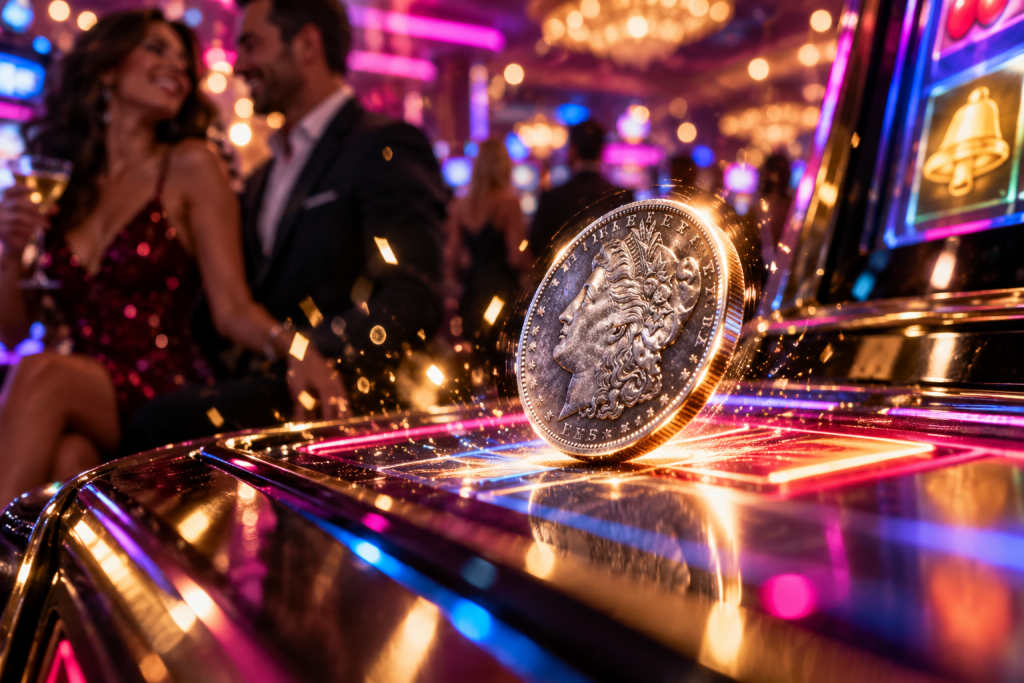
The short answer: no current Las Vegas slot machine accepts silver dollars
If you are walking through a Las Vegas casino today holding a silver dollar and looking for a machine that will take it, you will not find one. The shift away from coin-operated play is complete across the city's documented venues, and no property in the current reference set lists a coin-accepting slot machine. The machines that once took silver dollars were retired or converted as casinos moved to bill validators and ticket-in, ticket-out systems.
This article explains what changed, why the coin slot disappeared, and what you should do with a silver dollar if you are in Las Vegas now. It also gives you the documented layout of the downtown venues most associated with older coin play, so you can understand the geography of where those machines once sat.
Why silver dollars left the slot machine
A slot machine that takes a silver dollar is a mechanical or electromechanical device built around a coin comparator and a hopper. The comparator checked the coin's size, weight, and metal signature, and the hopper held enough coins to pay jackpots in physical currency. That architecture made sense when a dollar was a dollar and a jackpot was a few hundred coins.
The economics and the logistics changed. Modern machines are networked, track play electronically, and pay via printed tickets or digital credits. A coin mechanism adds maintenance, jams, coin handling labor, and security risk. Casinos removed coin acceptors because the cost of running them exceeded any benefit, not because of any single regulation. The result is that a silver dollar is now a collectible or a curiosity, not a form of payment on the casino floor.
What the documented Las Vegas venues show
The reference set for this article documents several downtown Las Vegas properties with slot machine counts. These figures come from publicly published reference sources and describe a documented point in time, not today's floor. Casinos rebuild, rebrand, and change their machine mix constantly, so any count you see here should be read as a snapshot, not a live inventory.
None of these documented counts distinguishes coin-operated machines from ticket-based machines. That distinction is not captured in the source material, which is itself a useful fact: the industry stopped reporting coin acceptance as a feature because it stopped being one.
| Venue | Documented slot machines | Documented table games | Measurement type |
|---|---|---|---|
| The D Las Vegas | 1,000 | 22 | Publicly published reference source, as-of date not stated |
| Four Queens | 105 | Not documented | Publicly published reference source, as-of date not stated |
The Four Queens figure of 105 slot machines refers specifically to a 1972 expansion called the Four Queens Arcade, not to the property's current total. That is a good example of why comparing slot counts between venues is difficult: one number may describe a single addition, another may describe a whole floor, and neither tells you what the machine accepts.
Why slot machine counts are hard to compare
Even when two venues both have a documented slot machine number, the figures are rarely measuring the same thing. One property may count only standalone reel machines, while another includes video poker, electronic table games, or multi-game terminals. A count taken before a renovation will not match a count taken after one, and a number published in a historical source may describe a casino that no longer exists under that name.
This matters for your question because a machine's ability to take a silver dollar is a physical feature that changes with the machine itself. A venue could have a thousand machines and zero coin acceptors, or it could have a single antique machine on display that is not in service. The only way to know what a specific machine accepts is to look at the machine, and in practice, the answer on a modern Las Vegas floor is that none of them take coins.
What happened to the coin slot
The disappearance of the silver dollar slot is part of a larger shift in how casino money moves. In the coin era, a player bought a roll of coins, dropped them into a machine, and collected winnings from a hopper. The casino's cash cage handled enormous volumes of physical coin, and every machine required regular emptying, counting, and refilling.
Bill validators changed the input side: a player inserted paper currency and the machine credited the amount electronically. Ticket printers changed the output side: instead of coins dropping into a tray, the machine printed a bar-coded ticket redeemable at a kiosk or cage. Once both sides of the transaction were electronic, the coin mechanism became redundant. Silver dollars, which were already uncommon in circulation, had no role left in the system.
This transition happened gradually across the industry, and it is now complete enough that no current Las Vegas venue advertises coin acceptance. The question "do any slot machines take silver dollars" is therefore answered by the absence of any documented coin-accepting machine, not by a single regulation or a single date.
What to do with a silver dollar in Las Vegas
If you have a silver dollar, the casino floor is not where it will be useful. You have three practical options. First, you can keep it as a collectible; silver dollars have value beyond their face amount depending on their silver content and condition. Second, you can exchange it for paper currency at a bank or currency exchange, though you will typically receive face value unless the coin has numismatic value. Third, you can sell it to a coin dealer, who will assess it based on metal content, year, mint mark, and condition.
None of these options involves a slot machine. The slot machine's role in your silver dollar's story ended when the coin acceptor disappeared from the casino floor. Understanding that shift is more useful than searching for a machine that no longer exists.
Downtown Las Vegas: where the coin era was most visible
The documented venues in this reference set cluster in downtown Las Vegas, which is also where the coin-slot era was most concentrated. The D Las Vegas, Four Queens, Horseshoe, Binion's, Golden Nugget, Golden Gate, and Main Street Station all sit within a few blocks of each other at the eastern end of the Fremont Street Experience. That geography matters because downtown casinos were the last stronghold of older, lower-denomination play, and they are the properties most associated with the coin machines people remember.
The straight-line distances below show how tightly these venues are packed. Remember that straight-line distance is not walking distance; the Fremont Street Experience is a pedestrian mall, but the actual walking path between any two casinos will be longer than the great-circle figure.
| From downtown Las Vegas reference point | To venue | Straight-line distance (miles) | Measurement type |
|---|---|---|---|
| Las Vegas city reference point | The D Las Vegas | 0.1 | Great-circle, not road or walking distance |
| Las Vegas city reference point | Four Queens | 0.2 | Great-circle, not road or walking distance |
| Las Vegas city reference point | Horseshoe | 0.3 | Great-circle, not road or walking distance |
| Las Vegas city reference point | Binion's | 0.3 | Great-circle, not road or walking distance |
| Las Vegas city reference point | Golden Nugget Las Vegas | 0.3 | Great-circle, not road or walking distance |
| Las Vegas city reference point | Golden Gate | 0.4 | Great-circle, not road or walking distance |
| Las Vegas city reference point | Main Street Station | 0.4 | Great-circle, not road or walking distance |
Road distance between any of these venues is always longer than the straight-line figure. This article does not publish road mileage or driving times, because those depend on route, traffic, and construction. If you are planning to walk the downtown casino corridor, the venues are close enough that the walk between any two of them is measured in minutes, but the exact time depends on your pace and the pedestrian flow on Fremont Street.
How to confirm what a specific machine accepts
The authoritative answer for any specific machine is the machine itself. A modern slot machine displays its denomination and its payment method on its cabinet or its screen. If a machine accepted coins, it would have a visible coin slot and a coin tray, and neither feature appears on current Las Vegas floors. If you are unsure, a casino floor attendant or slot technician can tell you what a machine accepts, but the answer will be the same: bills, tickets, or digital credits, not coins.
For the broader question of whether any venue in the city has a coin-operated machine, the property's own slot department is the channel that holds the current answer. Casinos change their machine mix frequently, and a property could in theory install an antique or novelty coin machine. No documented venue in this reference set does, and no current Las Vegas casino advertises one, but the definitive check is a call or visit to the property's slot desk.
What to confirm before you go
If your Las Vegas trip plan includes a silver dollar, confirm these changeable items before you travel. First, confirm the current machine mix at the specific property you plan to visit; the slot department or the casino's published floor information is the channel for that. Second, confirm the exchange rate and any fees at the bank or coin dealer you plan to use; those change with the silver market and the dealer's own pricing. Third, confirm the current status of any downtown venue you plan to walk through; properties change ownership, branding, and floor layouts, and a venue documented here under one name may operate under another.
The most common mistake is assuming that an older casino still has older machines. Age of the building does not predict coin acceptance. A casino that opened in 1966 has been through decades of machine replacement, and its current floor is as ticket-based as a casino that opened last year. The coin slot is a historical feature, not a vintage amenity that survives in older buildings.
FAQ
Do any Las Vegas slot machines take silver dollars?
No. Current Las Vegas slot machines operate on bill validators and ticket systems, not coin acceptors. No venue in the documented reference set lists a coin-accepting machine, and the industry stopped reporting coin acceptance as a feature once the transition to electronic credits was complete. A silver dollar has no payment role on a modern casino floor.
Why did slot machines stop taking coins?
Coin mechanisms required maintenance, jam clearing, coin counting, and physical security. Bill validators and ticket printers made the transaction electronic on both ends, removing the need for a coin comparator and hopper. The change reduced casino labor costs and improved machine reliability, and it happened gradually across the industry rather than through a single mandate.
What should I do with a silver dollar in Las Vegas?
Keep it as a collectible, exchange it for paper currency at a bank, or sell it to a coin dealer who can assess its silver content and numismatic value. None of these options involves a slot machine. The coin's value depends on its metal content, year, mint mark, and condition, not on any casino's willingness to accept it.
Play responsibly
Gambling should be treated as paid entertainment, never as a way to earn income or recover losses. 1-800-MY-RESET (1-800-697-3738)
18+ or 21+ depending on where you are; follow the minimum age that applies to you.
This article is general information about how these mechanics work. It is not legal advice and not a recommendation to gamble or to use any particular operator. Availability and legality differ by jurisdiction — check the rules that apply where you are.