


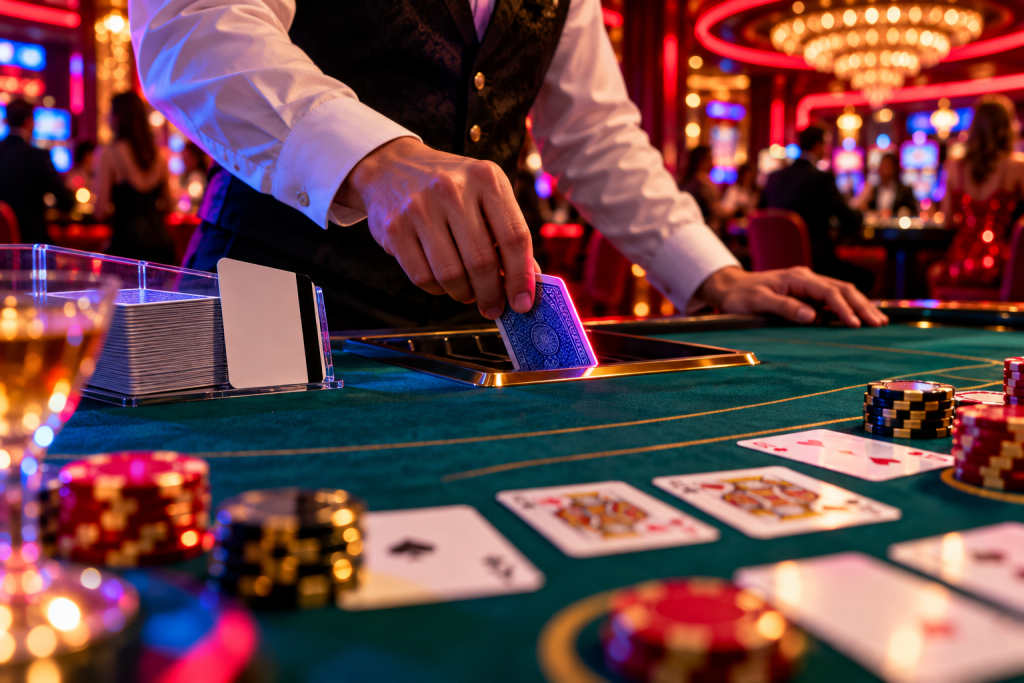
The card that disappears before you play
You sit down, buy in, and the dealer slides a single card face down into the discard tray before anyone has seen a hand. That card is the burn card. It is not a mistake, not a penalty, and not part of your hand. It is a dealing procedure designed to make a marked or exposed card less useful, and it happens at specific moments in a blackjack shoe or handheld game.
Understanding the burn card matters less for strategy than for reading the table. New players sometimes think the burn card was a misdeal, or that it changes the count, or that they should have been allowed to see it. None of those is true. The burn card is simply removed from play, face down, before the round begins or before the dealer draws.
When a card gets burned
Burning happens at two distinct points in a blackjack game, and the reason differs slightly between them.
The first burn occurs when a new shoe or deck is put into play. After the cards are shuffled and cut, the dealer removes the first card from the top of the stack and places it in the discard tray without showing it. This is the opening burn. Its purpose is to obscure the top card, which may have been visible during the shuffle or cut, and to prevent any player from knowing the first card that would otherwise be dealt.
The second burn happens in handheld games, where the dealer holds the deck and deals cards face down to players. After the players have acted on their hands and before the dealer turns over the hole card to play the dealer hand, the dealer burns the next card. This burn prevents a player who saw the back of that card, or who marked it, from knowing what the dealer will draw next.
In shoe games, where cards are dealt face up from a dealing shoe and the dealer does not hold the deck, there is no burn before the dealer draws. The dealer simply takes the next card from the shoe. The opening burn when a new shoe is loaded still applies.
| Moment | Handheld game | Shoe game |
|---|---|---|
| New deck or shoe enters play | Burn the top card | Burn the top card |
| Before dealer plays their hand | Burn the next card | No burn |
| Card visibility to players | Cards dealt face down | Cards dealt face up |
| Reason for dealer-draw burn | Hide the next card from marked-card or peeking concerns | Not needed; shoe conceals the next card |
What the burn card is not
The burn card is not a card that was misdealt. A misdeal occurs when the dealing sequence itself goes wrong—cards are exposed, the wrong number of cards is dealt, or a card is dealt to an empty seat. In a misdeal, the hand is usually voided and the cards are collected and reshuffled, or the round is corrected under the house procedure. A burn card is a deliberate, scheduled removal of a card from play.
It is also not a card that counts against the deck composition in any way that changes your strategy. The card is removed face down, unseen. For basic strategy purposes, it is simply an unknown card, no different from any other card still in the shoe. Card counters treat it the same way: an unseen card is an unseen card. It does not adjust the running count, because the counter never sees its value.
Some players ask whether they are allowed to see the burn card. The answer at almost every table is no. The entire point of the burn is that nobody sees it. If the burn card is accidentally exposed, the dealer will normally call a supervisor, and the house procedure will determine whether the card is simply discarded, shown to all players, or whether the deck is reshuffled. That procedure varies by venue, so the table's own posted rules or the supervisor's decision controls.
How the burn fits into the round sequence
To see why the burn matters, it helps to place it inside the full sequence of a blackjack round. The sequence below describes a standard shoe game with face-up dealing, which is the most common format in large venues.
First, players place their bets before any cards are dealt. The dealer then deals one card face up to each player, moving from their left to their right, and one card face up to themselves. A second card is dealt to each player face up, and the dealer takes a second card face down. This face-down card is the hole card.
If the dealer's upcard is an ace, the dealer offers insurance before anyone plays. Insurance is a side bet that the dealer's hole card is a ten-value card, giving the dealer a blackjack. It is a separate wager, usually up to half the original bet, and it carries its own house edge. The dealer then checks the hole card under a peeking procedure, or uses a card-reading device in many shoe games, to see whether a blackjack exists.
If the dealer has blackjack, the round ends immediately for all players except those who also have blackjack, who push. If the dealer does not have blackjack, players act on their hands in turn. Each player decides whether to stand, hit, double down, split pairs, or surrender where the table rules allow it. These decisions are the heart of the game, and published basic-strategy charts derive from the specific rule set in use: the number of decks, whether the dealer stands or hits on soft 17, whether doubling after splitting is allowed, and whether surrender is offered.
After all players have acted, the dealer reveals the hole card and plays the dealer hand according to fixed rules. The dealer must hit until reaching a total of 17 or higher, and in many games must hit a soft 17. In a shoe game, the dealer draws directly from the shoe. In a handheld game, the dealer burns the next card before drawing. The dealer then compares totals with each remaining hand, and bets are settled.
Why the burn does not change your decisions
Because the burn card is unseen, it has no effect on basic strategy. A player using a basic-strategy chart makes the same decision whether the dealer burned a card or not. The chart is built from the full composition of the remaining deck or shoe, and an unknown removed card does not alter the probabilities in any way a player can act on.
This is worth stating plainly because new players sometimes overthink the burn. They wonder whether the burned card might have been the card that would have made their hand. It might have been. It might also have been the card that would have busted them, or the card that would have given the dealer a perfect total. Since the card is unseen, its removal is symmetric: it removes one unknown card from a pool of unknown cards. The expected value of the next card dealt is unchanged.
The same logic applies to the cut card and the discard tray. Cards already played and placed in the discard tray are visible to attentive players, and card counters track them. The burn card is the exception: it goes into the discard tray unseen. A counter who tracks visible discards simply does not count the burn card, because there is nothing to count.
Procedural mistakes new players make around the burn
The burn card itself rarely causes a dispute, but it sits next to several procedural mistakes that new players make at a blackjack table.
The first is touching the cards in a shoe game. In a face-up shoe game, players never touch the cards. The dealer handles everything. In a handheld game, players may hold their cards, but only with one hand, and the cards must remain above the table and in view. A player who reaches toward the discard tray, or who tries to touch or inspect the burn card, will be corrected immediately.
The second is acting out of turn. Because the burn happens before the dealer draws, some players think the dealer's draw is the next event and rush their own decision. The dealer draws only after every player has acted. A player who signals a hit or stand while another player is still deciding has acted out of turn, and the dealer will usually ask them to wait.
The third is misreading the dealer's upcard after a burn. In a handheld game, the dealer burns a card, then draws. The drawn card is the dealer's next card, not the burned one. A player who tries to reconstruct what the dealer might draw by remembering the burn card is working from a card they never saw.
What to watch at the table
If you want to know exactly how burning works at the table where you are sitting, look at three things. First, watch the opening of a new shoe: the dealer will remove the top card and place it in the discard tray, usually without showing it. Second, note whether the game is handheld or shoe-dealt. If the dealer holds the deck, expect a burn before the dealer draws. If the cards come from a shoe, expect no burn at that point. Third, if a burn card is ever exposed, stop and wait for the supervisor's instruction. Do not try to use the information, and do not argue that the hand should be replayed. The house procedure controls what happens next.
The burn card is a small piece of table procedure, but it is a useful test of whether you understand how a blackjack game is run. It is not a rule you play against. It is a rule the house uses to keep the dealing sequence clean, and it asks nothing from you except that you leave the card alone and keep your decisions based on the cards you can see.
FAQ
Does the burn card affect the house edge?
No. The burn card is an unseen card removed from play. It does not change the mathematical advantage on any bet, because the remaining deck or shoe is still just a set of unknown cards. The house edge on a blackjack bet depends on the table's rule set and the player's decisions, not on the burn procedure.
Can I ask the dealer to show me the burn card?
You can ask, but the answer will almost always be no. The burn exists precisely so that no one sees the card. If the card is exposed by accident, the dealer will call a supervisor, and the venue's own procedure decides what happens. There is no player right to see a burn card.
Is the burn card the same in online blackjack?
Online blackjack games do not physically burn a card in the way a live table does, because the dealing sequence is generated by software. Live-dealer online blackjack, where a real dealer deals physical cards on camera, follows the same physical procedures as a land-based table, including burning where the dealing format calls for it. The game's rules and help panel state the dealing procedure in use.
Play responsibly
Gambling should be treated as paid entertainment, never as a way to earn income or recover losses. 1-800-MY-RESET (1-800-697-3738)
18+ or 21+ depending on where you are; follow the minimum age that applies to you.
This article is general information about how these mechanics work. It is not legal advice and not a recommendation to gamble or to use any particular operator. Availability and legality differ by jurisdiction — check the rules that apply where you are.