


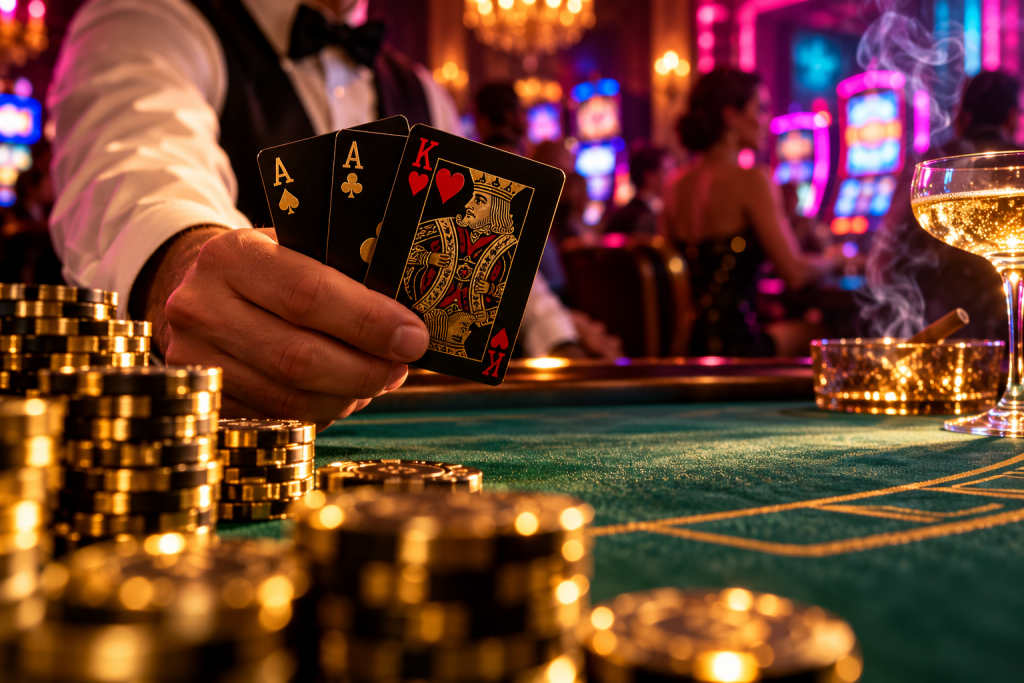
The payout printed on the felt is the first thing to check
You sit down at a blackjack table, put your chips in the betting circle, and the dealer slides the cards. Before any of that, there is one number on the layout that matters more than almost anything else you will read about the game: the payout for a natural, the two-card 21 made from an ace and a ten-value card. Most tables print it right on the felt, often near the dealer or on the arc of the layout. It will say 3:2 or 6:5. It will not say 2:1.
No standard blackjack game pays 2:1 on a natural. The question comes up often enough that it is worth answering directly: 2:1 blackjack, in the sense of a normal casino table that pays two units for every one unit wagered on a natural, does not exist as a standard offering. What does exist is a family of payout ratios, and the difference between them changes the cost of playing far more than most rule variations.
What a blackjack payout ratio means
When a table pays 3:2 on a natural, a winning 10-unit bet returns 15 units in profit, plus the original stake back. When a table pays 6:5, that same 10-unit bet returns 12 units in profit. The ratio is a multiplier on the stake for one specific outcome: an ace paired with a ten, jack, queen, or king as the first two cards.
The payout applies only to that hand. Every other winning hand in blackjack pays even money, 1:1. A 2:1 payout would mean a natural returns twice the stake in profit, which would be a materially better deal for the player than either common payout. That is precisely why it is worth knowing it is not standard: if a promotion, a side bet, or a variant advertises 2:1, the terms around it are doing the heavy lifting, and the base game is almost certainly still paying something else.
Why the payout ratio changes the whole game
Blackjack is a negative-expectation game, meaning the mathematical advantage sits with the house on every hand. The size of that advantage is not fixed; it is built from the specific rule set in use. Deck count, whether the dealer stands or hits on soft 17, doubling and splitting rules, and the natural payout all feed into the house edge. The natural payout is one of the largest single contributors because a natural is a relatively common event that pays a bonus over even money.
When a table moves from 3:2 to 6:5, the house edge on the game rises. The change is not cosmetic. A player who sits at a 6:5 table is paying more for the same game, hand after hand, without any change in strategy or skill. The rule is printed on the layout precisely because it is a material term, not a footnote.
How to spot the payout before you buy in
The payout ratio is one of the few blackjack rules you can verify before committing a single chip. Look at the felt. Most tables print the natural payout in text on the layout, often in a curved band near the dealer's chip rack or along the edge of the betting spots. If the felt is unclear, ask the dealer directly: "What does a blackjack pay here?" The dealer will answer. No competent dealer will be surprised by the question, and the answer is binding for the table you are about to join.
Online, the same information lives in the game's information panel or rules screen, usually accessible before the first hand is dealt. The game information panel is the equivalent of the printed felt. It states the natural payout, the deck count, and the other rule variants that determine the house edge. Read it before you commit a deposit to that specific table.
The sequence of a round, from buy-in to settlement
Understanding the payout ratio is easier when you can place it inside the flow of a hand. The round begins with a buy-in. At a live table, you place cash on the layout, never directly into the dealer's hand, and the dealer exchanges it for chips. Those chips are your only currency at the table. You place a wager in the betting circle before the cards are dealt.
The dealer then deals each player two cards, face up in most modern games, and takes two for themselves, one face up and one face down. If the dealer's upcard is an ace, the dealer will typically offer insurance before checking the hole card. Insurance is a side bet on the dealer having a natural. It is a separate wager with its own house edge, and it is generally a worse bet than the main hand.
If you have a natural and the dealer does not, the hand settles immediately at the posted payout. If neither side has a natural, play proceeds around the table. Each player decides whether to stand, hit, double down, or split pairs, depending on the table rules. When all players have acted, the dealer reveals the hole card and plays their hand according to a fixed procedure: hit until the total is 17 or higher, with the soft-17 rule varying by table.
Settlement happens at the end. Winning non-natural hands pay even money. Losing wagers are collected. A push returns the stake. The natural payout applies only to the two-card 21, and only when the dealer does not also have one.
Where the 2:1 idea comes from
The 2:1 figure appears in blackjack in a few places, none of which is the base-game natural payout. Insurance pays 2:1 when the dealer has a natural, but it is a side bet with a house edge of its own, and it pays only when the player's main hand is about to lose to that natural. Some side bets and variant games advertise 2:1 payouts on specific outcomes, but those outcomes are rarer than a natural and carry their own odds. A promotional table might offer 2:1 on a natural for a limited time, but that is a marketing event with terms and conditions, not a standard game.
The confusion may also come from other table games. In some baccarat side bets, certain outcomes pay 2:1. In craps, some proposition bets pay 2:1. In blackjack itself, the base game has never standardised on 2:1 for a natural, and no major rule set uses it as the default.
Comparing the common payouts
The difference between 3:2 and 6:5 is best seen side by side. The table below uses a 10-unit wager as an example, marked as an example rather than a recommendation.
| Payout | Profit on a 10-unit natural | Effect on house edge | Where it appears |
|---|---|---|---|
| 3:2 | 15 units | Lower house edge, all else equal | Standard tables, often with higher minimums |
| 6:5 | 12 units | Higher house edge, all else equal | Common on lower-minimum and single-deck tables |
| 2:1 | 20 units | Would reduce the house edge sharply | Not a standard base-game payout |
The table shows why 2:1 is not offered as a base payout: it would shift the game's economics enough that operators would need to change other rules to compensate. When a variant or promotion advertises 2:1, read the full terms to see what else changed.
Decision points and what they cost
Blackjack is a comparing card game. The objective is a hand total closer to 21 than the dealer's without exceeding it. The decisions you make during a hand change the expected rate of loss, not the fundamental fact that the house holds an edge. Standing, hitting, doubling, and splitting are choices with mathematically better and worse answers depending on your hand and the dealer's upcard.
Published basic-strategy charts derive from a specific rule set. A chart built for a game where the dealer stands on all 17s and doubling after splitting is allowed will not be exactly right for a game where the dealer hits soft 17 or doubling after splitting is restricted. The chart is a map of the least costly decision at each point under those exact rules. Change the rules, and some of the map changes. That is why the payout ratio, the deck count, and the soft-17 rule all belong in the same conversation: they are inputs to the same calculation.
Procedural mistakes new players make
The first mistake is sitting down without reading the payout. A player who assumes every table pays 3:2 can spend an entire session at a 6:5 table without realising the cost. The felt states the rule. Read it before you buy in.
The second mistake is touching the cards or the chips after the hand has begun. In face-up games, players never touch the cards. In face-down games, the rules for handling cards are specific, and the dealer will instruct you. Chips placed in the betting circle should not be adjusted once the deal starts. The dealer manages the layout; your job is to signal your decision clearly.
The third mistake is treating insurance as a routine part of the hand. Insurance is a separate wager that pays 2:1 when the dealer has a natural. It is offered only when the dealer's upcard is an ace. The bet has its own house edge, and taking it habitually increases the expected cost of the session. It is not a hedge on your main wager in any sense that improves the combined expectation.
What the table rules can and cannot tell you
The printed felt and the game information panel give you the rule set. They do not give you a forecast. No payout ratio, strategy chart, or decision rule changes the fact that blackjack is a negative-expectation game. What the rules do is let you compare one table against another before you commit. A table with a 3:2 payout, a stand-on-soft-17 rule, and liberal doubling rules is a different product from a 6:5 table with restrictive doubling, even though both are called blackjack.
If a table's payout is not printed, or an online game's information panel is unclear, treat that as a reason to ask before you play. The answer exists. It is on the felt, in the rules screen, or in the dealer's answer to a direct question. No one should have to infer the most expensive rule on the table.
FAQ
Is 2:1 blackjack ever offered as a promotion?
Some venues run limited-time promotions that pay 2:1 on a natural, but these are marketing events with specific terms, time windows, and often maximum bet limits. The base game underneath the promotion still uses its standard payout. Read the promotion's terms before assuming the 2:1 rate applies to every hand you play.
Why do some tables pay 6:5 instead of 3:2?
The 6:5 payout increases the house edge on the game, which lets an operator offer blackjack at lower minimum bets or on single-deck layouts while preserving the game's economics. The payout is printed on the felt, so the difference is visible before you sit down. The choice between tables is a choice about the expected rate of loss, not about the rules of play.
Does the payout ratio change basic strategy?
Basic strategy itself is built from the full rule set, and the natural payout is one of the inputs. A chart published for a 3:2 game may still be close for a 6:5 game, but the payout change is large enough that it should be treated as a different game for comparison purposes. The strategy decisions are driven primarily by the dealer's upcard and the player's total; the payout ratio is a separate cost factor that does not change whether you should hit a 16 against a 10.
Gamble responsibly. If you or someone you know has a gambling problem, call or text the helpline printed in the footer below.
Play responsibly
Gambling should be treated as paid entertainment, never as a way to earn income or recover losses. 1-800-MY-RESET (1-800-697-3738)
18+ or 21+ depending on where you are; follow the minimum age that applies to you.
This article is general information about how these mechanics work. It is not legal advice and not a recommendation to gamble or to use any particular operator. Availability and legality differ by jurisdiction — check the rules that apply where you are.