
The question is about a machine, not a map
Whether a casino slot machine accepts a particular banknote is decided by the bill validator fitted inside that machine and by the currency policy of the operator, not by where the building sits. A venue's street address, its city, its state and its distance from any reference point have no bearing on the answer. This article explains the mechanism that controls what a slot will take, and it names the official channel where the current answer for a specific venue is published.
The reader searching for a venue's fixed geographic position will not find one here, because the query is not about a place. It is about a hardware and policy question. The honest first answer is that no distance, no coordinate and no facility figure belongs in this article, and none will be invented.
What a slot machine's bill validator does
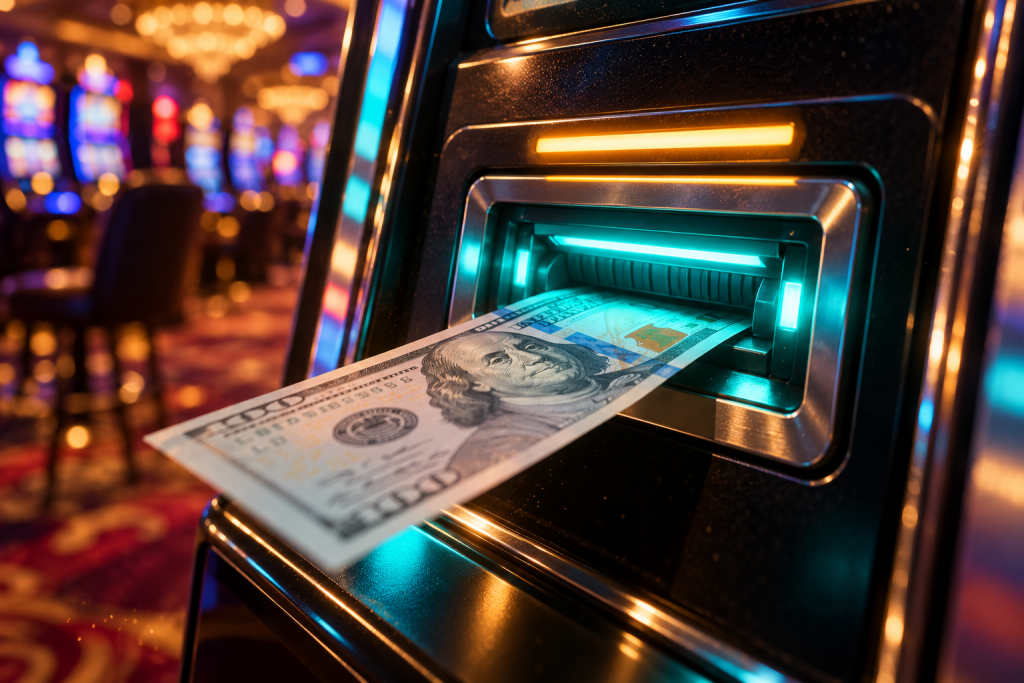
A modern slot machine contains a bill validator, sometimes called a bill acceptor. Its job is to pull a banknote in, scan it, compare its features against stored reference data, and either credit the machine or return the note. The validator looks at physical and optical characteristics: paper or polymer substrate, printed patterns, security threads, watermarks, ultraviolet features and magnetic ink. It does not know which venue it is sitting in.
The validator is programmed to recognise specific currency series and denominations. A machine configured for United States currency will typically accept a defined range of US banknote denominations, and it will reject notes it cannot identify, notes in the wrong currency, heavily worn notes, torn notes, taped notes or notes that fail its sensor checks. The machine's acceptance list is a configuration setting, not a geographic fact.
The term that needs clarifying
The word at the centre of the query needs careful handling. A banknote that is creased, folded, crumpled, stained, washed, worn at the edges or otherwise physically distressed may still be legal tender, but a bill validator can refuse it. The validator's decision is mechanical and binary: it either authenticates the note to its satisfaction and credits the machine, or it returns the note to the player. There is no middle outcome in which a note is half-accepted.
Whether a specific note passes depends on the validator model, its firmware, its calibration and the condition of the note itself. Two identical machines in the same venue can behave differently if one validator is older, dirty or calibrated differently. That is why no article can promise that a given note will be accepted at a given venue.
What changes between venues and what stays fixed
Some things are constant across almost all casino slot machines, and some things vary by property. The table below separates what is fixed by the hardware and what is set by the operator.
| Factor | Who controls it | What the reader should know |
|---|---|---|
| Which denominations are accepted | Operator configuration | Set per machine or per bank of machines; can differ between venues |
| Which currency is accepted | Operator configuration and jurisdiction | A machine set for US dollars will not accept foreign notes |
| Condition thresholds for worn notes | Validator firmware and calibration | Fixed by the hardware model but adjustable within limits |
| Whether a rejected note can be retried | Machine behaviour | Usually the note is returned and the player can try again or use another note |
| Whether staff can manually accept a rejected note | Venue policy | Some venues allow a cashier to exchange a worn note; this is not a machine function |
The table shows why a venue's location is irrelevant to the question. The factors that decide whether a note is accepted are hardware configuration, firmware, calibration, currency setting and operator policy. None of those is a geographic attribute.
Where the authoritative answer lives
The only source that can state what a specific venue's machines currently accept is the venue itself. Slot machine acceptance settings are not published in any central public register, and they are not part of a venue's licensing record. They are operational settings that the property can change when it updates firmware, replaces validators or revises its currency handling policy.
The correct channel is the venue's own guest services operation. A reader who needs to know whether a particular casino's slots will take a particular note should contact the property directly through its published guest services channel and ask about bill validator acceptance. The question to ask is specific: which denominations and which note conditions the floor's validators are currently set to accept.
What to confirm before you go
Several items can change between the time a reader researches and the time they arrive, and none of them can be answered by this article. The reader should confirm each of the following through the venue's own published channels.
- The current accepted denominations on the slot floor, since operators can change configuration.
- The currency or currencies accepted, especially at venues near an international border or inside a resort that serves foreign visitors.
- The venue's policy on worn or damaged notes, including whether a cashier will exchange a note the validator rejects.
- Whether any machine on the floor has been upgraded to a newer validator model with different acceptance behaviour.
- Any posted notice at the machine or at the cashier cage about note acceptance, since that is the most current on-site source.
None of these items is a distance, a coordinate or a facility count. They are operational facts that only the venue can confirm, and they are exactly the facts a reader should verify before travelling.
Why a geography article cannot answer this query
This article series normally explains where a venue sits, how far it is from documented reference points and how a reader can reach it. That structure does not fit this query. The query asks about a machine function, and no venue has been identified in the request. Without a named venue, there are no coordinates to report, no straight-line distances to list and no city or state to describe.
The honest answer is that this article can explain the mechanism and name the channel that holds the current answer, but it cannot state a distance, a price, an opening hour or a facility count. None of those facts exists for this query, and none will be invented to fill space.
FAQ
Can a casino slot machine accept a crumpled or worn banknote?
A slot machine's bill validator decides by scanning the note and comparing it against stored reference data. A note that is creased, stained, torn or heavily worn may be rejected even if it is genuine legal tender. The validator either credits the machine or returns the note. The outcome depends on the validator model, its calibration and the note's condition, not on the venue's location.
Where can I find out what banknotes a specific casino's slots accept?
The venue itself is the only authoritative source. Slot acceptance settings are operational configurations that the property controls and can change. Contact the venue's guest services channel and ask which denominations and note conditions the slot floor's validators are currently set to accept. No central public register publishes this information.
Does a casino's location affect which bills its slots take?
No. A venue's address, city, state and distance from any reference point have no bearing on bill validator behaviour. What matters is the validator hardware, its firmware, its calibration, the currency setting and the operator's policy. Two venues in the same city can have different acceptance settings if their machines are configured differently.
Play responsibly
Gambling should be treated as paid entertainment, never as a way to earn income or recover losses. 1-800-MY-RESET (1-800-697-3738)
18+ or 21+ depending on where you are; follow the minimum age that applies to you.
This article is general information about how these mechanics work. It is not legal advice and not a recommendation to gamble or to use any particular operator. Availability and legality differ by jurisdiction — check the rules that apply where you are.