
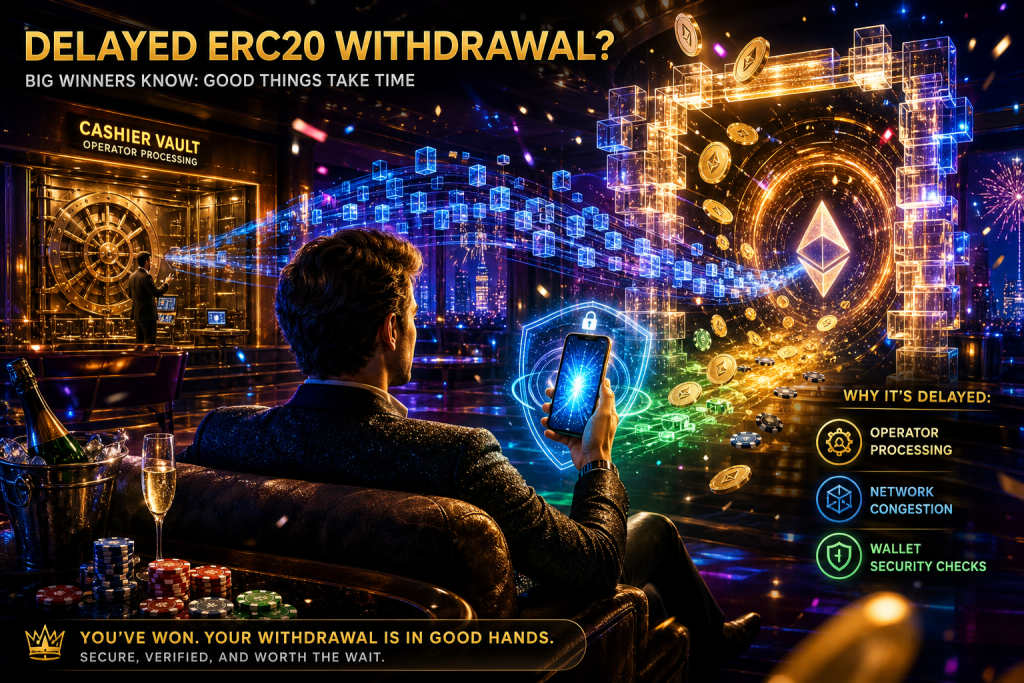
The withdrawal page says pending, and the number never moves. Maybe the status is stuck on processing, or the transaction hash has not appeared yet. That slowdown usually comes from one of three stages: operator review, broadcast to the network, and confirmation depth on chain.
An ERC20 transfer is a token transfer on a network that supports that token standard, so the token moves only after the transaction is sent to the network and included in blocks. Until then, the operator may still be checking the request, and that stage is separate from the blockchain itself.
Where the delay actually happens
The first delay can be internal. Many operators review withdrawals before sending them out, and that review may include anti-fraud checks, queue management, or KYC checks if identity verification is requested before release. When a request sits there, the blockchain has not even been asked to do anything yet.
The second delay is broadcast. Once the transaction is created, it still has to be signed and sent to the correct network. If the wrong network is selected, the withdrawal can fail or land in a place the recipient did not intend, and that is not something a player can fix after the fact.
The third delay is confirmation depth. A transaction is considered included once a block contains it, but many systems wait for more confirmations before treating the withdrawal as final. That waiting period is separate from the operator's own processing time.
| Stage | What it means | Who controls it |
|---|---|---|
| Operator review | The request is checked before broadcast | The operator |
| Broadcast | The transaction is sent to the network | The operator's wallet setup and network conditions |
| On-chain confirmation depth | Blocks are added after inclusion | The blockchain network |
What the player can influence
Some parts are under your control. You can use the correct network, double-check the address, and keep your wallet ready to receive the token. A copied address with one wrong character can send the transfer into a dead end, especially on irreversible on-chain transfers.
You can also avoid extra review triggers. A withdrawal requested before identity checks are complete often waits longer than a plain transfer would. If the operator asks for ID or proof of address, the request may remain on hold until those documents are accepted.
What you usually cannot control is queue order, manual approval speed, or how fast the network confirms. Even a healthy network can be busy at the moment your transaction is broadcast, which can make a small payout look oddly slow.
What ERC20 timings can look like
Timing labels vary a lot across sites. Across the sites surveyed, wording ranged from “up to 72 hours” to “90% under one minute,” with other examples such as “up to 24 hours” and “5 minutes to 96 hours.” Those figures describe how sites phrase timing, not a guaranteed delivery window for every withdrawal.
On-chain confirmation also varies by network conditions. A token transfer can be included quickly and still wait for more confirmations before a wallet or operator treats it as complete. That is why one withdrawal may finish in minutes while another appears stuck much longer.
Fees affect speed only indirectly. A higher network fee can make a transaction more attractive to validators on some networks, but the exact effect depends on current congestion and the wallet or routing method used. The recipient does not receive less because a fee was paid; the fee is part of the sender-side transaction setup.
Why “processed” is not the same as “received”
Operators sometimes use status labels that sound final when they are not. “Processed” may mean the request passed internal checks, while “sent” may only mean the transaction was broadcast. The funds can still be waiting on confirmations after that.
For ordinary token withdrawals, the moment that matters is not the cashout screen but the transaction hash. Once you have a hash, you can check whether the transfer was included in a block and how many confirmations it has. Before that, you are still inside the operator's workflow.
That distinction matters because a withdrawal can be delayed without being lost. A request may simply be sitting in review, queued for broadcast, or waiting for the network to settle it to the level the wallet expects.
Common causes of long waits
- Manual review before broadcast
- Identity checks not yet finished
- Wrong network chosen for the token
- Address copied incorrectly
- Network congestion affecting confirmation speed
- Wallet or platform waiting for extra confirmations
One more detail can slow things down: some systems batch withdrawals. That means your request may wait until the operator sends a group of transactions together, which is efficient for them but not very comforting when the screen says pending.
Availability of the token itself also matters. Across the surveyed sites, BTC, ETH, XRP and USDT appeared more often than smaller-token options such as BCH. That does not set a rule for timing, but it does show that coin support varies a lot from one platform to another.
What to check before contacting support
Start with the transaction status. If there is no hash, the request has likely not left operator control. If there is a hash but no confirmations, the network stage is still in progress. If there are confirmations but the wallet shows nothing, the address or network choice deserves another look.
Next, compare the requested network with the receiving wallet. ERC20 tokens require the compatible network path, and choosing the wrong one can make the funds unreachable in the intended wallet. That is one of the few mistakes a player cannot reverse by waiting longer.
Finally, check whether any identity or withdrawal-limit review is pending. Many delays are administrative rather than technical, and the blockchain cannot speed those up.
Examples of timing differences
| Situation | Likely bottleneck | What you can do |
|---|---|---|
| No transaction hash yet | Operator review or queue | Wait or contact support |
| Hash exists, no confirmations | Network broadcast / congestion | Check the explorer |
| Confirmed on chain, wallet empty | Wrong address or network mismatch | Verify details immediately |
| Withdrawal still pending KYC | Operator verification | Submit requested documents |
A useful habit is to separate the three clocks. The operator clock ends when the transaction is sent. The blockchain clock starts when it is included in a block. The wallet or platform clock may continue until enough confirmations have accumulated for its own policy.
That separation explains most “forever” withdrawals. The screen may look frozen, but the bottleneck is usually specific, not mysterious. Once you know which stage is holding the request, you know whether to wait, verify details, or ask support for the missing transaction hash.
FAQ
Why does my ERC20 withdrawal show pending for hours?
Most often the delay is at operator review, broadcast, or confirmation depth. The status text alone does not show which stage is slow.
Can I speed it up myself?
You can only influence the parts under your control: correct network, correct address, complete verification, and a proper wallet setup. You cannot force manual approval or network confirmations.
Does a confirmed transaction mean the funds are already usable?
Not always. Confirmation means the transaction was included in a block, but some wallets and platforms wait for additional confirmations before marking it complete.
Play responsibly
Gambling should be treated as paid entertainment, never as a way to earn income or recover losses.
18+ or 21+ depending on where you are; follow the minimum age that applies to you.
Help line (US): 1-800-MY-RESET (1-800-697-3738)
This article is general information about how these mechanics work. It is not legal advice and not a recommendation to gamble or to use any particular operator. Availability and legality differ by jurisdiction — check the rules that apply where you are.