
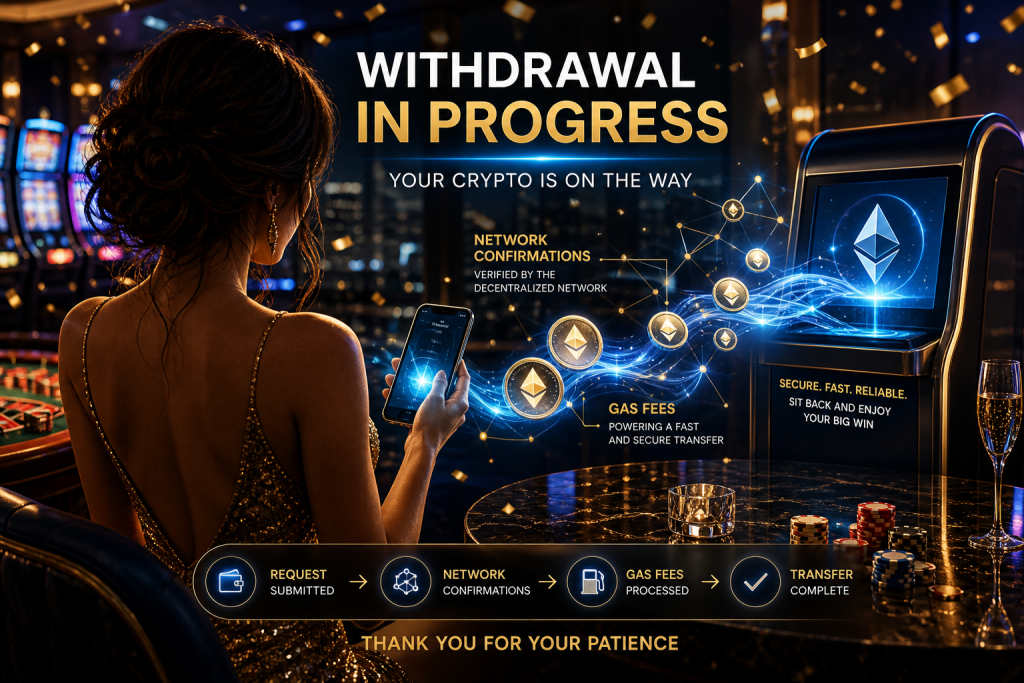
The withdrawal page shows pending, the ETH wallet address is pasted, and the fee line is changing while the network dropdown sits beside it. That moment usually raises the same question: why does an ethereum gas fees casino withdrawal move so slowly, and what is actually blocking it?
Start with the transfer itself. On-chain crypto withdrawals are not bank transfers. Once a transaction is confirmed on the network, it is irreversible, and the recipient sees it only after the blockchain includes it in a block. The operator’s own banking hours are not what governs the timing.
What “gas fees” mean on Ethereum
Ethereum uses gas to pay for computation and network inclusion. For a withdrawal, the sender pays that network cost on the Ethereum chain. The fee does not reduce the amount the recipient is set to receive; instead, it is part of the transaction cost carried by the sender side of the transfer.
That distinction matters because a casino cashier can show a net amount, a fee estimate, and a final send amount at the same time. If the withdrawal is built on Ethereum, the relevant issue is whether the fee is high enough for the transaction to be picked up and confirmed in a timely way, not whether the recipient will lose part of the sent amount.
Network selection decides where the coins can land
A withdrawal can stall before it ever reaches the blockchain if the wrong network is selected. ETH sent on Ethereum Mainnet cannot simply be received on an incompatible chain, and the same is true for many tokens that exist on more than one network.
Across the sites surveyed, multiple coins were offered and the same asset sometimes appeared on more than one network. That makes the checkout step easy to rush and expensive to get wrong. A withdrawal address must match the chosen chain, or the transfer may fail, disappear from the intended wallet, or require recovery steps that are outside normal support flows.
| Step | What it affects | Common consequence of a mismatch |
|---|---|---|
| Network choice | Which blockchain carries the transfer | Funds may be sent to the wrong chain |
| Address format | Where the recipient wallet can accept the asset | Deposit does not arrive as expected |
| Token standard | How the asset is represented | Extra conversion or recovery may be needed |
Confirmations are the real checkpoint
A transaction can be submitted and still remain unconfirmed for a while. That does not mean the blockchain “rejected” it in some abstract sense. It means the transfer has been broadcast, but no block has yet included it.
Confirmation speed depends on network congestion, the fee attached to the transaction, and the current state of the chain. A low-fee transaction can sit in the mempool longer because validators or miners may prioritise higher-fee transactions first. If congestion eases, the same transaction may confirm without any change from the operator.
One practical example: if a withdrawal is broadcast during a busy period and the attached fee is too low for current conditions, the transaction may linger. If the fee is competitive, it often moves faster, though timing still varies.
Why a transfer sits unconfirmed
The most common cause is simple fee pressure. The transaction has been created, but the network does not treat it as attractive enough to include quickly.
Another cause is an internal hold before broadcast. Some operators batch withdrawals, perform risk checks, or wait for manual review before they even send the transaction to the chain. In those cases, the wallet may show a pending status even though nothing has reached Ethereum yet.
KYC can also interrupt timing. Many operators request identity checks before withdrawals, often requiring a government ID and proof of address. Those requirements vary, and the process can pause a payout until the requested documents are reviewed.
Minimums can stop the request before fees matter
Sometimes the withdrawal never gets as far as the gas estimate because it does not meet the minimum. Surveyed sites showed minimum withdrawals that varied widely, which means the cashier threshold matters before any network fee does.
That minimum can be expressed in cash value or in crypto equivalent. If the balance is below the threshold, the system may not allow the request at all, regardless of how cheap Ethereum gas looks at that moment. The same issue can appear with deposit minimums on the way in.
| Constraint | What it does | Where it acts |
|---|---|---|
| Minimum withdrawal | Blocks small cashouts | Casino cashier |
| Gas fee | Pays the network for inclusion | Ethereum chain |
| Confirmations | Finalize the transfer | Blockchain state |
What fee wording usually means
Some pages show an estimated network fee, while others fold it into a total or make it visible only near the final confirmation step. The wording changes, but the mechanics do not: Ethereum gas is the network cost needed to process the transaction.
On many sites, the withdrawal timing language is also imprecise. Phrases such as “up to 24 hours,” “up to 72 hours,” or a minute-based average appear beside each other, but those are operational claims, not guarantees. A transaction can still be delayed by congestion, review, or a mismatch in wallet details.
Deposits and withdrawals behave differently
Depositing to a gambling account is usually simpler than withdrawing because the operator only has to credit the incoming transaction once it is sufficiently confirmed. With a withdrawal, the operator must also decide whether the request meets internal checks and whether the destination details are valid.
That is why a cashout can take longer than a deposit even on the same chain. The sender’s side has more moving parts, and Ethereum gas is only one of them. If the network is busy, the fee matters; if the cashier is waiting on verification, the fee is not the bottleneck.
How to read the pending status
A pending ETH withdrawal usually falls into one of three buckets. First, it has not been broadcast yet. Second, it has been broadcast but not confirmed. Third, it has been confirmed on-chain but the wallet or explorer view has not refreshed.
The first bucket is an operator-side delay. The second is a network-side delay. The third is usually just a display issue. Knowing which stage you are in saves time, because each one needs a different fix.
- Before broadcast: check account verification and cashier status.
- After broadcast, before confirmation: wait for network inclusion or review the fee.
- After confirmation: verify the address and the correct network in your wallet.
What to check before you press confirm
Match the network first. Then check the wallet address character by character. After that, confirm the minimum withdrawal and the expected fee. Those four items usually explain most routine problems without needing any deeper technical guesswork.
For example, if a cashier shows a 60x playthrough on a 120-unit bonus, that means 7,200 units would need to be wagered before bonus-related funds became withdrawable; that kind of rule is separate from the blockchain fee, but it can still delay when a cashout is even permitted.
Finally, remember that Ethereum gas can change between the moment you open the cashier and the moment the transaction is sent. A crowded network can make a reasonable-looking fee turn out to be too low a few minutes later.
FAQ
Why is my Ethereum withdrawal pending?
It is usually waiting for broadcast, waiting for confirmation, or paused by an internal review. The network fee may be too low, but the delay can also come from KYC or a minimum-withdrawal check.
Does the gas fee come out of my withdrawal amount?
On Ethereum, the gas fee is the network cost for sending the transaction. The recipient receives the amount the transaction specifies; the fee is not a cut taken from the recipient side.
What causes a transfer to stay unconfirmed?
Most often, congestion and a fee that is not competitive enough. Wrong network choice, cashier review, or an address problem can also delay the process before or after the transaction is sent.
Play responsibly
Gambling should be treated as paid entertainment, never as a way to earn income or recover losses.
18+ or 21+ depending on where you are; follow the minimum age that applies to you.
Help line (US): 1-800-MY-RESET (1-800-697-3738)
This article is general information about how these mechanics work. It is not legal advice and not a recommendation to gamble or to use any particular operator. Availability and legality differ by jurisdiction — check the rules that apply where you are.