


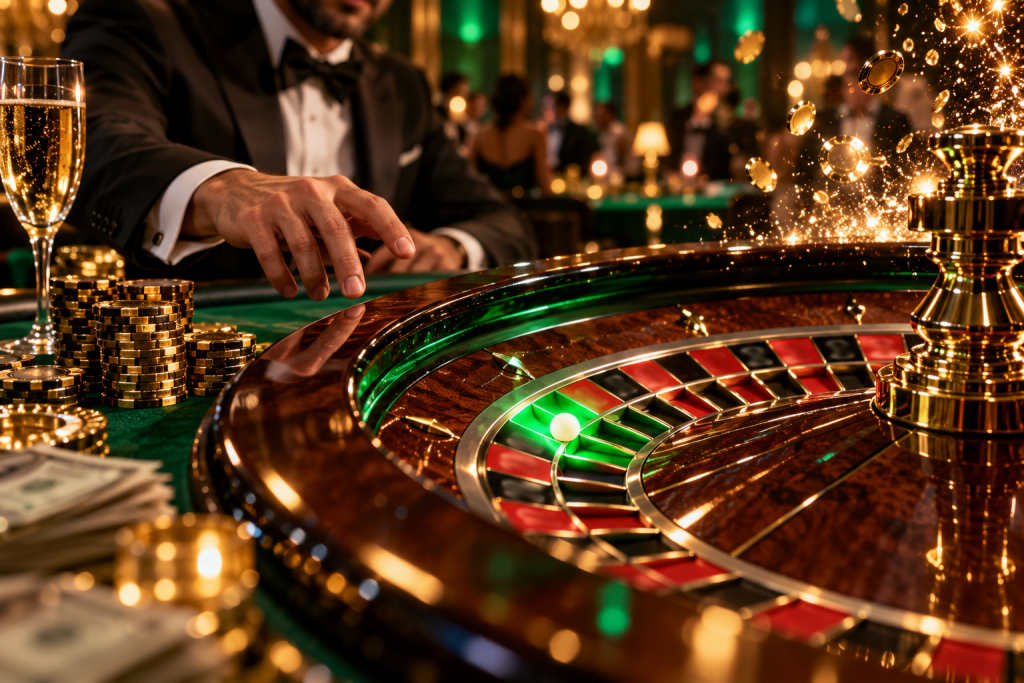
The Zero Pocket Is the Wheel's Quiet Edge
A green bet on roulette is a wager on the zero pocket, or on both zero pockets when the wheel has two. The moment you place that bet, you have accepted a payout that does not match the true chance of the ball landing there. That mismatch is not a mistake in the game's design. It is the entire business model of the table, and it is more visible on the green bet than almost anywhere else on the felt.
Roulette wheels come in two common layouts. A European wheel carries 37 pockets numbered 0 through 36, with a single green zero. An American wheel carries 38 pockets, adding a green double zero alongside the first. The extra pocket does not add a new winning number for you. It adds another losing number for every bet you place, and it widens the gap between what a winning bet pays and what the true odds say it should pay.
True Odds Versus the Payout on a Green Bet
True odds describe how many equally likely outcomes exist and how many of them win your bet. A straight-up bet on a single number, including a green zero, wins on exactly one pocket. On a European wheel, that is one winning pocket against 36 losing pockets, so the true odds against winning are 36 to 1. On an American wheel, the same bet faces 37 losing pockets, so the true odds against winning are 37 to 1.
The table does not pay those true odds. A winning straight-up bet on any single number pays a fixed multiple of the stake, and that multiple is printed on the table layout. The payout is lower than the true odds on both wheel types. The difference between the true odds and the payout is where the operator's mathematical advantage sits. On the green bet, that difference is easy to see because the bet is a single number with no combinations, splits, or corners to soften the arithmetic.
| Wheel type | Pockets on the wheel | Winning pockets for a green straight-up bet | Losing pockets | True odds against winning |
|---|---|---|---|---|
| European (single zero) | 37 | 1 | 36 | 36 to 1 |
| American (single and double zero) | 38 | 1 | 37 | 37 to 1 |
The payout printed on the layout is the same on both wheels for a straight-up bet. The true odds are not. That is why the American layout carries a larger built-in advantage for the house than the European layout, and why a green bet on an American wheel is a materially worse proposition than the same bet on a European wheel even though the payout looks identical.
How the House Edge Is Built Into the Green Bet
House edge and Return to Player (RTP) are complements: for the same bet under the same rule set, they sum to 100%. The house edge is the percentage of each wager the operator expects to retain over a very large number of spins. RTP is the percentage returned to players over that same long run. Neither figure is a promise about your next spin, your next hour, or your next session.
On a green bet, the house edge comes entirely from the gap between the payout and the true odds. Suppose a wheel has 37 pockets and a straight-up bet pays a fixed multiple of the stake. If you placed one unit on the green zero for every pocket on the wheel, you would stake 37 units across 37 spins. One of those spins would win, returning your stake plus the payout multiple. If the payout multiple were, as an example only, 35 to 1, that winning spin would return 36 units in total: your original unit plus 35 units of winnings. You staked 37 units and received 36 units back. The missing unit is the house edge expressed in units, and it is the same arithmetic that produces the percentage figure quoted on the game's information panel.
The same example on a 38-pocket wheel is worse. Staking one unit on every pocket costs 38 units. The single winning spin still returns the same total because the payout multiple has not changed. You are now short two units across the cycle, not one. The extra green pocket did not change the payout. It changed the true odds against you, and the house kept the difference.
Short Sessions Look Nothing Like the Long-Run Average
The house edge is a long-run statistical average. It is not a per-session guarantee, and it is not a schedule. A green bet can win on the first spin, twice in a row, or not at all for a hundred spins. None of those outcomes contradicts the edge. They are all contained inside the variance of a game whose outcomes are independent from spin to spin.
Variance describes how payouts are distributed over time. A single-number bet is a high-variance bet: most spins return nothing, and the rare win returns a multiple of the stake. High variance does not change the RTP or the house edge. It changes what your session feels like. You can sit at a table for an hour, hit a green zero early, and walk away ahead even though the bet you made carries one of the larger house edges on the layout. You can also miss for an entire session and lose every unit you brought. Both are normal samples from the same distribution.
What the edge does is set the direction of the average over enough bets. The more spins you place, the more your cumulative result is pulled toward the long-run average. That is not a strategy and not a warning about luck. It is the arithmetic of repeated independent bets with a negative expectation.
Decisions Per Hour Change Total Exposure, Not the Edge
Roulette is a fast game. A table can complete many spins in an hour, and each spin is a new decision to wager. The house edge applies to each wager, so the total amount you are expected to lose over time is the product of three things: the amount you stake per spin, the number of spins you play, and the house edge on the bet you choose. None of those three changes the edge itself. The first two change how much money passes across the table.
To see why that matters, build a labelled example from hypothetical inputs only. Suppose you wager ten units per spin on a green bet with a house edge of a small percentage, and suppose the table completes forty spins in an hour. Your total coin-in for that hour is four hundred units. The expected loss is the house edge applied to that total, not to any single spin. If you halve your stake or play half as many spins, you halve the expected loss. If you double either, you double it. The edge is unchanged; the exposure is entirely under your control.
This is the most useful thing to understand about a green bet before you place it. The bet itself is one of the worst on the table in expected-value terms, but the total cost of playing it is a function of stake and speed, both of which you choose. A player who understands the edge and still wants the occasional long-shot payout can size the bet and the session accordingly. A player who does not understand the edge will often stake the same amount on green as they would on an even-money bet, without realising how much more expensive the green bet is per unit wagered.
Why Progression Systems Redistribute Outcomes Instead of Removing the Edge
Betting systems that increase the stake after a loss, or after a win, are common at roulette tables. The green bet attracts them because the payout is large and the losing streaks are long, which makes a doubling progression look like a recovery plan. It is not.
A progression system changes the size and sequence of your wagers. It does not change the true odds of the green pocket, the payout printed on the layout, or the house edge built into the gap between them. What a progression does is redistribute outcomes: it turns many small losses into occasional larger wins during winning streaks, and it turns occasional losses into very large losses during losing streaks. The expected loss over a fixed number of spins is the same as it would be under flat betting with the same average stake, because every individual bet still carries the same negative expectation.
Suppose, as an example only, you start with a one-unit green bet and double after every loss. The first loss costs one unit, the second costs two, the third costs four, and so on. A losing streak of six spins costs a total that is a fixed sum of those doubled stakes, and the next bet required to continue the progression is larger than all of them combined. When the green zero finally lands, the payout recovers the accumulated losses plus a small profit on that single spin. The problem is that the losing streak can always run one spin longer than your bankroll or the table's maximum stake allows. The progression has not removed the edge. It has concentrated the same edge into a smaller number of high-stakes moments, and it has made the worst-case session much worse.
No betting pattern changes the built-in edge of a negative-expectation game. A green bet remains a long-shot wager with a payout below true odds on every spin, whether you bet one unit flat, double after losses, or follow any other sequence. The progression changes the shape of your session, not the mathematics underneath it.
Where to Find the Figures That Apply to Your Table
The payout for a straight-up bet is printed on the table layout or shown in the game's information panel. The number of pockets on the wheel is visible on the wheel itself, and it determines the true odds. The house edge and RTP for the specific game you are playing are published in the game's information or help screen, and they apply to that game under that rule set. Different roulette variants can carry different edges, and the same bet on a European layout and an American layout does not carry the same edge even when the payout looks identical.
If you are playing online, open the game information panel before you bet and read the RTP and the payout table together. If you are at a physical table, the layout and the wheel give you everything you need to work out the true odds, and the posted rules tell you the payout. The gap between those two numbers is the edge, and on a green bet it is wider than on almost any other single wager on the table.
FAQ
Is a green bet the same as betting on zero?
Yes, when the wheel has a single zero. On a wheel with a single and double zero, a green bet can mean either zero pocket, or a wager covering both, depending on how the table allows the bet to be placed. The true odds and the payout change depending on whether you are covering one pocket or two.
Does the green bet pay more on an American wheel because there are two green pockets?
No. The payout for a straight-up bet on any single number is the same on both common wheel layouts. The American wheel adds a second green pocket, which increases the number of losing pockets for every other bet, including a bet on the first green zero. The payout does not rise to compensate.
Why do people bet on green if the house edge is higher?
Because the payout is large and the bet is simple. A green bet is a single-number wager with a long-shot payout, and some players prefer the rare large win to the frequent small wins of even-money bets. The trade-off is a larger house edge per unit wagered, which is the price of that payout structure.
Play responsibly
Gambling should be treated as paid entertainment, never as a way to earn income or recover losses. 1-800-MY-RESET (1-800-697-3738)
18+ or 21+ depending on where you are; follow the minimum age that applies to you.
This article is general information about how these mechanics work. It is not legal advice and not a recommendation to gamble or to use any particular operator. Availability and legality differ by jurisdiction — check the rules that apply where you are.