
The Machine the Reader Is Looking At
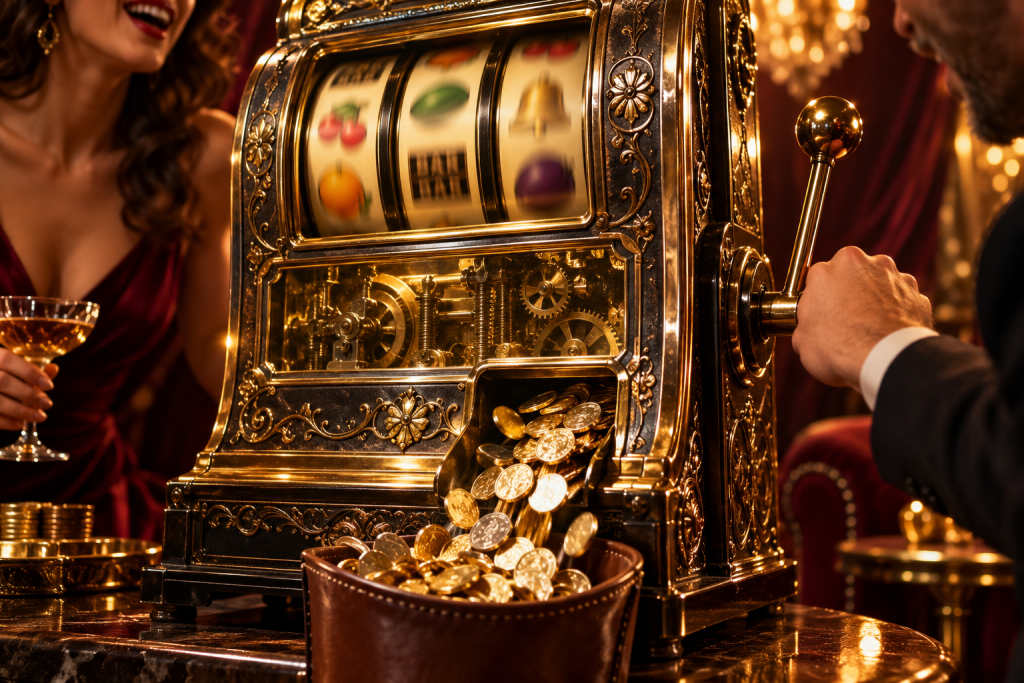
A person asking how antique slot machines worked is usually standing in front of one, or remembering one, and trying to reconcile the heavy cast-iron cabinet with the digital slots they know today. The defining difference is that an antique machine was a purely mechanical device. No computer, no random number generator, no screen. Every function that a modern slot performs in software was, on an antique machine, performed by springs, levers, gears, and a clockwork timing mechanism.
This article describes the general mechanism that the classic three-reel, lever-operated machines shared. It does not describe any specific venue, collection, or machine currently on display, because no venue facts are available for this piece.
What the Player Did
On the classic machines of the late nineteenth and early twentieth centuries, the player inserted a coin and pulled a lever on the side of the cabinet. The pull did two things at once. It wound a spring that stored the energy for the spin, and it released a set of three drums, or reels, so they could rotate freely for a moment. The player's physical pull was the power source; there was no motor and no electricity in the earliest machines.
The reels did not all stop at the same instant. Each drum sat on its own shaft with its own friction brake, and the brakes were set so the drums stopped in sequence, usually left to right. This staggered stop is what created the tension of watching the third reel come to rest.
How the Reels Stopped
Each reel was a metal disc or drum with symbols painted or stencilled around its edge. A notched metal star wheel, or a set of stop pins, was mounted on the same shaft. As the reel spun down, a spring-loaded stop arm, sometimes called a dog, rode against the notches. When the arm dropped into a notch, the reel stopped at that symbol.
The position where each reel stopped was determined by the physical state of the machine at the moment the player pulled the lever: how far the lever was pulled, how much force the spring had, and how the stop arms happened to engage. In practice the outcome was unpredictable to the player, but it was not generated by an electronic process. It was the result of a fast mechanical interaction that no player could control with any reliability.
Reading the Result
After all three reels stopped, the machine had to decide whether the combination showing on the payline was a winner, and if so, how much to pay. Early machines did this without any electrical sensor. The reels themselves carried pins or cams on their inner faces. When the reels came to rest in a particular combination, the pins either aligned to push a payout slide, or they did not.
The payout mechanism was a set of horizontal slides inside the cabinet. Each slide corresponded to a coin value or a number of coins. If the pin arrangement for a winning combination engaged a particular slide, that slide pushed coins out of a tube and into the payout tray. If no winning combination appeared, no slide was engaged and the coins simply stayed in the machine.
The Coin Path and the Payout Tube
The coin the player inserted did not go straight to a cashbox. It first passed through a mechanical validator that checked its size and weight, usually by dropping it through a shaped slot and past a balance. A coin of the wrong size or weight would be rejected and returned. A valid coin tripped a lever that armed the machine for one play.
Valid coins were routed into a vertical tube, called the payout tube or coin tube, inside the cabinet. This tube held the coins that would be paid out on a win. When a payout slide moved, it pushed coins from the bottom of this tube into the tray. When the tube was full, additional coins overflowed into a separate cashbox at the bottom of the cabinet. This separation mattered because the cashbox was the operator's money, while the tube was the reserve from which wins were paid.
Why the Symbols Were What They Were
The familiar symbols on antique machines were not chosen for decoration alone. Many early machines used card suits, stars, bells, and fruit symbols. The fruit symbols, in particular, came from a period when machines paid out in chewing gum or candy rather than cash, as a way of working around restrictions on cash gambling devices. A cherry or a lemon on the reel corresponded to a flavour of gum that the machine could dispense.
The bell symbol gave one famous machine its nickname and became a payout symbol in its own right. These symbols were painted on the reel strips, and the reel strips were often paper or thin metal wrapped around the drum. Over decades of use, the strips wore, faded, and were sometimes replaced by operators, which is why surviving machines from the same model can show different symbol art.
What the Player Could Not Do
A player could not choose how hard to spin the reels in any way that produced a reliable result. The stop arms and star wheels were designed so that the reel's resting position depended on a chain of mechanical events too fast and too sensitive for a person to control. Attempts to time the pull or to stop a reel early by shoving the lever back were not dependable methods, and on many machines the mechanism simply ignored such input once the pull had been released.
The machine also could not be made to pay by inserting a particular sequence of coins. The payout slides were engaged only by the physical pin arrangement on the reels after they stopped. No pattern of coin insertion changed that arrangement.
How This Differs from a Modern Slot
The comparison that matters most to a reader is between the mechanical process described above and the electronic process inside a modern machine. The table below sets the two side by side.
| Function | Antique mechanical slot | Modern electronic slot |
|---|---|---|
| Power source | Player's pull on the lever | Mains electricity |
| Reel movement | Spring-driven drums with friction brakes | Motor-driven or video-simulated reels |
| Result generation | Mechanical stop arms engaging notched wheels | Random number generator in software |
| Win detection | Pins and cams on the reels engaging payout slides | Software comparing the result to a paytable |
| Payout | Coins pushed from a tube by a slide | Credits added electronically, or a ticket printed |
| Coin validation | Mechanical size and weight check | Electronic sensor or cashless system |
The key difference is not the lever. Some modern machines still have a lever as a cosmetic input. The difference is where the result comes from. On an antique machine, the result came from the physical interaction of springs, gears, and stop arms. On a modern machine, the result comes from a random number generator, and the reels on screen are only a display of that result.
What to Check Before You Rely on Any Specific Machine
Antique machines that survive today vary enormously in condition, originality, and whether they have been modified. A machine in a museum may have been restored with reproduction parts. A machine in a private collection may have had its payout slides altered. A machine still operated as a curiosity may have been fitted with an electric motor or a modern payout counter.
If a reader wants to know how one specific machine worked, the authoritative source is the machine's own nameplate and any surviving documentation for that model. The nameplate usually carries the manufacturer's name and a model or serial number. Manufacturer catalogues, patent drawings, and collector reference works describe the mechanism for that model. A museum or collection that displays the machine can usually say whether it is original, restored, or modified.
FAQ
Did antique slot machines use electricity?
The earliest machines did not. The player's pull on the lever wound a spring that powered the spin, and the payout was driven by slides and gravity. Later machines, especially those made after electrification became common, added electric lights and, in some cases, electric motors to spin the reels. The defining mechanical payout and stop systems often remained.
Could a player control where the reels stopped?
No reliable method existed. The stopping position depended on a fast chain of mechanical events involving springs, star wheels, and stop arms. A player could not time the pull or manipulate the lever in a way that produced a predictable result. The machine was designed so that the outcome was effectively outside the player's control.
Why did some antique machines pay out gum instead of coins?
In some periods and places, cash-paying gambling devices were restricted. Manufacturers responded by building machines that dispensed chewing gum or candy, with the fruit symbols on the reels corresponding to flavours. The machine still operated on the same mechanical principle, but the payout was a physical product rather than coins.
Play responsibly
Gambling should be treated as paid entertainment, never as a way to earn income or recover losses. 1-800-MY-RESET (1-800-697-3738)
18+ or 21+ depending on where you are; follow the minimum age that applies to you.
This article is general information about how these mechanics work. It is not legal advice and not a recommendation to gamble or to use any particular operator. Availability and legality differ by jurisdiction — check the rules that apply where you are.