


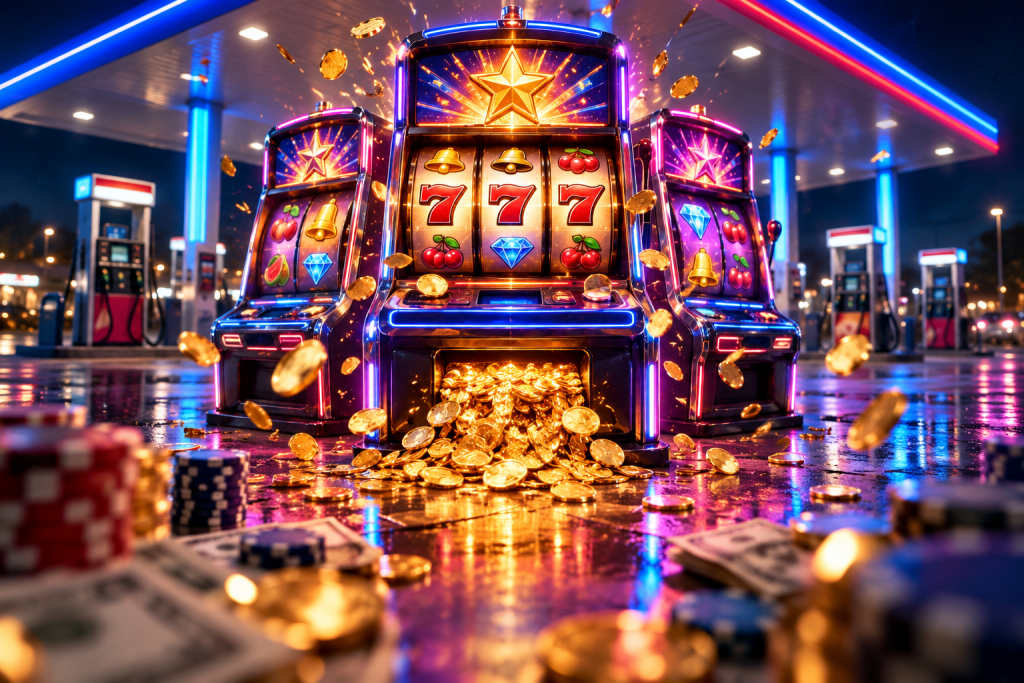
The Machine Behind the Counter
A reader pulling into a fuel stop and seeing a row of glowing cabinets near the register is usually looking at one of two very different devices. One is a true slot machine, where the outcome of each spin is produced by a random number generator and the prize is cash. The other is a machine that looks and sounds like a slot, but whose outcome is known to the player before the bet, or whose prize is not cash at all.
The distinction matters more than the cabinet design. The legal treatment, the odds, the payout method, and even whether the machine may sit in that building at all all flow from which category the device falls into, and that category is set by the jurisdiction, not by the manufacturer or the store owner.
How a True Slot Machine Produces an Outcome
A genuine slot machine does not remember what it paid yesterday, does not get hot, and does not become due. On every spin, a random number generator produces a value that maps to a position on each reel. The machine then displays the result and pays according to a fixed paytable stored in its software.
The house advantage is built into that paytable. It does not change from spin to spin, and no pattern of play, stopping the reels early, or changing bet size alters it. The machine is a device for generating a random outcome against a fixed mathematical edge, and every spin is independent of the one before it.
Machines That Are Not Slots
Many cabinets in convenience stores and fuel stops are not slots in the legal sense. Some are amusement devices that reveal the result of a future game before the player commits money, a structure that removes the element of chance at the moment of the wager. Others award points redeemable for merchandise rather than cash. Still others are sweepstakes terminals, where a purchase is framed as buying a product and the game is presented as a free bonus.
The table below sets out the mechanical differences that determine how each type works.
| Machine Type | When the Outcome Is Decided | Prize Form | What the Player Is Buying |
|---|---|---|---|
| True slot machine | At the moment of the spin, by random number generator | Cash | A wager on a random outcome |
| Amusement with preview | Before the wager; the next result is shown in advance | Usually points or credits | Continued play or entertainment |
| Sweepstakes terminal | Pre-determined, with the game framed as a reveal | Cash or cash equivalent | A product, with the game described as a free add-on |
| Merchandise redemption game | At the moment of play | Non-cash goods | A play on a game of skill or chance |
Why the Same Machine Looks Different Across State Lines
There is no single national rule for what may sit inside a gas station. Each state defines gambling, defines a slot machine, and defines the exceptions, and those definitions do not match. A cabinet that is a legal amusement device in one state may be an illegal gambling device twenty miles away.
What changes is not the hardware. The same cabinet can be configured with different software, different prize structures, and different disclosure screens depending on where it is installed. The store owner does not make this call; the machine's operator and the jurisdiction's rules do.
Who Places the Machines and Who Takes the Money
A gas station typically does not own the machines on its floor. A route operator owns or leases the cabinets, places them under a contract with the store, services them, and splits the revenue. The store provides floor space, power, and a staffed location; the operator handles the cash, the software, and the maintenance.
That split matters for the player. The person behind the counter usually cannot explain the machine's odds, cannot adjust a payout, and cannot resolve a disputed spin. The machine's operator, whose name and contact information are generally required to be displayed on the cabinet or available from the store, is the party responsible for the device.
Where the Current Answer Lives
Because these machines sit at the intersection of state gambling law, local ordinance, and private operator contracts, no article can state which machines are in a given store or whether they are legal there. The authoritative current answer for a specific location comes from the state body that regulates gambling or gaming devices in that state, and from the machine's own operator.
A reader who wants to know what a particular machine is should look for the certification or operator label on the cabinet itself, ask the store for the operator's name, and check the state gaming authority's published list of permitted device types. If the machine does not carry an operator label or a state certification mark, that absence is itself information worth weighing before play.
What to Confirm Before You Play
Several things change from store to store and from month to month, and none of them are knowable in advance. Confirm the machine's classification, the prize form, the operator's identity, and the state's current treatment of that device type before committing money.
- Whether the machine pays cash or points, and what the points can be redeemed for.
- Whether the outcome is determined before or after the wager is placed.
- The operator's name and contact information, which should be displayed on the cabinet.
- The state gaming authority's current published position on that device type.
- Whether the store's own policy permits cash redemption or only merchandise.
FAQ
Are gas station slot machines the same as casino slots?
Mechanically, some are and some are not. A true slot machine uses a random number generator and pays cash, while many gas station cabinets are amusement devices, sweepstakes terminals, or redemption games with different outcome timing and prize forms. The cabinet's appearance does not tell you which it is; the operator label and the state's device classification do.
Who decides whether a gas station can have these machines?
The state does. Each state defines gambling and slot machines differently, and those definitions determine what may legally sit in a fuel stop. Local ordinances can add further restrictions. The store owner does not decide; the machine operator places devices under contract, and the operator's compliance with state rules is what governs the installation.
Can I win cash on a gas station slot machine?
That depends on the machine's classification. A true slot machine pays cash according to a fixed paytable with a built-in house edge. Many gas station machines pay points or merchandise instead, or frame the game as a sweepstakes. The prize form should be disclosed on the machine or by the operator, and the house edge on any wager remains with the house on every play.
Play responsibly
Gambling should be treated as paid entertainment, never as a way to earn income or recover losses. 1-800-MY-RESET (1-800-697-3738)
18+ or 21+ depending on where you are; follow the minimum age that applies to you.
This article is general information about how these mechanics work. It is not legal advice and not a recommendation to gamble or to use any particular operator. Availability and legality differ by jurisdiction — check the rules that apply where you are.