
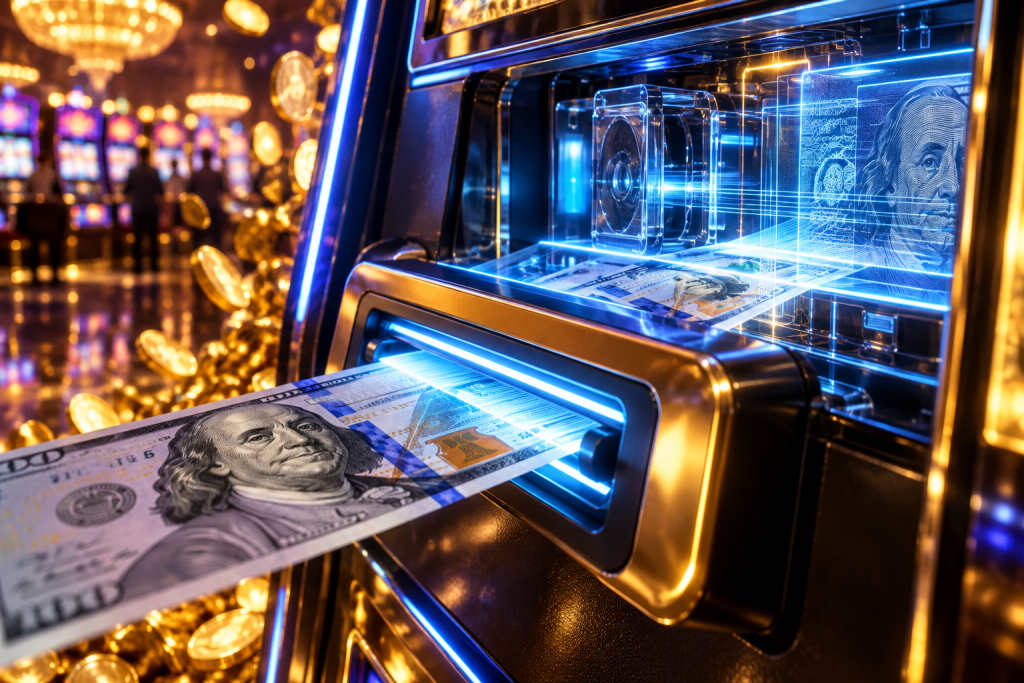
The machine does not know you; it scans the bill
A slot machine does not recognize a bill the way a person does. It has no memory of you, your face, or your bank account. What it has is a bill validator: a sensor array that reads physical and optical properties of the piece of paper you inserted, then compares those readings against stored reference data for authentic notes.
The validator checks several overlapping features at once. Magnetic ink patterns, ultraviolet fluorescence, infrared reflectance, paper density, and printed micro-features all contribute to an accept-or-reject decision. If too many readings fall outside the expected range, the machine returns the bill and does not credit the meter.
Where the bill goes inside the machine
When you insert a bill, a set of rollers pulls it past a sensor block. The sensors illuminate the note with specific wavelengths and measure what comes back. The validator then runs the captured signals through its internal comparison logic. A match within tolerance moves the bill into a locked cashbox; a mismatch reverses the rollers and pushes the bill back out.
The cashbox sits inside the machine cabinet, behind the validator assembly. Once a bill is accepted, the machine sends a credit pulse to the game controller. The game controller then adds the corresponding number of credits to the player's display. The bill itself is no longer involved in play.
What the validator measures
Bill validators in modern machines combine several detection methods. No single feature is enough to accept a note; the unit requires agreement across multiple channels. The table below shows the main detection categories and what each one looks for.
| Detection channel | What it measures | Why it matters |
|---|---|---|
| Magnetic sensing | Iron-based ink particles in specific print zones | Counterfeit notes often lack the correct magnetic signature |
| Ultraviolet fluorescence | How the paper and security threads glow under UV light | Authentic paper is usually dull; many fakes fluoresce brightly |
| Infrared reflectance | How ink absorbs or reflects infrared light | Genuine notes use IR-absorbing inks in known patterns |
| Optical imaging | Fine-line printing, watermarks, and color placement | Low-resolution copies blur or misalign these features |
| Dimensional sensing | Length, width, and thickness of the note | Wrong paper stock or size fails before other checks run |
These channels are not secret in principle. Central banks publish the security features of their notes, and validator manufacturers design sensors around those published specifications. What stays proprietary is the exact tolerance range and the weighting each manufacturer gives to each channel.
Why a real bill can still be rejected
A genuine bill is not guaranteed to be accepted. Validators reject notes that are too worn, too wrinkled, taped, torn, or washed. The sensors need a clean, flat surface to read the embedded features reliably. A bill that has been through a washing machine may have altered fluorescence or damaged magnetic ink.
Insertion angle and speed also matter. The rollers expect the note to enter straight and at a controlled rate. Crumpled corners can jam the transport path before the sensors finish their sweep. In those cases the machine returns the bill, and the correct next step is to smooth it and try again, or exchange it at the casino cage.
How the machine knows the denomination
The validator identifies the bill's denomination by matching its feature set against a stored library. Each supported denomination has a reference profile: size, magnetic map, IR pattern, and UV response. When the captured readings match one profile closely enough, the machine credits that amount.
If the readings fall between two denomination profiles, the validator rejects the note rather than guess. A slot machine never credits a partial or uncertain amount. The credit pulse is sent only after the validator has locked the bill and confirmed the denomination match.
What happens after acceptance
Once accepted, the bill drops into a removable cashbox. Casino staff collect these boxes on a schedule and reconcile them against the machine's credit logs. The machine's game controller records every credit pulse, so the cashbox total and the electronic meter must agree.
This reconciliation is part of the casino's internal control process. It does not involve the player directly, but it explains why a machine that accepted a bill will not later claim the bill never arrived. The credit event is logged at the moment of acceptance, not when the cashbox is emptied.
Counterfeit bills and what the machine does
A bill that fails validation is returned, not confiscated. The machine has no authority to seize a note, and it does not alert anyone in real time. The rejected bill comes back out of the same slot, and the player can inspect it or take it to the cage for a human check.
If a counterfeit bill is good enough to pass the validator, the loss is discovered later during cashbox reconciliation. The casino's bank or cash processor flags the note, and the casino adjusts its records. The player who inserted the bill is not identified by the machine, because the machine stored no identity data.
What to confirm before you go
Bill validator acceptance varies by machine, by currency, and by how worn your notes are. Before you travel, confirm which currencies the venue's machines accept, whether the casino cage exchanges foreign currency, and what condition of bill the validators are set to reject. The authoritative source is the venue's own guest services desk or its published cash-handling policy.
Also confirm whether the machines accept older series notes. Some validators are updated when a central bank issues a new note design, and a machine that has not received the update will reject the new series even though the bill is genuine. The cage can exchange older or newer notes for ones the floor machines accept.
FAQ
Does the machine keep a record of my bill's serial number?
The validator reads physical and optical features for authentication and denomination, not for identity tracking. Whether a serial number is captured depends on the validator model and the casino's own equipment settings. The machine's core job is to accept or reject the note and credit the right amount. If you need a record, ask the casino cage what its cash-handling system logs.
Why did the machine reject a bill that looks real to me?
Wear, wrinkles, tape, washing damage, or a note series the validator has not been updated to recognize can all cause rejection. The sensors need a flat, clean surface and a close match to the stored reference profile. Smooth the bill and try again, or exchange it at the cage. A rejection is not a statement that the bill is counterfeit.
Can a slot machine be fooled by a photocopy?
A photocopy fails the multi-channel check almost immediately. Copier paper lacks the magnetic ink, the correct UV response, and the IR properties of genuine notes. The validator requires agreement across several detection channels, so a single-channel imitation does not pass. The machine returns the copy and credits nothing.
Play responsibly
Gambling should be treated as paid entertainment, never as a way to earn income or recover losses. 1-800-MY-RESET (1-800-697-3738)
18+ or 21+ depending on where you are; follow the minimum age that applies to you.
This article is general information about how these mechanics work. It is not legal advice and not a recommendation to gamble or to use any particular operator. Availability and legality differ by jurisdiction — check the rules that apply where you are.