


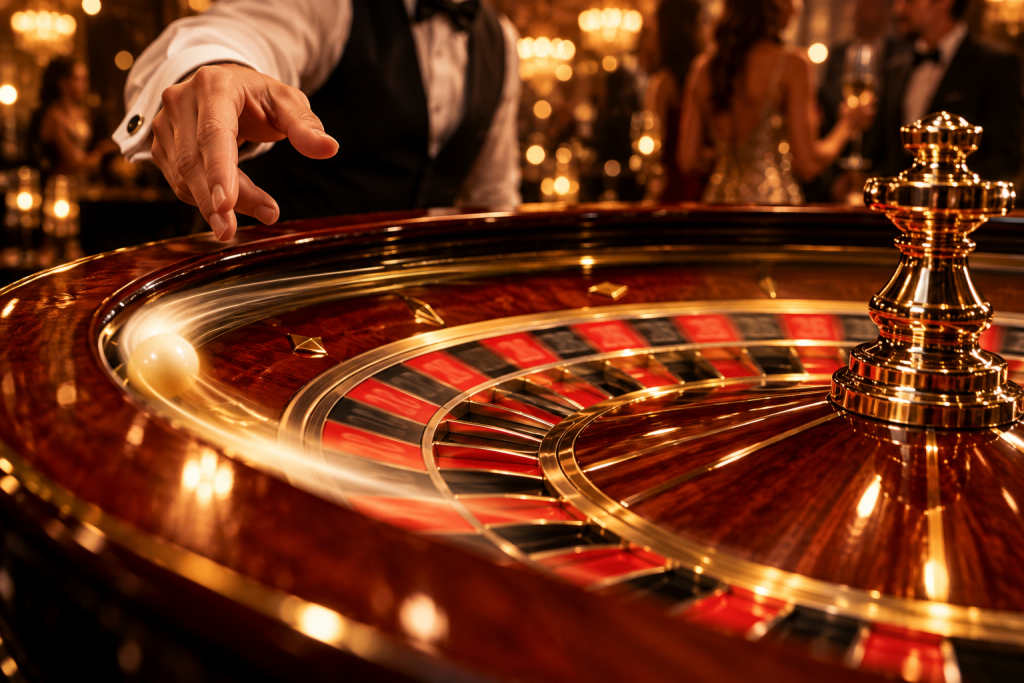
The Spin Starts Before the Ball Moves
A roulette round is already in motion before the dealer picks up the ball. The wheel is turning one way, the ball is about to travel the other, and every player at the table has a short window to finish placing bets. The throw itself is the moment the dealer launches the small ball against the direction of the spinning wheel, and from there the outcome is a matter of physics meeting a carefully built piece of equipment.
The ball is not thrown at random. A dealer launches it with enough force to carry it around the outer track several times, and the wheel's rotation speed is part of what makes the result unpredictable. As the ball loses momentum, it drops from the track, strikes one of the deflectors, and bounces between pockets until it settles. The pocket it lands in is the winning number.
None of this is under a player's control. The throw is a mechanical start to a process that ends with the ball at rest, and the wheel's construction is designed so that no launch style, spin speed, or timing pattern can determine where the ball stops.
The Physical Sequence of a Throw
Understanding the throw means seeing it as a sequence rather than a single action. Each stage has a job, and each one matters to how the result is produced.
- Launch. The dealer sends the ball along the outer track in the opposite direction to the wheel's rotation.
- Track travel. The ball circles the track several times while friction and air resistance slow it down.
- Drop. When the ball loses enough speed, it falls from the track toward the wheel's centre.
- Deflector contact. The ball hits one of the raised deflectors between pockets, which sends it bouncing unpredictably.
- Settlement. The ball comes to rest in a numbered pocket, and the dealer announces the winning number.
The deflectors are the reason no one can reliably predict the result from watching the throw. They are placed to break the ball's path, and the bounce they create is chaotic enough that even a precise launch produces a different outcome each time.
What the Wheel Design Does to the Ball
The wheel is not a passive bowl. Its layout changes how the ball behaves, and the two main wheel types differ in one specific way that affects the odds.
| Feature | European wheel | American wheel |
|---|---|---|
| Number of pockets | 37 | 38 |
| Zero pockets | Single zero | Single zero and double zero |
| Effect on the throw | Same physical process | Same physical process |
| Effect on the odds | Fewer pockets, lower house edge | Extra pocket, higher house edge |
The ball does not care which wheel it is on. The throw, the track, the drop, and the bounce work the same way on both layouts. What changes is the number of places the ball can land, and that changes the mathematics for every bet on the table. The extra pocket on an American wheel raises the house edge because the player is paid as if the zero were not there, while the ball has one more place to stop.
From Buy-In to Settlement: One Full Round
A roulette round has a clear structure, and the throw sits in the middle of it. Knowing the sequence helps a new player understand when to act and when to wait.
- Buy-in. A player exchanges cash for roulette chips at the table. These chips are usually a distinct colour so the dealer can track each player's bets.
- Betting window. Players place chips on the layout. The window stays open while the wheel is spinning and closes when the dealer calls for no more bets.
- The throw. The dealer launches the ball against the wheel's rotation.
- Ball drop. The ball falls, bounces, and settles. The dealer calls the winning number and marks it on the layout.
- Settlement. Losing bets are cleared, winning bets are paid, and the next betting window opens.
The call for no more bets is the hard stop. Once it is made, a chip placed on the layout is a late bet and will be returned or rejected. New players sometimes reach toward the layout as the ball is dropping, which is the most common procedural mistake at the table.
Bet Types and How Their Edges Differ
Every bet on the layout pays less than the true odds of winning, and that gap is the house edge. The size of the gap depends on the bet and the wheel. Some bets pay more because they win less often; none of them changes the physics of the throw.
| Bet type | What it covers | Payout structure | House edge relationship |
|---|---|---|---|
| Straight-up | One single number | Highest payout, lowest win frequency | Same house edge as other inside bets on the same wheel |
| Split | Two adjacent numbers | Lower payout than straight-up | Same house edge as other inside bets on the same wheel |
| Street | Three numbers in a row | Lower payout than split | Same house edge as other inside bets on the same wheel |
| Red or black | All numbers of one colour | Even-money payout | Same house edge as other outside bets on the same wheel |
The important point is that most bets on a given wheel carry the same house edge. A straight-up bet and a red-or-black bet lose at the same expected rate on the same wheel, because the zero pockets are what create the edge, and they sit outside every colour and every single-number bet alike. The exception is any special rule the table itself posts, which is why a player should read the felt and the posted rules before betting.
What a Player Controls, and What They Do Not
The throw is outside a player's control, and so is the result. What a player does control is which bets they place, how much they stake, and how long they stay at the table. Those choices change the pace of loss and the shape of a session, not the built-in edge.
A common misreading is that a number is "due" because it has not appeared for many spins. The wheel has no memory. Each throw is an independent event, and the ball is no more likely to land on a number that has been absent for an hour than on one that just hit. The wheel's design does not track history, and the dealer's launch does not compensate for past results.
Another misreading is that a slow spin or a particular dealer produces different odds. The house edge is set by the wheel's pocket count and the payout schedule, not by how the ball is thrown. A dealer who launches softly or hard is still sending the ball through the same deflectors onto the same wheel.
Strategy Charts Are Rule-Specific, and Roulette Has Few of Them
In games like blackjack, published strategy charts derive from the exact rule set in use: how many decks, when the dealer stands, which doubling and splitting options exist. A chart built for one rule set is not automatically correct for another. Roulette is different in one way: there is no decision after the ball is thrown, so there is no strategy chart for the throw itself. The only decisions happen before the spin, and they are about bet selection and stake size.
What roulette does have is rule variants that change the mathematics. A table may offer a rule that reduces the loss on even-money bets when the ball lands in zero, or it may not. The only reliable way to know is to read the table's posted rules and the payout schedule printed on the layout. If a rule is not posted, it is not in effect, and the standard edge applies.
Procedural Mistakes That Cost New Players
The throw is fast, and the table has its own rhythm. Three mistakes show up repeatedly among players who are new to roulette.
- Betting after the call. Reaching for the layout after the dealer calls no more bets is the fastest way to have a bet refused. The call is final.
- Confusing chip values. Roulette chips are colour-coded per player, and a chip's value is set at buy-in, not printed on the chip. A player who forgets their own colour's value can misread their stake.
- Stacking chips on a line. A chip placed on a line between numbers is a split bet, not a single-number bet. The position of the chip on the layout is the instruction, and a careless placement changes the bet.
None of these changes the house edge, but each one changes what the player intended to wager, and that is a cost a player can avoid by watching one full round before betting.
FAQ
Does the way a dealer throws the ball change the odds?
No. The dealer's launch speed and angle affect how long the ball travels and where it first drops, but the deflectors and the bouncing between pockets make the final resting place unpredictable. The odds are set by the wheel's pocket count and the payout schedule, not by the throw.
Can a player predict where the ball will land by watching the wheel?
Not in any reliable way. The ball's path is chaotic once it hits the deflectors, and the wheel's design is specifically built to break any pattern between launch and result. Watching the wheel can tell a player when the ball is about to drop, but not which pocket will win.
Why does the ball sometimes bounce out of a pocket and land in another?
The deflectors between pockets are raised, and the ball's remaining speed can carry it across several pockets before it settles. The bounce is part of the design: it randomises the result so that no launch or spin speed can determine the outcome in advance.
Gamble responsibly. If you or someone you know has a gambling problem, call the helpline printed in the footer below. Must be 18+ or 21+ depending on where you are. Follow the minimum age that applies to you.
Play responsibly
Gambling should be treated as paid entertainment, never as a way to earn income or recover losses. 1-800-MY-RESET (1-800-697-3738)
18+ or 21+ depending on where you are; follow the minimum age that applies to you.
This article is general information about how these mechanics work. It is not legal advice and not a recommendation to gamble or to use any particular operator. Availability and legality differ by jurisdiction — check the rules that apply where you are.